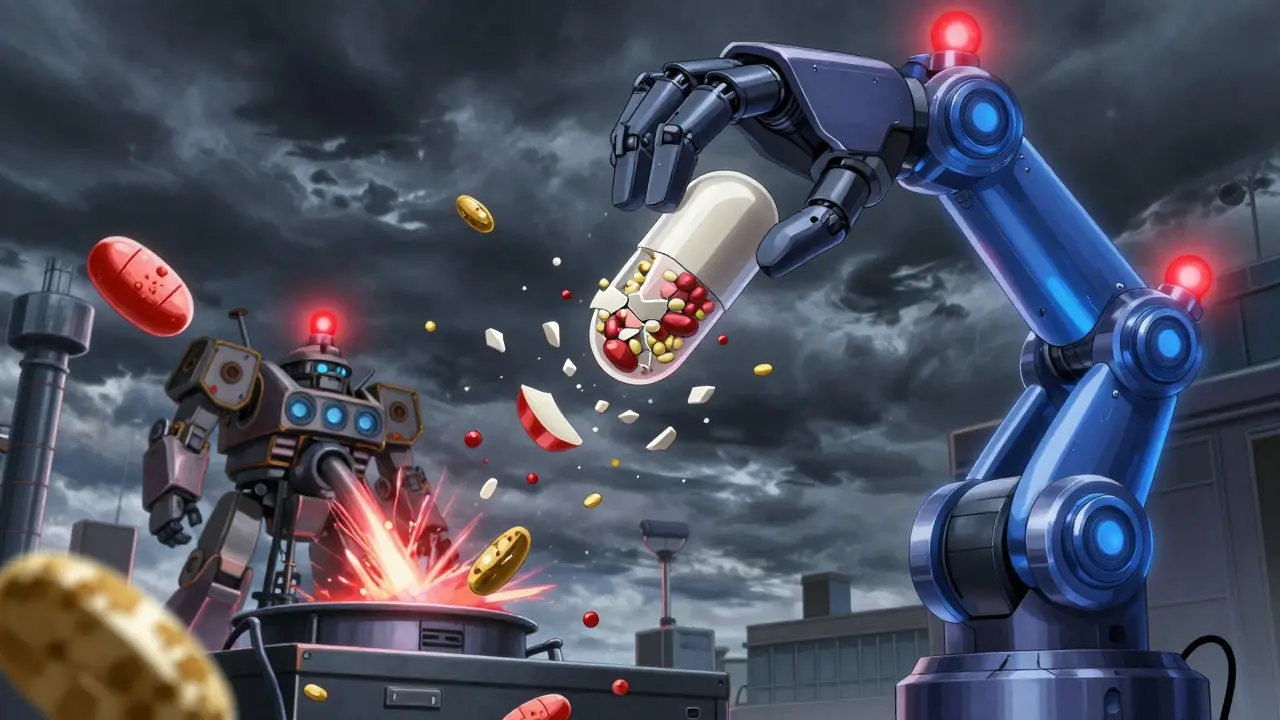
When you pick up a generic pill from the pharmacy, you expect it to work just like the brand-name version. But behind that simple tablet or capsule, there’s a complex manufacturing process-and it’s failing more often than most people realize. In 2023, generic drugs were responsible for 63% of all drug recalls in the U.S. due to manufacturing flaws. These aren’t rare mistakes. They’re systemic. And they’re putting patients at risk.
What Exactly Goes Wrong in Generic Drug Manufacturing?
Generic drugs aren’t made in fancy labs with unlimited budgets. They’re produced in high-volume factories where profit margins are razor-thin. This pressure leads to corners being cut. The most common defects fall into three categories: physical flaws, dosage inconsistencies, and contamination.Take capping, for example. This is when a tablet splits horizontally during production. It happens when the compression force is too high-over 15 kN-and the tablet’s moisture content drops below 2%. This is common with hydrophobic active ingredients like ibuprofen or metformin. The result? A pill that crumbles in the bottle or in your hand. Patients report this often: one pharmacist in Ohio described a batch of generic metformin ER that literally fell apart during dispensing.
Lamination is similar but worse. Instead of splitting, the tablet layers peel apart like an onion. It usually occurs when tablet presses run faster than 40 rotations per minute and pre-compression isn’t properly calibrated. This defect is invisible until the pill is handled. But if it breaks down in the stomach too early, the drug may be absorbed too fast-or not at all.
Sticking and mottling are cosmetic but still dangerous. Sticking happens when the drug material clings to the metal punch heads during compression. This is especially common with APIs that melt below 120°C and are exposed to moisture levels above 4%. The result? Inconsistent tablet weight. Mottling-uneven coloring-may seem harmless, but it often signals poor mixing of ingredients. In one FDA inspection, a batch of generic amoxicillin showed mottling due to uneven distribution of the active ingredient. Some pills had 120% of the labeled dose; others had barely 60%.
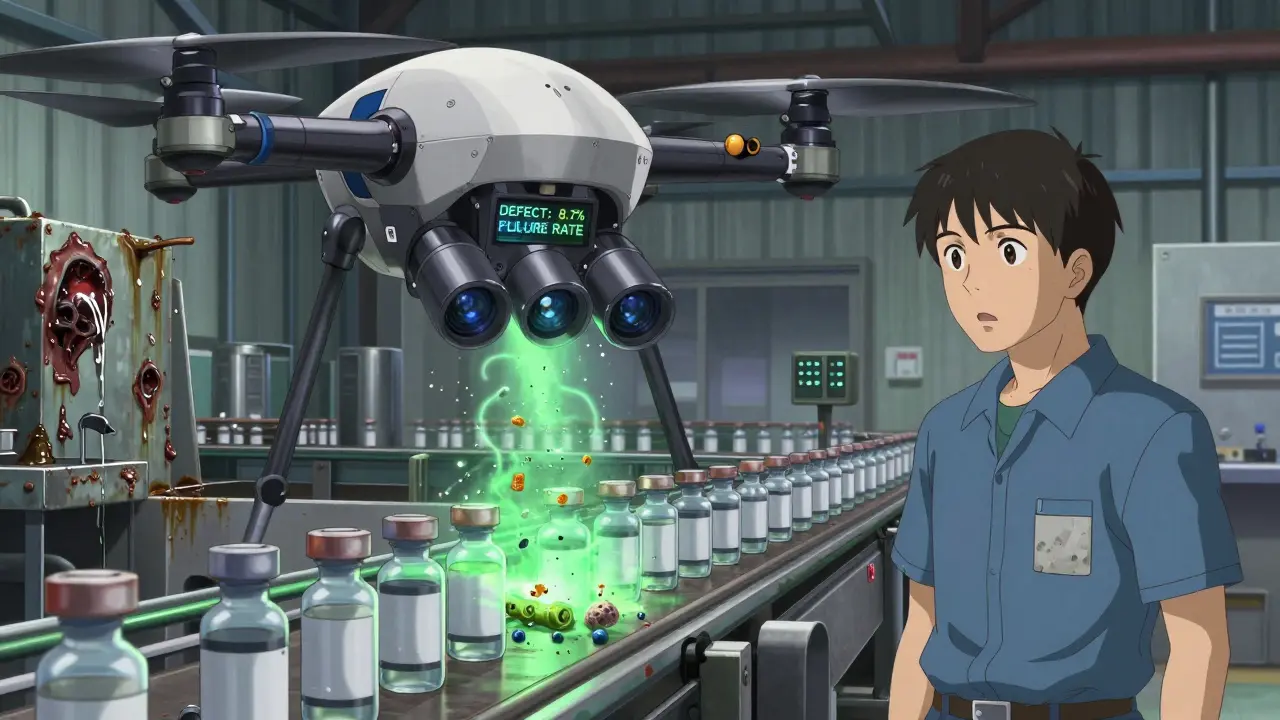
For injectables, the stakes are even higher. Particulate contamination is the leading defect. Tiny glass fragments, rubber stopper particles, or even microbial growth can end up in a vial. These aren’t just unsightly-they can cause strokes, infections, or anaphylaxis. In 2022, a generic heparin recall affected over 100,000 vials after particulates were found in 8% of tested batches.
Why Are Generic Drugs More Prone to Defects?
It’s not because generic manufacturers are careless. It’s because the system is built to fail.Branded drug companies spend 15-18% of their production budget on quality control. Generic manufacturers? Just 8-10%. That difference shows up in equipment. Many generic factories still use tablet presses from the 1990s. They lack real-time monitoring. They don’t have automated visual inspection systems that catch defects as small as 0.1 mm. Instead, they rely on human inspectors who miss 30% of flaws.
Then there’s the shared facility problem. One plant might produce five different generics in a single week. Cleaning between batches is rushed. Cross-contamination happens. In 2021, a generic blood pressure medication was recalled because it contained traces of a diabetes drug from a previous run. Patients taking both drugs experienced dangerous interactions.
Price pressure is the root cause. Generic drugs make up 90% of prescriptions in the U.S. but only 23% of spending. That means manufacturers are forced to produce more, faster, cheaper. The math doesn’t add up. A 2023 study found that for every 10% drop in generic drug prices, defect rates rose by 7.4%.
How Defects Translate to Real-World Harm
Defects aren’t just numbers on a report. They’re real patient stories.A 2023 survey of 1,247 pharmacists found that 68% had seen quality issues with generics in the past year. Over 40% reported patients complaining about pills that looked wrong-cracked, discolored, or crumbling. Nearly 30% said patients noticed changes in how the drug worked-more side effects, less effectiveness, or sudden withdrawal symptoms.
One case in Florida involved a woman on generic levothyroxine. She switched brands and suddenly developed tremors, rapid heartbeat, and insomnia. Her doctor checked her TSH levels: they had dropped 40% below target. The new generic had 15% less active ingredient. She wasn’t overdosed-she was underdosed. It took three months to stabilize her.
The FDA’s MedWatch system logged 1,842 adverse events in 2023 directly tied to generic drug quality. Over 300 involved visible defects: chipped tablets, oily residue on pills, pills that dissolved too quickly. These aren’t isolated incidents. They’re patterns.
What’s Being Done to Fix It?
There’s hope-but it’s slow.The FDA launched its Emerging Technology Program in 2023. So far, 47 generic manufacturers have adopted continuous manufacturing-a modern process that produces drugs in one uninterrupted flow instead of in batches. This reduces defects by 65%. But only 5% of the industry has made the switch. The rest are stuck with outdated equipment.
AI-powered quality control is another breakthrough. Pilot programs at Sandoz and Dr. Reddy’s are using machine learning to analyze tablet images at 600 pills per minute. These systems detect defects with 92% accuracy-compared to 78% for human inspectors. But the cost? Up to $2 million per line. Most generic manufacturers can’t afford it.
The 2024 Drug Supply Chain Security Act now requires track-and-trace for high-risk generics. Early results show a 22% drop in counterfeit-related defects. That’s progress. But it doesn’t fix poor manufacturing. It just helps find fake pills.
What Patients and Providers Can Do
You can’t control the factory. But you can protect yourself.- Check your pills. If they look different-color, shape, markings-ask your pharmacist. A change doesn’t always mean a problem, but it’s worth verifying.
- Report bad pills. Use the FDA’s MedWatch system. Even one report can trigger an inspection.
- Ask about the manufacturer. Not all generics are equal. Teva, Sandoz, and Mylan have far better track records than smaller, unknown makers.
- If you’re on a critical drug-like levothyroxine, warfarin, or seizure meds-stick with one brand. Switching generics increases risk.
- Pharmacists: document every quality issue. Keep photos, batch numbers, and patient reports. This data helps regulators act.
The Bigger Picture
The generic drug system was designed to save money. It succeeded. But at what cost?By 2030, the global generic market will be worth over $780 billion. Yet, the same factories that produce these drugs are running on 30-year-old machinery. The industry needs $28.7 billion just to modernize. It’s getting $1.2 billion.
Without investment, quality will keep slipping. More recalls. More shortages. More patients harmed.
Generic drugs aren’t inherently unsafe. But when profit overrides precision, safety becomes a casualty. The system isn’t broken because of bad people. It’s broken because it was never designed to prioritize health over cost.
Are generic drugs less effective than brand-name drugs?
Not inherently. Generic drugs must meet the same bioequivalence standards as brand-name drugs. But manufacturing defects-like inconsistent dosing, poor mixing, or contamination-can cause some batches to underperform. Between 2015 and 2020, 7.3% of generic drug applications failed bioequivalence testing due to manufacturing inconsistencies, not formulation differences.
Which generic drugs have the highest defect rates?
Complex formulations have the highest defect rates. Inhalers (18.2% defect rate), modified-release tablets (14.7%), and sterile injectables (8.7%) are the most problematic. Simple immediate-release tablets have lower rates at 9.3%. The reason? Complexity increases manufacturing variables. A single mistake in a tablet that releases drug over 12 hours can ruin the entire batch.
Why do some generic pills look different from others?
Different manufacturers use different inactive ingredients, binders, or dyes. That’s legal and normal. But if the shape, size, or color changes suddenly-especially within the same brand-you should check the batch. A sudden change can signal a switch to a new supplier with lower quality controls.
Can I trust generic drugs made overseas?
Many are safe, but oversight is inconsistent. Over 80% of generic drug ingredients are made in India and China. The FDA inspects only about 10% of foreign facilities each year. A 2023 report found that 57% of generic manufacturing facilities failed FDA inspections-compared to 28% for U.S.-based branded drug makers. Always ask your pharmacist which country the drug was made in. Some countries have stricter standards than others.
How can I report a defective generic drug?
Use the FDA’s MedWatch system at fda.gov/medwatch. Include the drug name, batch number, expiration date, manufacturer, and a description of the defect. If you’re a healthcare provider, document the incident in your records. Patient reports are critical-they’re often the first signal that a batch is faulty. The FDA acted on over 1,800 such reports in 2023, leading to 12 major recalls.
Aisling Maguire
February 28, 2026 AT 19:34Just had a batch of generic metformin that crumbled in my hand like stale cookies. Called the pharmacy-they said it was "normal variation." Normal? My grandma’s diabetes is stable because she’s on the same brand for 12 years. Why are we accepting this as fate?
Lisa Fremder
March 1, 2026 AT 12:49China and India make most of these pills and their inspectors sleep through shifts. FDA? They’re out of budget and out of steam. We’re playing Russian roulette with our meds and nobody’s calling it what it is-systemic negligence.
Justin Ransburg
March 2, 2026 AT 11:21While the challenges are real, we must recognize that the generic drug system delivers essential medications to millions who otherwise couldn’t afford treatment. The answer isn’t to abandon generics-it’s to invest in modernization, enforce stricter oversight, and incentivize quality over cost. We can do better without sacrificing access.
Sumit Mohan Saxena
March 3, 2026 AT 17:00It is imperative to note that the bioequivalence standards mandated by regulatory agencies are robust and scientifically validated. However, manufacturing deviations-particularly in high-volume, low-margin facilities-can and do lead to significant batch-to-batch variability. This is not a failure of the regulatory framework per se, but rather a consequence of operational compromises driven by economic pressures.
Brandon Vasquez
March 4, 2026 AT 12:21I’ve been a pharmacist for 18 years. I’ve seen pills crack, change color, taste weird. I always ask patients: "Did this just switch?" If yes, I call the manufacturer. Most don’t even know who makes their generic. We need to change that. Documentation saves lives.
Vikas Meshram
March 5, 2026 AT 03:50Anyone who thinks generics are safe is naive. The FDA’s inspection rate for foreign plants is pathetic. 10%? That’s a joke. I’ve read the reports. One facility had rats in the cleanroom. Another had workers washing vials with tap water. This isn’t negligence-it’s criminal. And the FDA lets it slide.
Ben Estella
March 7, 2026 AT 01:06Let’s be real. We let Big Pharma monopolize prices for decades. Now we’re mad when the cheap alternative turns out to be junk? That’s on us. Stop complaining and start demanding better. Or pay more. Pick one.
Jimmy Quilty
March 8, 2026 AT 15:33Did you know the same factory that makes your generic blood pressure med also makes pesticides? They use the same equipment. No cleaning. Just wipe and go. And the FDA approves it? I’ve got documents. I’ve got emails. This isn’t about quality-it’s about corporate collusion. The system is rigged.
Miranda Anderson
March 10, 2026 AT 10:46I used to think generics were interchangeable until my mom went from stable to crashing on a new batch of levothyroxine. She lost 15 pounds in two months, couldn’t sleep, had panic attacks. Turns out the new version had 18% less active ingredient. We switched back-she’s fine now. But what if we hadn’t noticed? What if she’d been alone? I’m not mad at the pharmacy. I’m mad at a system that treats human lives like cost centers.
Gigi Valdez
March 10, 2026 AT 21:58The data presented here is compelling and aligns with peer-reviewed studies on batch variability in generic pharmaceuticals. The introduction of continuous manufacturing and AI-based inspection systems represents a paradigm shift. However, scalability remains a critical barrier. Policy interventions must prioritize funding for infrastructure upgrades, not merely reactive recalls.
Byron Duvall
March 12, 2026 AT 13:32They’re all made in the same three factories. Same people. Same machines. Just different labels. You think your "trusted" brand is different? Nope. Same pill, different box. Welcome to the illusion of choice.
Eimear Gilroy
March 14, 2026 AT 07:31I’m curious-do you think the FDA’s current inspection protocols are sufficient given the scale of production? Or is the real issue that they’re understaffed and underfunded? I’ve read that inspectors travel 200 days a year. Is that enough to catch defects in real time?
Ajay Krishna
March 14, 2026 AT 08:40Thank you for this detailed breakdown. Many patients don’t realize that a change in pill appearance doesn’t always mean a change in efficacy-but when it does, it can be dangerous. I always advise my patients to keep the original packaging and compare photos. A simple habit can prevent a medical crisis.
Charity Hanson
March 16, 2026 AT 05:43This is why I tell my clients: if you’re on a life-saving med, stick with one brand. Don’t let the pharmacy switch it without asking. I’ve had patients come to me with tremors and heart palpitations because their generic got swapped. It’s not paranoia-it’s survival. And if you’re worried, ask for the manufacturer name. Research them. You’ve got power.