Why Foreign-Made Generic Drugs Are Under Fire
Over 90% of generic drugs in the U.S. come from factories overseas-mostly in India and China. These pills, capsules, and injections are cheaper than brand-name drugs, but their safety depends entirely on how well they’re made. The FDA says all manufacturers, no matter where they’re located, must follow the same rules: Current Good Manufacturing Practices (CGMP). But in practice, the rules haven’t been enforced the same way. Until recently, U.S. factories got surprise inspections. Foreign ones got weeks of notice. That meant some facilities had time to clean up, hide problems, or even fake records before inspectors showed up.
What CGMP Actually Means for Drug Factories
CGMP isn’t just a checklist. It’s a full system. Every step-from mixing raw chemicals to packaging pills-must be documented, tested, and controlled. Workers need proper training. Equipment must be cleaned and maintained. The air in the room can’t have too much dust. Water used in production must be pure. And every batch of medicine must be tested before it leaves the factory. If any of this fails, the drug could be weak, contaminated, or even dangerous.
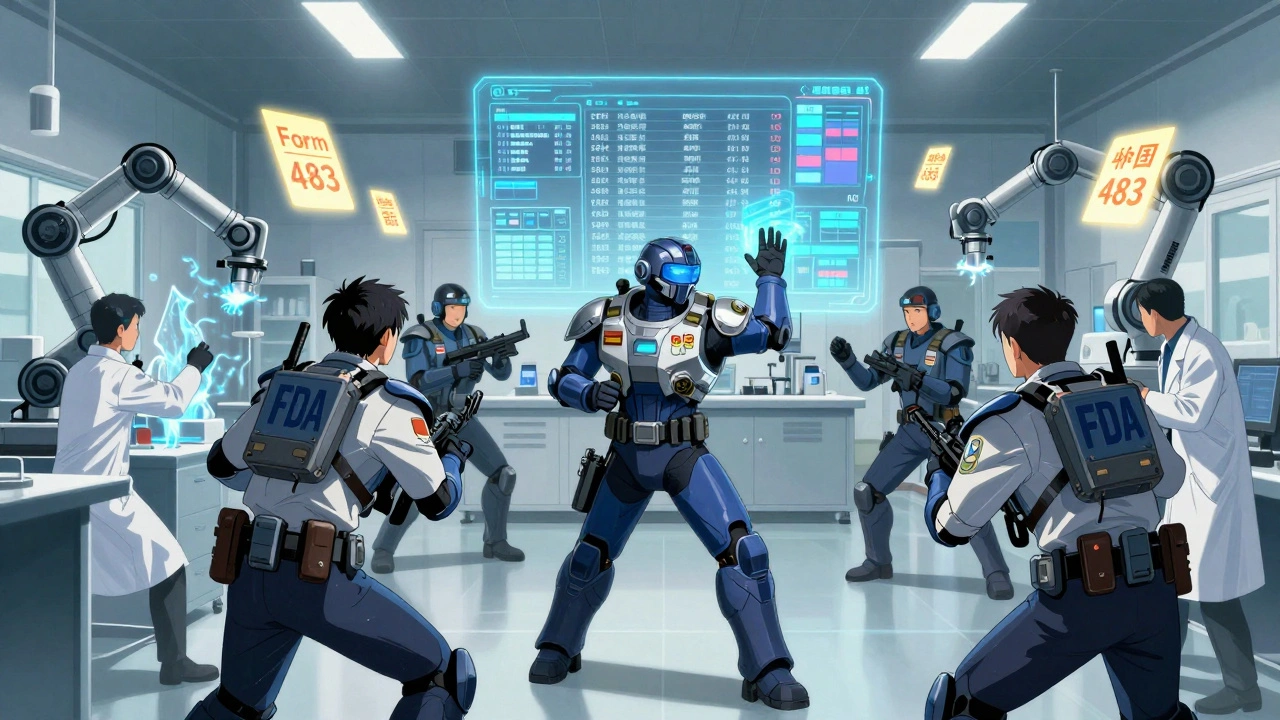
The FDA checks these things during inspections. They look at logs, interview staff, and test samples. If they find problems, they issue a Form 483-a list of violations. Serious ones can lead to warning letters, import bans, or even criminal charges. The problem? Foreign facilities were failing at more than twice the rate of U.S. ones. In 2024, 45% of foreign inspections found serious issues like falsified data or poor contamination control. At U.S. plants, that number was under 20%.
The Double Standard in Inspections
For years, the FDA did about 12,000 inspections a year in the U.S.-almost all unannounced. Meanwhile, they only did 3,000 inspections overseas, and most came with 8 to 12 weeks’ notice. That’s not oversight. That’s a heads-up. Companies could stockpile clean records, fix broken machines, or temporarily clean up labs just before inspectors arrived. Real problems stayed hidden.
That changed in May 2025. The FDA announced it would start unannounced inspections at foreign factories, just like in the U.S. The goal? To catch bad actors before they ship unsafe drugs to American pharmacies. FDA Commissioner Marty Makary said it bluntly: “Unannounced inspections will expose those who falsify records or conceal violations.”
By mid-2026, at least half of all foreign inspections will be unannounced. That’s up from just 15% before. This isn’t a small tweak-it’s a complete overhaul of how the FDA protects patients.
Why India and China Are the Focus
India makes 40% of the active ingredients in U.S. generic drugs. China makes another 13%. Together, they supply the bulk of medications Americans take every day-antibiotics, blood pressure pills, diabetes drugs. But they’re also where most violations are found.
ProPublica’s 2024 investigation found that even after the FDA banned a major Indian factory, Sun Pharma, from exporting drugs in 2021, four of its medicines still made it into the U.S. market. How? The FDA’s approval system had gaps. Some approvals were overridden by internal teams, despite clear safety concerns raised by inspectors.
These aren’t isolated cases. In early 2025, multiple Indian and Chinese manufacturers received FDA warning letters for failing to control contamination, using outdated testing methods, or not properly training staff. The message was clear: the old system was broken.
What’s Changing in 2025 and Beyond
The FDA isn’t just increasing unannounced inspections. They’re hiring 200 new inspectors by 2026 to handle the workload. They’re also expanding partnerships with regulators in the EU, Japan, and Australia. If one agency finds a problem, others get the report. That helps close loopholes.
President Trump’s Executive Order 14135, signed in May 2025, forced the FDA to eliminate the inspection gap within 18 months. The agency responded with a plan: ramp up unannounced visits, improve training for inspectors, and push for stronger accountability from importers.
One idea gaining traction? Copying the EU’s “Qualified Person” model. In Europe, a certified expert must sign off on every batch before it’s sold. That person is legally responsible. If something goes wrong, they’re on the hook. U.S. importers don’t have that same responsibility. Experts at Brookings Institution say adding this layer could cut foreign facility violations by 30-40%.

How Foreign Manufacturers Are Adapting
Companies in India and China are scrambling to get ready. A PDA survey found 68% of foreign manufacturers expect compliance costs to rise 15-25% because of the new rules. Smaller factories, especially, are struggling to afford the upgrades needed for real-time documentation, better air filtration, and staff training.
Industry consultants are telling factories to do three things: run mock inspections every quarter, update all documentation daily, and train staff to handle surprise visits. One company in Hyderabad now conducts weekly internal audits. Another in Shanghai hired a former FDA inspector as a consultant. These aren’t luxuries anymore-they’re survival tactics.
Generic drug makers who don’t adapt risk having their products blocked at the border. The FDA can issue an import alert, which stops all shipments from a facility until the problems are fixed. That can mean lost revenue, delayed shipments, and damaged reputation.
What This Means for Patients
For you, the patient, this isn’t about politics or trade deals. It’s about whether the pill you take every morning actually works. A weak antibiotic won’t kill the infection. A contaminated blood pressure pill could cause a stroke. A fake diabetes drug could lead to organ damage.
The FDA’s new approach is meant to fix that. More unannounced inspections mean fewer hidden problems. Stronger oversight means safer drugs. But change takes time. In the short term, some generic medications might be harder to find. Evaluate Pharma predicts a 15-20% drop in availability for certain drugs in 2025-2026 as factories catch up.
That’s not a failure. It’s a correction. The system was letting unsafe drugs slip through. Now, it’s being fixed-even if it’s messy.
What You Can Do
You don’t need to become a drug inspector. But you can stay informed. If your pharmacy switches your generic brand unexpectedly, ask why. If a drug seems less effective or causes new side effects, report it to the FDA’s MedWatch program. Patient reports help the agency spot patterns.
Also, don’t assume “made in the U.S.A.” is always safer. Many U.S.-branded drugs still use foreign-made ingredients. The key isn’t where it’s made-it’s whether the maker follows the rules. And now, thanks to new inspections, that’s harder to fake.
Are foreign-made generic drugs safe?
Yes-when they follow FDA rules. The vast majority of foreign-made generics are safe and effective. But before 2025, inspections were too predictable, allowing some bad actors to hide violations. The new system of unannounced inspections is designed to catch those risks before drugs reach patients.
How does the FDA inspect foreign factories?
FDA inspectors visit facilities to check records, observe production, interview staff, and test samples. They look for compliance with CGMP standards: cleanliness, equipment maintenance, data integrity, and quality control. Inspectors use Form 483 to list violations. If problems are serious, the FDA can block imports or issue warning letters.
Why are unannounced inspections so important?
They prevent facilities from cleaning up just before an inspection. If a factory knows inspectors are coming in two weeks, they can fix broken equipment, erase bad records, or hide contamination. Unannounced visits catch real operations-day-to-day practices that determine drug safety.
What happens if a foreign factory fails an inspection?
The FDA issues a Form 483 listing violations. If issues aren’t fixed, a warning letter follows. Repeated failures can lead to an import alert-blocking all drugs from that facility. In extreme cases, the FDA can pursue criminal charges. Some companies have been banned from exporting to the U.S. for years.
Is the U.S. going to stop importing generic drugs?
No. The U.S. depends on foreign manufacturing for 80% of active ingredients and 40% of finished drugs. Stopping imports would cause drug shortages and spike prices. The goal isn’t to stop imports-it’s to make sure every imported drug meets the same safety standards as U.S.-made ones.
John Webber
December 3, 2025 AT 02:28Shubham Pandey
December 4, 2025 AT 17:23Elizabeth Farrell
December 5, 2025 AT 11:13Sheryl Lynn
December 6, 2025 AT 06:40Paul Santos
December 6, 2025 AT 06:53John Morrow
December 7, 2025 AT 19:57ruiqing Jane
December 9, 2025 AT 03:55Fern Marder
December 9, 2025 AT 19:59Chris Wallace
December 10, 2025 AT 00:14william tao
December 10, 2025 AT 22:04Sandi Allen
December 11, 2025 AT 05:22Eddy Kimani
December 11, 2025 AT 11:59