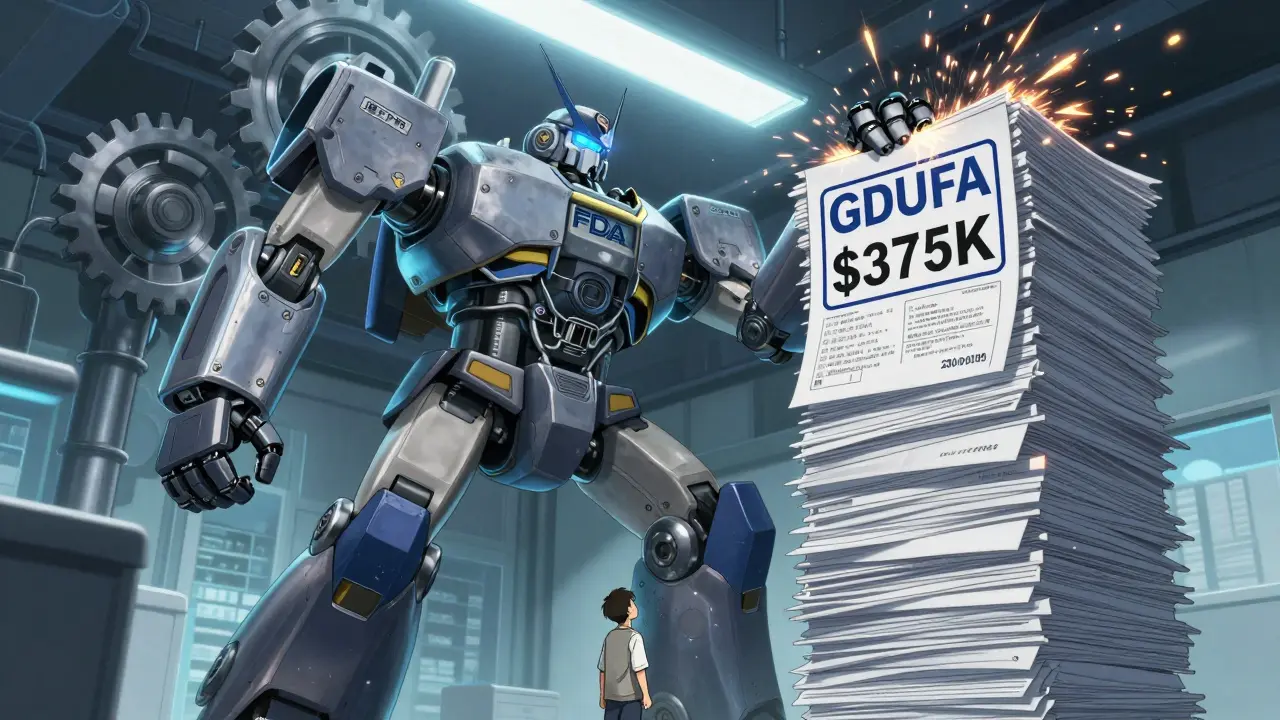
When you pick up a prescription for a generic drug, you probably assume it’s cheaper because it’s just a copy of the brand-name version. But behind that simple idea is a complex, expensive, and often frustrating regulatory maze - one that can delay life-saving medications for years and cost manufacturers millions. The FDA approval costs for generics aren’t just a line item in a corporate budget. They directly affect how fast you get affordable medicine, how much you pay out of pocket, and whether a drug even reaches the market at all.
What You’re Really Paying for: The GDUFA Fee Structure
The main driver of generic drug approval costs is the Generic Drug User Fee Amendments (GDUFA), a program created in 2012 and renewed in 2022 under GDUFA III. This isn’t a tax - it’s a fee system where generic drugmakers pay the FDA to review their applications. For FY 2025, the total user fee revenue is $638.9 million, with generic drug applications alone accounting for $210.9 million of that total. Here’s how the fees break down per application:- Product fee: $136,485 - paid per generic drug application submitted
- Facility fee: $238,055 - paid per manufacturing site (even if you make 10 drugs there)
- Application fee: Part of the product fee, but separate from facility costs
The Hidden Cost: When the FDA Says “We Don’t Know”
The real problem isn’t the fee - it’s what happens after you pay it. In 2015, the FDA changed its policy on complex generics - drugs like inhalers, nasal sprays, injectables, and topical creams where the exact formulation matters as much as the active ingredient. Before 2015, the FDA gave detailed feedback on why a generic didn’t match the brand-name version. Now? They say things like “insufficient data” or “not sufficiently similar,” without explaining what’s wrong. This might sound like a small change. But for manufacturers, it’s a nightmare. One mid-sized generic company told RAPS in 2024 that they spent $8.7 million over three years trying to get approval for a single nasal spray. Each time they reformulated it based on vague feedback, the FDA rejected it again. That’s three failed attempts. Three years. $8.7 million. And no approval yet. This policy change has turned approval timelines from 10-12 months into 3-5 years for complex generics. The FDA’s own data shows only 42% of complex generic applications get approved on the first try - compared to 65% for simpler pills.
Why This Matters to Patients
You might think, “So what? It’s just a company’s problem.” But when a generic drug gets delayed, patients pay. In 2024, generics saved the U.S. healthcare system $467 billion. They make up 90% of all prescriptions but only 12% of drug spending. That’s the power of competition. But here’s the catch: 83% of brand-name drugs still have no generic competition five years after their patent expires. Why? Because the FDA approval process is too slow, too expensive, or too unclear. Take testosterone replacement therapy. Between 2016 and 2020, generic versions were delayed by 4.7 years. During that time, patients paid up to 300% more for the brand-name version. On Reddit’s r/pharmacy, a September 2025 thread with 147 comments showed patients paying $1,200 a month for a drug that could’ve cost $120 if the generic had been approved. Pharmacists aren’t blind to this. One New York pharmacist wrote on Pharmacy Times: “The extra scrutiny prevents quality issues like the 2022 valsartan recall that affected 22 million patients.” That’s true - safety matters. But when the FDA doesn’t tell manufacturers what’s wrong, safety becomes a guessing game.How Companies Are Trying to Cope
Manufacturers have adapted - but not without cost.- They now spend 18-24 months developing a product before even submitting an application - up from 12-15 months a decade ago.
- ANDA applications now average 150,000-200,000 pages of documentation. In 2013, it was 50,000-75,000. That’s a 35% increase in prep costs.
- Companies that use early meetings with the FDA (called Type II meetings) cut review times by 3.2 months on average. But only 78% of successful applicants do this - and it’s expensive to schedule.
The Political Pushback: H.R. 1843 and What’s Next
In September 2025, Rep. Neal Dunn (R-FL) and Rep. Kevin Mullin (D-CA) introduced H.R. 1843 - the Increasing Transparency in Generic Drug Applications Act. This bill would force the FDA to return to the pre-2015 policy: give specific, actionable feedback on formulation issues. The Congressional Budget Office estimates this could cut approval times for complex generics by 18-24 months. That means 12-15 more complex generics hit the market each year. Annual savings? $1.8-2.3 billion. The bill has 72 co-sponsors - bipartisan support rare in today’s politics. It’s scheduled for committee markup in December 2025. But the FDA isn’t backing down. In a July 2025 meeting, leaders warned that without more staff and funding, giving detailed feedback could slow down other applications. “Reversing the 2015 policy without additional resources could compromise review quality,” one official said. The truth? The system is stuck between speed and safety. And patients are caught in the middle.The Bigger Picture: Generics Are the Backbone - But They’re Straining
In 2024, the FDA approved 1,051 generic drugs - a record. But 287 applications were stalled by patent lawsuits. Another 143 were delayed by manufacturing issues. That’s over 400 drugs that could’ve saved patients money - but didn’t. Meanwhile, biosimilars (the next wave of biologic generics) are getting new attention. In September 2025, FDA Commissioner Robert Califf said the agency would “streamline the review pathway for 15 high-priority complex generics by 2027.” That’s a start. But 15 out of hundreds? It’s a drop in the ocean. The real solution isn’t just more money. It’s smarter rules. Clearer feedback. Faster decisions. And a system that doesn’t punish companies for trying to make complex drugs. Right now, the FDA’s process is a black box. You pay, you wait, you guess. And if you’re wrong? You lose millions. The system was designed to ensure safety. But it’s now doing the opposite - delaying affordable medicine and driving up costs. If we want real savings, we need to fix the approval process - not just the price tag.How much does it cost to get a generic drug approved by the FDA?
The total cost to submit a single generic drug application includes a product fee of $136,485 and a facility fee of $238,055, totaling around $375,000. But this is just the filing fee. Most companies spend $5-10 million on development, testing, and reformulation before submission. For complex generics, additional delays can add millions more in failed attempts.
Why are generic drug approvals taking so long?
The main reason is the FDA’s 2015 policy change, which stopped giving specific feedback on formulation issues for complex generics like inhalers and nasal sprays. Without clear guidance, manufacturers must guess what’s wrong, leading to multiple failed submissions. The average review time for standard generics is 11.2 months, but for complex ones, it can stretch to 3-5 years.
Do generic drugs cost less because they’re easier to make?
No. Generic drugs are chemically identical to brand-name versions, but making them isn’t always easier - especially for complex formulations. The real cost savings come from not needing to repeat expensive clinical trials. However, regulatory hurdles, like vague FDA feedback and high fees, have made the approval process so expensive and slow that many companies avoid complex generics altogether.
What’s the difference between GDUFA and PDUFA?
GDUFA (Generic Drug User Fee Amendments) applies to generic drug applications and costs around $375,000 per application. PDUFA (Prescription Drug User Fee Act) applies to brand-name drugs and costs $3.685 million per application. The higher PDUFA fee reflects the need for full clinical trials, while GDUFA only requires proof of bioequivalence - but the regulatory complexity for generics has grown so much that the cost gap is narrowing in practice.
Can patients do anything about generic drug delays?
Yes - by advocating for policy changes. The introduction of H.R. 1843, which would require the FDA to give clear feedback on generic drug applications, is a major step. Patients can contact their representatives to support this bill. They can also share their stories with advocacy groups like Patients Rising and the Association for Accessible Medicines. Public pressure has already pushed the FDA to consider reforms - and it’s working.
Tim Hnatko
March 5, 2026 AT 11:03The FDA's current approach to complex generics is a classic case of bureaucracy outpacing common sense. You pay hundreds of thousands just to get feedback that says 'try again' with zero direction. It's not safety-it's guesswork wrapped in paperwork. Companies aren't lazy; they're drowning in ambiguity.
amber carrillo
March 6, 2026 AT 04:17I’ve seen this firsthand. My dad needed a generic nasal spray for chronic sinusitis. It took five years. He paid $900 a month for the brand. When it finally came out? $110. That’s not a market failure. That’s a system failure.
Aaron Pace
March 7, 2026 AT 15:05Bro this is wild 😳 Imagine spending $8.7M and still getting told ‘insufficient data’ like it’s a TikTok comment. The FDA needs to stop acting like a cryptic oracle and start giving real feedback. 🤦♂️
William Minks
March 9, 2026 AT 07:53As someone from a country where generics are accessible within months, this feels surreal. In Nigeria, we don’t have this level of regulatory overreach. It’s not that we’re lax-we just don’t turn medicine into a bureaucratic obstacle course. The U.S. system is broken in plain sight.
Amina Aminkhuslen
March 10, 2026 AT 03:07This isn’t regulation-it’s corporate extortion disguised as public health. The FDA’s vague rejections are a velvet glove over a steel fist. They’re not protecting patients; they’re protecting their own inflated workflow. Meanwhile, people are rationing insulin because a nasal spray got stuck in a paperwork purgatory.
Roland Silber
March 11, 2026 AT 21:47Let’s not forget the real hero here: the small manufacturers. Big pharma can absorb $10M in failed applications. But the mom-and-pop labs? They vanish. One rejected application can wipe out a decade of work. We need incentives, not penalties, for innovation in generics.
Adebayo Muhammad
March 13, 2026 AT 01:31...and yet, the FDA is not the villain-no, no, no. The real villain is the pharmaceutical-industrial complex that lobbied for GDUFA to create artificial scarcity. The fees? A tax on competition. The delays? A market-control mechanism. The FDA? Just the janitor cleaning up the mess made by Wall Street. The bill? A band-aid on a hemorrhage.
Pranay Roy
March 14, 2026 AT 01:09Did you know the FDA’s ‘insufficient data’ rejections are secretly coded? They’re using AI to block generics from entering the market so Big Pharma can extend monopolies. The 2015 policy change? A backdoor patent extension. They’re even burying documents under ‘trade secrets.’ I’ve seen the leaks. This isn’t incompetence-it’s collusion.
Joe Prism
March 14, 2026 AT 20:13Fix the feedback. Not the fee. Not the staff. Just give clear, actionable reasons. That’s all. No magic. No bureaucracy. Just transparency. The rest follows.