
You pick up your prescription at the pharmacy. It’s the same drug you’ve taken for years, but the pill looks different. Maybe it’s a different color, or slightly smaller. You take it, and suddenly, things feel off. More nausea? Less energy? Or perhaps just a nagging doubt that isn’t working as well?
This is a common frustration. Many patients assume that because a generic drug contains the same active ingredient as the brand-name version, it should behave identically in their body. While that is true for the therapeutic effect, it ignores a crucial detail: the inactive ingredients, also known as excipients, are often different.
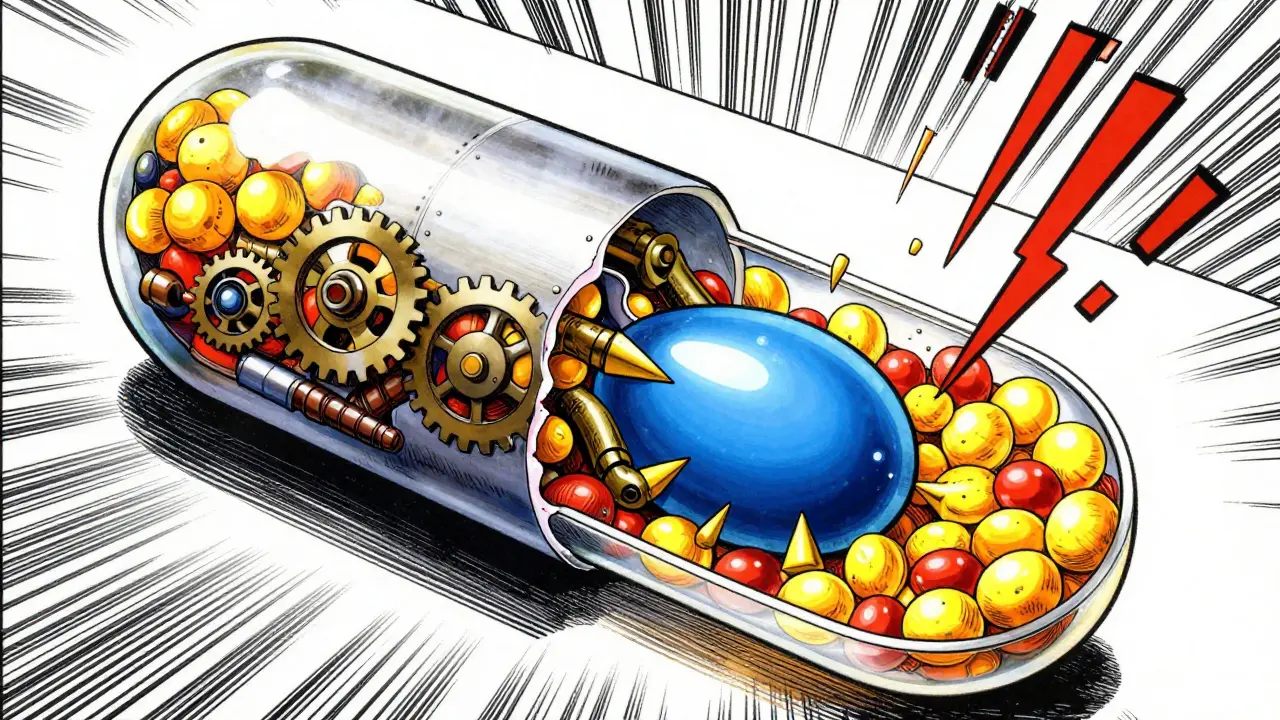
These non-active components make up the bulk of the tablet or capsule. They determine how the drug dissolves, how it tastes, and how your gut absorbs it. When you switch from a brand-name drug to a generic, or even from one generic manufacturer to another, you are changing the vehicle that delivers the medicine. For most people, this change is invisible. For a small but significant percentage, it causes real side effects or reduced effectiveness.
What Are Inactive Ingredients Really Doing?
It sounds counterintuitive to put "inactive" substances into a life-saving medication. But without them, pills wouldn’t exist. Active ingredients are potent chemicals; they need help to be stable, swallowable, and absorbable.
Think of an inactive ingredient like the binding agent in concrete. The steel rebar (the active ingredient) provides the strength, but the cement and sand (the inactive ingredients) hold it together and allow it to set properly. In pharmaceutical terms, these excipients serve specific mechanical functions:
- Fillers (Diluents): These add bulk. If the active dose is tiny-say, 5 milligrams-you can’t make a pill out of 5mg of powder; it would be dust. Fillers like lactose, microcrystalline cellulose, or starch bring the volume up to a size you can handle.
- Binders: These act like glue, holding the powder together so the tablet doesn’t crumble in the bottle. Common binders include povidone or hydroxypropyl methylcellulose.
- Disintegrants: Once swallowed, the pill needs to break apart quickly so the drug can enter your bloodstream. Disintegrants like croscarmellose sodium swell up when wet, forcing the tablet to split open.
- Coatings: Some pills have a film coating to mask bitter tastes or to protect the stomach lining. Others use special coatings for extended release, ensuring the drug drips into your system over 12 hours rather than all at once.
- Preservatives: Especially in liquid medications, preservatives like sodium benzoate prevent bacterial growth.
The U.S. Food and Drug Administration (FDA) requires that all inactive ingredients be Generally Recognized As Safe (GRAS). However, "safe for the general population" does not mean "safe for everyone." If you have a specific allergy or sensitivity, a GRAS ingredient can still trigger a reaction.
The Bioequivalence Standard: What the FDA Allows
To get approved, a generic drug must prove it is "bioequivalent" to the brand-name original. This means it must deliver the same amount of active ingredient into your bloodstream within a similar timeframe.
Here is where the math gets tricky. The FDA allows a variation window. Specifically, the 90% confidence interval for the ratio of geometric means of AUC (area under the curve, representing total absorption) and Cmax (maximum concentration) must fall between 80% and 125%.
In plain English: if the brand-name drug puts 100 units of medicine into your blood, the generic is allowed to put anywhere from 80 to 125 units. That sounds like a huge range, but remember, this is a statistical confidence interval across thousands of patients. In practice, Dr. Niteesh Choudhry of Harvard Medical School notes that actual observed variation is typically only about 4%, which is well within safe parameters for most conditions.
However, that 4% difference, combined with different dissolution rates caused by unique inactive ingredients, can matter. If you are sensitive to slight changes in absorption speed, you might feel the difference even if the total amount absorbed is technically equivalent.
When Do Inactive Ingredients Cause Problems?
For the vast majority of patients-about 94.7% according to a 2021 JAMA Internal Medicine study comparing 2,000 switches-there is no clinically significant difference. But for the remaining few percent, the issue usually boils down to three factors: allergies, intolerances, and narrow therapeutic indices.
| Ingredient | Function | Who Should Watch Out | Prevalence in Meds |
|---|---|---|---|
| Lactose | Filler/Diluent | People with lactose intolerance or milk protein allergy | ~40% of oral meds |
| Tartrazine (Yellow #5) | Dye/Colorant | Those with aspirin sensitivity or asthma triggers | Variable |
| Sulfites | Preservative | Asthmatics (3-10% sensitivity) | ~5% of injectables |
| Aspartame | Sweetener | Patients with Phenylketonuria (PKU) | Some chewable tablets |
| Starch (Corn/Wheat) | Filler/Binder | Celiac disease or corn allergies | Common |
Lactose Intolerance: This is the most common culprit. Lactose is used as a filler in approximately 40% of oral medications. If you are lactose intolerant, taking multiple pills throughout the day can add up to a significant dairy load, leading to bloating, gas, or diarrhea. Patients often mistake these GI symptoms for side effects of the drug itself.
Dyes and Allergies: Brand-name drugs often have trademarked colors. Generics may use different dyes to achieve a similar look, or they may be a completely different color due to patent laws requiring distinct appearance. If you are sensitive to artificial dyes like Red #40 or Yellow #5, a switch could trigger hives or headaches.
Narrow Therapeutic Index (NTI) Drugs: Some medications have a very thin line between "effective" and "toxic." Examples include warfarin (blood thinner), levothyroxine (thyroid hormone), digoxin (heart failure), and certain anti-seizure meds like phenytoin. For these drugs, even a 5% shift in absorption can lead to dangerous outcomes. Dr. Robert A. Berman, a pharmaceutical scientist, warns that for NTI drugs, minor formulation differences can affect clinical outcomes in sensitive patients. The FDA has tightened regulations on these specific generics, but variability remains a concern.
Real-World Experiences: Anecdotes vs. Data
Data tells us that 95% of switches go smoothly. But human experience is personal. On forums like Reddit’s r/pharmacy and PatientsLikeMe, stories of negative experiences are frequent.
One common theme involves antidepressants. A user noted, "The generic version of my sertraline caused more nausea - likely due to different fillers." Another reported, "Switched to generic Synthroid (levothyroxine) and my TSH levels went out of range - had to switch back."
Why the discrepancy? Partly, it’s the placebo/nocebo effect. If you believe the generic is "lesser," you may perceive negative effects. However, a 2022 Consumer Reports survey of 1,200 respondents found that 7% reported minor side effects and 4% experienced significant differences severe enough to warrant switching back. That 4% represents thousands of people who genuinely suffer from the switch.
Cost is the other side of the coin. Brand-name Lipitor cost around $370 per month in 2023, while the generic atorvastatin was $4. For most, saving $366 is worth a tiny risk of a different filler. But for those with sensitivities, the savings come with a hidden health tax.

How to Manage the Switch Safely
If you are worried about switching to a generic, or if you have already switched and feel worse, don’t just stop taking your medication. Here is a practical checklist to manage the transition.
- Check the Excipient List: You have the right to know what is in your pill. Ask your pharmacist for the full list of inactive ingredients. Look for lactose, gluten-derived starches, or dyes you know you react to.
- Monitor Closely for 2-4 Weeks: After switching, keep a simple diary. Note any new headaches, stomach issues, or changes in symptom control. This helps distinguish between a temporary adjustment period and a genuine adverse reaction.
- Stick to One Manufacturer: Not all generics are created equal. Pharmacy A might source its generic lisinopril from Company X, while Pharmacy B uses Company Y. Both are FDA-approved, but their inactive ingredients differ. If you find a generic that works well for you, ask your doctor to write "Dispense As Written" (DAW) or specify the manufacturer to ensure consistency.
- Consider Authorized Generics: These are generic versions produced by the original brand-name company. They contain identical inactive ingredients but are sold at generic prices. They represent about 15% of the generic market. Ask your pharmacist if an authorized generic is available for your medication.
- Consult for NTI Drugs: If you take thyroid medication, blood thinners, or anti-seizure drugs, discuss the risks of switching with your specialist. They may prefer you stay on a specific brand or a specific generic supplier to maintain stability.
Looking Ahead: Cleaner Formulations
The industry is aware of these concerns. There is a growing trend toward "clean label" pharmaceuticals, especially in over-the-counter markets, where manufacturers highlight "dye-free" or "gluten-free" formulations. The FDA’s 2023 CARES Act amendments require clearer labeling of common allergens in inactive ingredients, making it easier for patients to spot potential triggers.
Furthermore, the FDA’s planned expansion of the Inactive Ingredient Database will provide comprehensive information on all approved excipients. By 2025, analysts project that 70% of generic manufacturers will offer allergen-free formulations for common medications. This means the gap between brand-name comfort and generic affordability is closing.
Until then, knowledge is your best tool. Understanding that inactive ingredients play a vital role in how you feel can empower you to advocate for your health. A generic drug is not just a cheaper copy; it is a distinct formulation. And for some of us, those distinctions matter.
Are generic drugs less effective than brand-name drugs?
No. Generic drugs must contain the same active ingredient in the same dosage and strength as the brand-name drug. The FDA requires them to meet strict bioequivalence standards, meaning they deliver the same therapeutic effect. The difference lies in inactive ingredients, which do not affect the primary medical outcome for most patients.
Can inactive ingredients cause allergic reactions?
Yes. While inactive ingredients are generally recognized as safe, individuals with specific allergies or intolerances (such as to lactose, gluten, sulfites, or certain dyes) may experience reactions. Approximately 1-2% of patients report noticeable differences or side effects linked to these excipients when switching medications.
Why do generic pills look different from brand-name pills?
Trademark laws prevent generic manufacturers from copying the exact color, shape, and imprint of brand-name drugs to avoid consumer confusion. Therefore, generics often have different coatings and dyes, which are types of inactive ingredients, resulting in a different appearance.
Should I avoid generics for thyroid or heart medication?
Not necessarily, but caution is advised. Medications like levothyroxine (thyroid) and warfarin (blood thinner) have a narrow therapeutic index, meaning small changes in absorption can have big effects. Consult your doctor before switching. If you switch, monitor your blood levels closely and consider sticking to one specific manufacturer to minimize variability.
What is an "authorized generic"?
An authorized generic is a generic version of a brand-name drug produced by the original brand manufacturer. It contains the exact same active and inactive ingredients as the brand-name version but is sold at a lower price. It is a good option for patients who tolerate the brand-name formula well but want to save money.