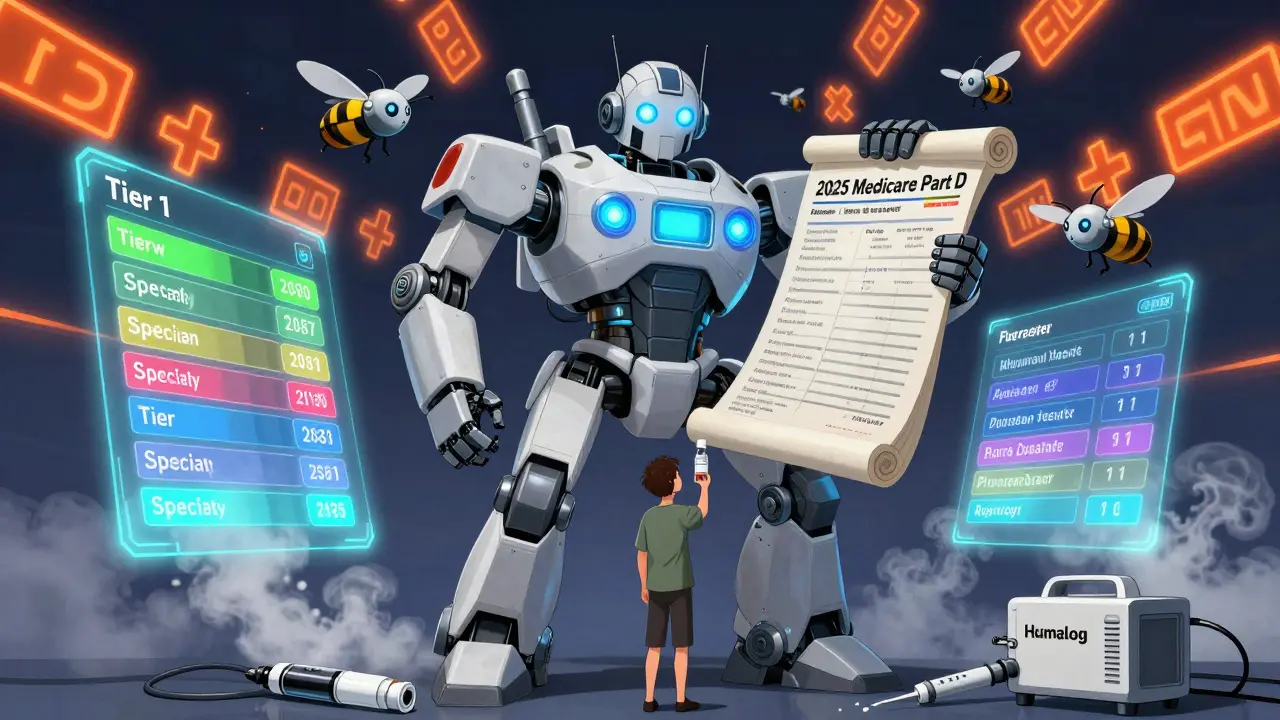
Every year, your prescription drug coverage changes - and most people don’t find out until they show up at the pharmacy and get hit with a surprise copay. In 2025, those changes are bigger than ever. Thanks to the Inflation Reduction Act (IRA) of 2022, Medicare Part D plans have been overhauled, and the way drugs are covered, priced, and switched is now completely different. If you’re taking any regular medication - especially for diabetes, arthritis, or cancer - you need to understand what’s happening. This isn’t just paperwork. It’s about whether you’ll be able to afford your pills next year.
What’s Actually Changing in 2025?
The biggest shift isn’t about which drugs are covered - it’s about how much you pay. Starting January 1, 2025, there’s a hard cap on out-of-pocket drug costs: $2,000 per year. That means if your medications cost $8,000, you’ll never pay more than $2,000. Sounds great, right? But here’s the catch: insurers are responding by shifting more drugs to higher tiers or excluding them entirely. To offset the $2,000 cap, they’re pushing patients toward generics and biosimilars - even if you’ve been stable on your current drug for years.
For example, if you’re on Humalog insulin, UnitedHealthcare moved it from Tier 1 to Tier 3 in their 2025 formulary. That means your copay jumped from $35 to $113. Same drug. Same dose. Same manufacturer. Just a new price tag. That’s not a medical decision. That’s a financial one - and it’s happening to millions.
How Formularies Work Now
Insurance companies organize drugs into tiers. Each tier has a different cost. In 2025, here’s what the typical structure looks like:
- Tier 1: Preferred generics - $1 to $10 copay. These are the drugs insurers want you on.
- Tier 2: Non-preferred generics and preferred brands - average $47 copay.
- Tier 3: Non-preferred brands - average $113 copay.
- Specialty Tier: High-cost drugs like biologics - either $113 or 25% coinsurance.
That’s not just a chart. It’s a roadmap. If your drug is in Tier 3, you’re paying nearly three times more than someone on a Tier 1 generic. And if your drug got moved from Tier 1 to Tier 3? You’re suddenly paying hundreds more per month.
Insurers don’t just move drugs - they drop them. CVS Caremark’s 2025 formulary removed nine specialty drugs, including Herzuma and Ogivri. In their place? Biosimilars like Kanjinti and Trazimera. These aren’t random replacements. They’re cheaper versions of the same medicine. But if you’ve been on Herzuma for five years, switching isn’t just paperwork - it’s a risk.
Why Generics and Biosimilars Are Being Pushed
It’s not about saving money for insurers - it’s about survival. The IRA didn’t just cap your costs. It forced PBMs (pharmacy benefit managers) to change how they make money. Before, they made profits by negotiating rebates from drugmakers. The more expensive the brand-name drug, the bigger the rebate. That created a perverse incentive: push expensive drugs, even if cheaper options existed.
Now? The rules changed. With the $2,000 cap and the elimination of the "donut hole," insurers can’t rely on rebates anymore. So they’re switching tactics: push generics. Push biosimilars. Push the cheapest option - even if it’s not what your doctor originally prescribed.
The FDA has made this easier. In May 2024, they updated guidance to say that biosimilars don’t need to be labeled "interchangeable" to be covered. That means insurers can switch you to a biosimilar like Amjevita (a Humira alternative) even if your doctor didn’t say it was okay. And they’re doing it - fast. In 2024 alone, 17 new biosimilars were approved. That’s a 34% jump from the year before.

Who Gets Hit Hardest?
It’s not everyone. People on simple, low-cost generics? They’re mostly fine. But if you’re on:
- Insulin (Humalog, Lantus, Fiasp)
- Biologics for autoimmune diseases (Humira, Enbrel, Stelara)
- Cancer drugs (Herceptin, Rituxan, Revlimid)
- Chronic kidney or liver medications
…you’re in the crosshairs. Milliman’s analysis shows that 78% of standalone Medicare Part D plans (PDPs) are aggressively switching patients to generics. That’s compared to only 42% of Medicare Advantage plans (MAPDs). Why? PDPs have fewer tools to manage care. They rely on formulary changes to control costs. MAPDs have doctors, nurses, and care coordinators. They can talk to patients before switching.
And the data backs it up. On Reddit, users are posting about insulin hikes. On HealthUnlocked, someone shared: "My switch from Humira to Amjevita saved me $450 a month - no difference in how I feel." But another user wrote: "I’ve been on my drug for 10 years. My doctor says it works. My insurer says no. Now I’m in a 10-day delay while they review my exception."
What You Can Do - Step by Step
You don’t have to wait for a surprise bill. Here’s how to protect yourself:
- Check your formulary between October and December. Every insurer sends a notice called the "Summary of Coverage" (SOC). Look for your drug. Is it still covered? Is it still in the same tier?
- Ask your pharmacist. Pharmacists see formulary changes every day. They know which drugs got moved, dropped, or replaced. Ask: "Is my medication still covered under my plan in 2025?"
- Call your insurer. Don’t rely on mail. Call and ask: "Is my drug still on the formulary? What’s the new tier?" Write down the date, time, and person you spoke with.
- Request an exception. If your drug was moved to a higher tier or removed, you can ask for an exception. Your doctor fills out a form saying why you need it. Approval rate for tier changes? 82%. For complete removal? Only 47%.
- Use the 30-day transitional supply. If your drug is being removed, you’re entitled to a 30-day supply at your old price. Use it to buy time.
And remember: if you’re switched to a biosimilar, give it time. Many people report no difference in effectiveness. But if you feel worse? Tell your doctor. Immediately.
What’s Coming in 2026
2025 is just the start. In January 2026, the Medicare Drug Price Negotiation Program kicks in. For the first time, the government will force insurers to cover 10 specific drugs - no exceptions. These include Stelara, Prolia, and Xolair. That means even if your insurer tried to remove them, they now have to cover them.
But here’s the twist: they can still switch you to biosimilars. And biosimilars for these drugs are expected to launch in Q2 2025. So while you’ll still have access to the drug, you might not get the brand you’re used to.
By 2027, experts predict 45% of targeted therapies will be biosimilars. That’s up from 28% today. That’s not a trend. It’s a revolution.
Don’t Wait Until January
Insurance changes don’t happen overnight. They’re planned months in advance. If you’re on a chronic medication, you have until December 31, 2025, to act. Don’t wait for a letter. Don’t wait for a pharmacy call. Don’t assume your drug is safe.
Check your plan. Talk to your pharmacist. Talk to your doctor. Ask for exceptions if needed. And if you’re switched to a biosimilar - track how you feel. If something changes, speak up.
This isn’t about fighting insurers. It’s about knowing your rights. The system is designed to push you toward cheaper drugs. But you still have power. Use it.
What happens if my drug is removed from my formulary?
If your drug is removed, you’re entitled to a 30-day transitional supply at your current cost. After that, you can file an exception request through your insurer. Your doctor must submit a letter explaining why the drug is medically necessary. Approval rates are low for complete removals (only 47%), so it’s better to act early. You can also ask your pharmacist about alternative generics or biosimilars that are covered.
Can I be forced to switch to a biosimilar?
Yes - and this is new. Insurers can switch you to a biosimilar even if your doctor didn’t recommend it. The FDA now allows this as long as the biosimilar is approved, even if it’s not labeled "interchangeable." But you can request an exception if you’ve had side effects or poor results with previous switches. Document your experience - it strengthens your case.
Why do some people save money switching to generics, but others get worse?
It depends on the drug. For most conditions - like high blood pressure or cholesterol - generics work just as well. But for biologics (used in autoimmune diseases, cancer, or severe diabetes), even small differences in formulation can affect how your body responds. Some people report no change. Others develop rashes, fatigue, or loss of symptom control. If you feel worse after a switch, tell your doctor immediately. Don’t assume it’s "all in your head."
How do I know if my plan is changing my drug tier?
Your insurer must send you a notice at least 60 days before any change. Look for the "Summary of Coverage" (SOC) mailed between October and December. You can also log into your plan’s website, go to "Drug List" or "Formulary," and search for your medication. If the copay or tier changed, it will be listed. If you didn’t get a notice, call your insurer - they’re required to send one.
Is there a limit to how many times I can be switched?
No - there’s no federal limit. Insurers can switch you back and forth between generics, biosimilars, and brands as long as they’re on the formulary. This is called "non-medical switching," and it’s increased by 23% since 2023. Each switch creates disruption. Keep records of every change and how it affected you. That documentation can help if you need to file a complaint or appeal.
Chris Bird
March 12, 2026 AT 12:00Robert Bliss
March 14, 2026 AT 03:15APRIL HARRINGTON
March 16, 2026 AT 00:23Randall Walker
March 16, 2026 AT 17:05Miranda Varn-Harper
March 16, 2026 AT 23:12Alexander Erb
March 18, 2026 AT 04:30Donnie DeMarco
March 20, 2026 AT 00:44Tom Bolt
March 20, 2026 AT 22:39Shourya Tanay
March 22, 2026 AT 20:50LiV Beau
March 24, 2026 AT 03:46Adam Kleinberg
March 24, 2026 AT 04:27