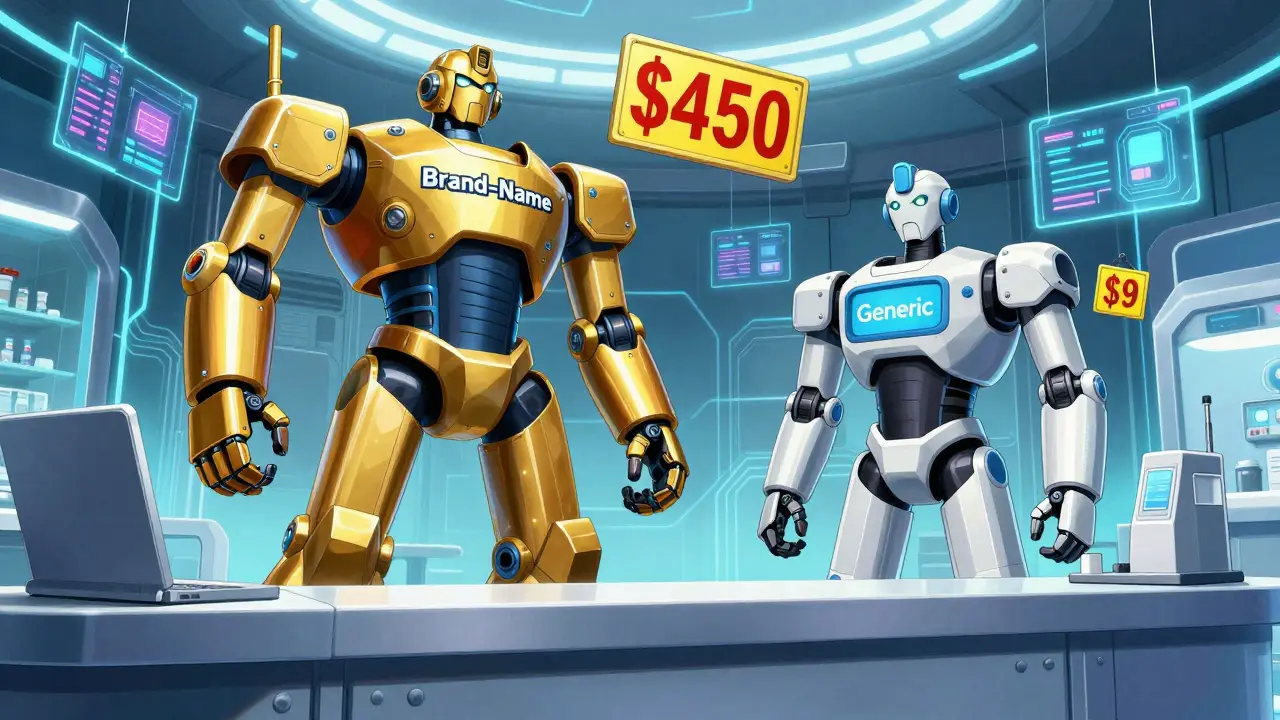
Imagine walking into a pharmacy and seeing two boxes for the exact same medication. One has a fancy brand name and a price tag of $450; the other is a generic version that costs just $9. For many people, this isn't a hypothetical scenario-it's a daily reality. The difference between these two options can be the difference between someone affording their life-saving medicine or being forced to skip doses. Generic medications is a bioequivalent version of a brand-name drug produced after the original patent expires, meeting the same quality, strength, and potency standards. By switching to generics, patients and the broader healthcare system save hundreds of billions of dollars every year without sacrificing the quality of care.
The Real Math of Generic vs Brand Name Costs
When we talk about healthcare cost savings, the numbers are staggering. In 2022 alone, generics and biosimilars saved American patients and the healthcare system a record $408 billion. To put that in perspective, over the last decade, these affordable alternatives have slashed a cumulative $2.9 trillion from healthcare spending. But how does that translate to your wallet at the pharmacy counter?
The gap is massive. The average copay for a generic drug is about $6.16, while the brand-name equivalent jumps to $56.12. That means brand names are roughly 9.1 times more expensive. In fact, 93% of generic prescriptions cost under $20, whereas only 59% of brand-name drugs fall into that same affordable bracket. It's a disproportionate impact: while generics make up 90% of all prescriptions dispensed in the U.S., they account for only about 1.5% of total healthcare spending. This shows that generics do the heavy lifting in keeping the system from collapsing under the weight of drug costs.
Are Generics Actually the Same?
A common worry is that a cheaper price means lower quality. However, the FDA is the federal agency responsible for protecting public health by ensuring the safety, efficacy, and security of human and veterinary drugs has strict rules. For a generic to be approved, it must prove bioequivalence. This means the drug must deliver the same amount of active ingredient into the bloodstream at the same rate as the brand name, typically within a narrow 80-125% pharmacokinetic window.
Most generics are rated "AB" in the Orange Book is the official FDA publication that lists approved drug products and their therapeutic equivalence , meaning they are therapeutically equivalent. While some patients with "narrow therapeutic index" drugs-like levothyroxine for thyroid issues-report slight variations in how they feel, the vast majority of medications, including statins and allergy reliefs, work identically regardless of the label.
| Feature | Generic Medications | Brand-Name Medications |
|---|---|---|
| Average Copay | $6.16 | $56.12 |
| Prescription Volume | ~90% of prescriptions | ~10% of prescriptions |
| Development Time | 3-5 years (abbreviated) | 10-15 years |
| Cost Impact | Up to 83% cheaper | High cost due to R&D/Marketing |
Beyond the Label: Therapeutic Substitution
Saving money isn't just about swapping a brand for a generic; sometimes it's about swapping one generic for another. This is called therapeutic substitution. A study in Colorado found that some generics are actually priced high, even though other drugs in the same class provide the same clinical value for much less. In some cases, high-cost generics were 15.6 times more expensive than their lower-cost therapeutic alternatives.
By switching to these lower-cost alternatives, some patients saw savings of up to 88.3%. This often involves changing the dosage form or strength of the drug. If you feel your generic is still too expensive, it's worth asking your doctor if there is a different but clinically equivalent medication that your insurance covers more favorably.
The Hurdles to Lower Prices
If generics are so great, why isn't every single drug cheap? The problem often lies in the legal system. Brand-name manufacturers sometimes use "patent abuse" tactics, filing dozens of patents on a single drug to block generic competitors from entering the market. This extends their monopoly and keeps prices high long after the original innovation has been paid for.
Additionally, we are seeing a rise in drug shortages. In late 2023, nearly 78% of active drug shortages involved generic medications. Because generics have such thin profit margins, manufacturers may stop producing them if the cost of ingredients rises, leaving patients stranded. There is also the issue of "biosimilars"-generic versions of complex biological drugs. These are harder to make and take longer for doctors to trust, meaning the massive savings seen in simple pills haven't fully hit the world of injectable specialty drugs yet.
How to Maximize Your Savings
You don't have to be a medical expert to lower your pharmacy bill. A few simple steps can make a huge difference in what you pay out of pocket.
- Ask your doctor explicitly: Many physicians write brand names by habit. Simply asking, "Is there a generic version of this I can take?" can save you hundreds.
- Check the Orange Book: If you're worried about equivalence, you can look up the drug's rating. An "AB" rating is the gold standard for equivalence.
- Shop around: Some pharmacies have different contracts with insurance companies, leading to different generic copays.
- Inquire about therapeutic alternatives: If your generic is still expensive, ask your provider if a different drug in the same class is cheaper.
Are generic drugs as effective as brand-name drugs?
Yes. The FDA requires generic drugs to be bioequivalent, meaning they must have the same active ingredient, strength, purity, and potency as the brand-name version. They are designed to produce the same clinical effect in the body.
Why are generic medications so much cheaper?
Brand-name companies spend billions on research, development, and clinical trials. Generics don't have to repeat these trials; they only need to prove they work the same way. Once the patent expires, multiple companies compete to sell the drug, which drives the price down through market competition.
What is the difference between a generic and a biosimilar?
Standard generics are copies of chemically synthesized drugs (small molecules). Biosimilars are versions of complex biological products made from living cells. Because biologics are much more complex, biosimilars are "highly similar" rather than identical copies.
Can I always switch from a brand to a generic?
In most cases, yes. However, for some medications with a "narrow therapeutic index" (where a tiny change in dose can cause a big change in effect), your doctor might prefer a specific brand to ensure absolute consistency. Always consult your physician before switching.
What happens if my pharmacy doesn't have the generic in stock?
Drug shortages are common with generics. If your generic is unavailable, you can ask the pharmacist to check other locations or ask your doctor for a therapeutic alternative-a different drug that does the same job and is available.
Next Steps for Patients and Caregivers
If you are currently paying high prices for your medications, your first move should be a pharmacy audit. List every medication you take and identify which are brand-name. Bring this list to your next doctor's appointment and specifically ask about generic medications. If you are on a fixed income, such as Medicare, keep an eye on new policies like the Inflation Reduction Act, which aims to cap out-of-pocket costs and encourage the use of affordable generics. For those using specialty biologics, ask your provider about the availability of biosimilars, as this is the newest frontier in healthcare cost savings.
Quinton Bangerter
April 18, 2026 AT 22:22Sure, the FDA says they're the same, but who actually believes the government these days? The 'bioequivalence' window is just a convenient way for big pharma to dump lower-grade fillers into our systems while pretending it's the same drug. I've noticed a huge difference in efficacy whenever I'm forced onto a generic. It's all part of a larger scheme to prioritize profit margins over actual patient outcomes, and the 'Orange Book' is basically just a brochure for the industry's corporate interests. Don't trust the labels, trust your own body's reaction to the chemicals.
Cynthia Didion
April 19, 2026 AT 00:36Only in America is healthcare this dysfunctional. Pathetic.
Arthur Luke
April 20, 2026 AT 10:05I appreciate the detailed explanation regarding the pharmacokinetic window. It's interesting that some medications, like levothyroxine, are more sensitive to these changes than others. I wonder if there are specific resources to track the consistency of various generic manufacturers over time.
Ms. Sara
April 20, 2026 AT 16:41For those of you feeling overwhelmed, just start by making a list of your current meds. It's a small step, but it empowers you to have a real conversation with your provider. Everyone deserves access to affordable care, and being your own advocate is the best way to ensure that happens.
Valorie Darling
April 22, 2026 AT 06:39lol imagine paying 450 bucks for a brand name just because of a label... some people are just suckers i guess
Akshata Kembhavi
April 22, 2026 AT 15:41Generic medicines are a huge deal in India too. We have a massive industry for this and it really helps a lot of people get their treatment without breaking the bank.
Venkatesh Venky
April 24, 2026 AT 08:41This is so great! We can all work together to find these cost-saving modalities. Using biosimilars is a total game-changer for the healthcare ecosystem and will help a lot of patients reach their health goals faster. Let's stay positive and keep pushing for these affordable options to be the norm everywhere!
anne camba
April 25, 2026 AT 05:11Money... is just a ghost... hindering the flow... of healing...!