
Imagine landing in Tokyo with your anxiety medication in your suitcase-only to be told by customs it’s illegal. Or arriving in Dubai with your ADHD pills and being held for hours because the label didn’t match your passport. These aren’t rare horror stories. They happen every day to travelers who assume their prescriptions work everywhere. The truth? medications abroad are not a one-size-fits-all issue. What’s legal in Sydney might be a felony in Singapore. What’s over-the-counter in Mexico could require a special permit in Germany. And if you’re on controlled substances like opioids, benzodiazepines, or stimulants, you’re playing with fire if you don’t do your homework.
Why Your Prescription Doesn’t Travel Well
Different countries have wildly different rules about what drugs are allowed, how much you can bring, and whether you need a local doctor to refill them. The root of the problem? International drug treaties from the 1960s that still shape today’s laws. The International Narcotics Control Board (INCB) tracks these rules, but only 68 out of 190+ countries publish clear guidelines for travelers. That means for more than half the world, you’re guessing-and guessing wrong can mean fines, detention, or deportation. Take hydrocodone. It’s a common painkiller in the U.S., but it’s completely banned in Japan. Codeine? Available without a prescription in Mexico, but you need special authorization just to carry it in Australia. Even something as simple as pseudoephedrine (found in cold meds) is illegal in Australia, New Zealand, and the UAE because it can be used to make methamphetamine. In Q1 2025 alone, Sydney Airport seized 387 packages of these medications from travelers.What You Can Legally Bring Across Borders
Most countries allow you to carry a personal supply of medication-but only under strict conditions. The universal rule? Never pack pills in a Ziploc bag. Always keep them in their original pharmacy containers with the prescription label attached. That label must show your full name (matching your passport), the drug name (both brand and generic), dosage, and quantity. The standard allowance is a 90-day supply for personal use. But exceptions exist:- Japan: Max 30 days’ supply of narcotics
- Singapore: Max 14 days’ supply for controlled substances
- EU countries: Generally allow 90 days if you have a valid prescription
- United Arab Emirates: Even sleep aids like zolpidem require pre-approval from the Ministry of Health
Getting a Local Prescription Abroad
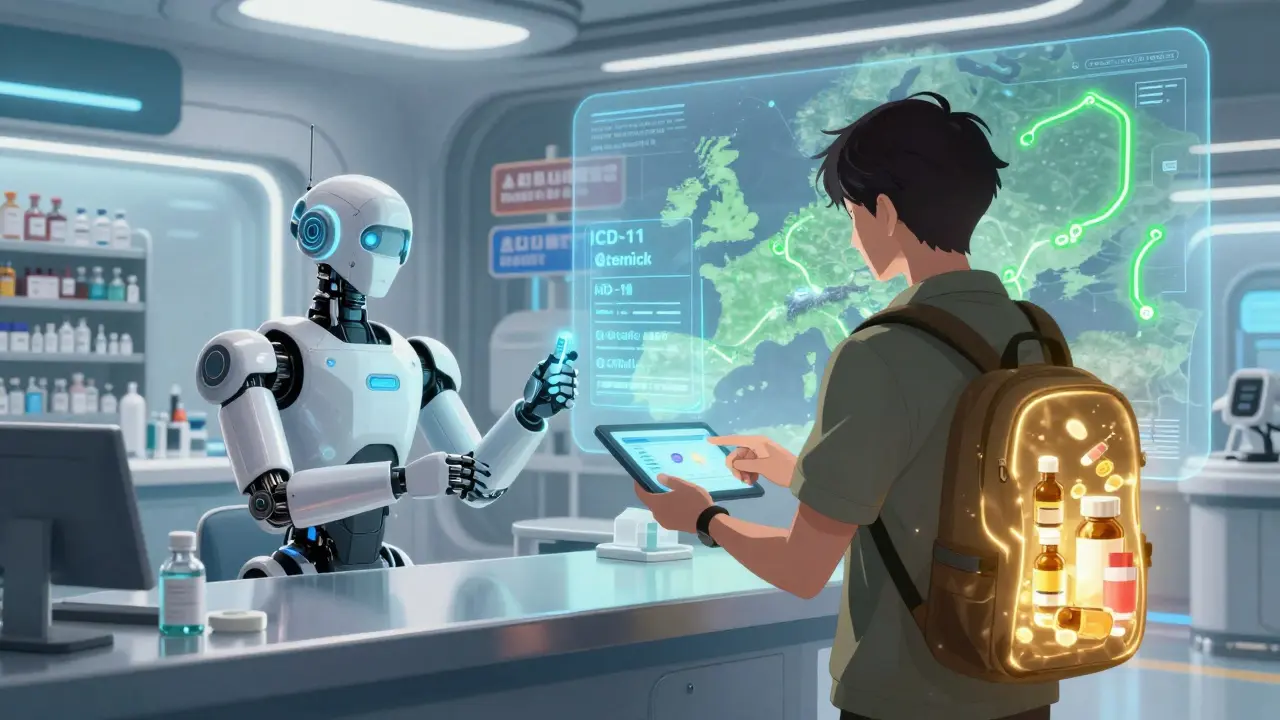
If you run out-or your meds are confiscated-you’ll need to see a local doctor. Sounds simple, right? It’s not. In many countries, you can’t just walk into a clinic and say, “I need my American prescription filled.” Here’s how it actually works:- Get a doctor’s letter from home before you leave. It must include your diagnosis using ICD-11 codes (the global standard), the generic drug name, dosage, and reason for use. No handwritten notes. No email printouts. It needs to be on official letterhead.
- Get it notarized if you’re going to a non-English-speaking country. Many places require a certified translation.
- Bring your original prescription and a copy. Keep the copy separate from the original.
- Find a reputable pharmacy. Use the International Association for Medical Assistance to Travellers (IAMAT) directory. They vet over 1,400 clinics worldwide for travelers.
- Be prepared to pay out-of-pocket. Most foreign pharmacies don’t accept foreign insurance.
High-Risk Medications: What to Avoid
Some drugs are red flags everywhere. The CDC says 43% of medication-related travel incidents involve benzodiazepines-drugs like Xanax, Valium, and Ativan. They’re tightly controlled in most of Asia and the Middle East. Even with a doctor’s note, you’re likely to get stopped. ADHD medications like Adderall and Ritalin are another minefield. The U.S. ranks 23rd globally for traveler medication access, mostly because stimulants are treated like narcotics. In the UK, you need a special license. In Japan, they’re illegal. In Canada, you can bring a 90-day supply under new import rules-but only if it’s from a certified pharmacy. Opioids? Even morphine and oxycodone require special permits in many countries. A 2025 MIUSA survey found that 67% of travelers with opioid prescriptions faced access issues abroad. That’s more than triple the rate of those needing antibiotics.How to Prepare: The 90-Day Rule
You can’t wing this. The U.S. State Department recommends starting your planning 90 days before departure. Here’s your checklist:- Step 1: Visit the INCB’s Country Regulations database (updated October 2025). Only 68 countries are listed-but it’s the only official source.
- Step 2: Go to the embassy website of your destination. Search for “medication,” “drugs,” or “controlled substances.” Look for official PDFs, not blog posts.
- Step 3: Call or email the embassy. Ask: “What are the rules for bringing [drug name] into your country?” Get their answer in writing.
- Step 4: Ask your doctor for a letter with ICD-11 codes. Make sure the generic name is included. Example: “Alprazolam (Xanax)” not just “Xanax.”
- Step 5: If the country requires it, get the letter translated and notarized. Use a certified translator-Google Translate won’t cut it.
- Step 6: Pack your meds in your carry-on. Never check them. Airlines lose bags. Customs checks luggage.
- Step 7: Carry a printed copy of the WHO’s 2025 international medication guidelines. It’s not a legal document, but it shows you’ve done your research.
Real Stories: What Happens When You Don’t Plan
On Reddit, a traveler named u/TravelMedWoe posted: “Lost 3 days of my vacation fighting with Dubai customs over 10mg zolpidem. I had a doctor’s note. I had the original bottle. They still confiscated it.” That story has over 1,400 upvotes. Others report similar nightmares with Adderall in Singapore, Xanax in Thailand, and codeine in Australia. One student studying in Paris brought her ADHD meds from the U.S. and was denied a refill because French doctors wouldn’t recognize the prescription. She had to fly back to the U.S. for a new script. On the flip side, u/EUtraveler99 shared: “Used my German e-prescription to get my sertraline filled in France within 2 hours. EU system works seamlessly.” That’s the difference between planning and winging it.What’s Changing in 2026
Good news: change is coming. The WHO’s new 2025 guideline introduces standardized international documentation templates for controlled medications. By Q2 2026, these will be rolled out to member countries. It’s not a magic fix-but it’s the biggest step forward in 15 years. The U.S. Affordable and Safe Prescription Drug Importation Act of 2025 also starts Phase 1 on May 1, 2026. It allows Americans to legally import 90-day supplies from certified pharmacies in Canada, the UK, EU, and Switzerland. That could cut costs and reduce risk for long-term travelers. Telemedicine is also expanding. As of September 2025, 41 countries now allow tourists to get prescriptions via video consult. Services like MediFind and MyTravelMed are growing fast-but success rates vary. MediFind has an 85% success rate. MyTravelMed? Only 62% for controlled substances.Final Tips: What Actually Works
- Always carry your meds in original bottles. No exceptions. - Never rely on pharmacy apps or online pharmacies abroad. Many are fake or illegal. - Know your drug’s generic name. Brand names vary by country. “Lipitor” is “atorvastatin” everywhere. - Use IAMAT’s clinic finder. It’s free. It’s trusted. It’s the only global network vetted for travelers. - Bring extra pills. If you need 30 days, bring 45. Delays happen. - Keep a digital copy of everything. Email it to yourself. Save it in the cloud. Print it. You’ll need it if your bag gets lost. If you’re on chronic medication, don’t treat travel like a vacation. Treat it like a medical mission. The stakes are higher than you think.Can I bring my prescription medications on a plane?
Yes, but only if they’re in their original pharmacy containers with your name on the label. Pack them in your carry-on, not checked luggage. Declare them if asked. TSA allows medically necessary liquids over 3.4 ounces if you notify them at screening. Other countries have their own rules-always check your destination’s laws.
What if my medication is banned in the country I’m visiting?
Don’t bring it. Even with a doctor’s note, you risk arrest, fines, or deportation. Talk to your doctor before you travel. They may be able to switch you to an alternative medication that’s legal in your destination. If not, plan ahead-some countries allow you to apply for special import permits, but that can take weeks.
Can I get a local prescription while abroad?
Maybe. In the EU, yes-your prescription may be honored. Outside the EU, you’ll likely need to see a local doctor with your original prescription and a doctor’s letter. Bring your medical records, ICD-11 codes, and generic drug names. Many clinics won’t refill a foreign prescription without proof of diagnosis. Use IAMAT to find vetted clinics.
Are over-the-counter meds safe to bring?
No. Many OTC drugs contain ingredients that are controlled substances elsewhere. Pseudoephedrine (in Sudafed) is banned in Australia and the UAE. Codeine is OTC in Mexico but restricted in Australia. Always check the active ingredients, not just the brand name. When in doubt, leave it behind.
How far in advance should I plan for travel medications?
At least 90 days. Some countries require pre-approval letters that take weeks to process. Doctors’ letters need notarization and translation. Pharmacies abroad may need time to order your medication. If you’re on controlled substances, start even earlier. Waiting until the week before you leave is a recipe for disaster.
What should I do if my medication is confiscated at customs?
Stay calm. Do not argue. Ask for a written receipt of confiscation. Contact your country’s embassy immediately. They can’t get your meds back, but they can help you find local medical care or connect you with a doctor who can issue a new prescription. If you have a medical emergency, prioritize your health over legal disputes.
Konika Choudhury
January 10, 2026 AT 12:54Why do Americans think their pills are sacred? India has strict drug laws for a reason. You don't bring your chaos to our borders. If your meds are banned here you're lucky you weren't jailed. Stop acting like the world owes you your prescription
Darryl Perry
January 11, 2026 AT 12:48The article is accurate but lacks actionable enforcement metrics. No data on conviction rates, border seizure statistics beyond Sydney, or legal precedent cases. A superficial overview masquerading as a guide.
Windie Wilson
January 11, 2026 AT 15:24So let me get this straight - you're telling me I can't bring my Xanax to Thailand... but I can bring 17 bottles of kombucha? 🤦♀️ The world is a circus and I'm just the clown with the anxiety pills.
Daniel Pate
January 11, 2026 AT 21:45It's fascinating how national sovereignty over pharmaceuticals reflects deeper cultural attitudes toward the body, control, and individual autonomy. The 1960s treaties were never about health - they were about power. Who gets to define what's medicinal versus what's dangerous? And why do we still let bureaucrats in distant capitals decide that for us?
When a country bans a drug because it 'can be used to make meth,' are they protecting public health - or controlling the behavior of their citizens? The line blurs when a sleep aid becomes a political symbol.
And yet, the solution isn't global uniformity. It's mutual recognition. If we treated medical need as a human right rather than a legal loophole, we'd see fewer travelers detained and more people treated with dignity.
The fact that 97% of countries require original labels suggests we're still stuck in a pre-digital, pre-trust era of medicine. Why not a blockchain-based, encrypted prescription registry? It's technically possible. Politically? That's the real barrier.
We're not just carrying pills. We're carrying our identities, our diagnoses, our desperation. And the world treats them like contraband.
Jose Mecanico
January 12, 2026 AT 13:39Good summary. I’ve had to refill sertraline in Germany and it was surprisingly easy. Just brought my bottle, doctor’s note, and paid cash. No drama. The EU really does make it smoother.
Monica Puglia
January 13, 2026 AT 21:35PLEASE bring extra pills 🙏 I once lost my bag in Lisbon and had to wait 10 days for a refill. My anxiety went full horror movie. Also - digital copies are non-negotiable. Save it to iCloud, Google Drive, and email it to your mom. You’ll thank me later. 💯
Alice Elanora Shepherd
January 14, 2026 AT 15:16Excellent, comprehensive guide - though I’d add that many countries require the doctor’s letter to be issued within 30 days of travel, not just 'before departure.' Also, ensure the ICD-11 code is the most current revision (e.g., F41.1 for generalized anxiety disorder, not outdated F41.0). And, critically: always carry a printed copy of the embassy’s official medication policy page - not just the article you read online. Authorities demand verifiable sources.
Christina Widodo
January 16, 2026 AT 08:43Wait - so if I’m in Japan and my Xanax gets confiscated, can I just walk into a clinic and get a new one? Or do I need to be a resident? I’m planning a 6-month stay and I’m terrified I’ll run out.
Jennifer Phelps
January 16, 2026 AT 08:44My cousin got arrested in Dubai for melatonin. Yes melatonin. They thought it was a drug. He had a doctor's note. They still took him to jail for 3 days. Don't trust anything you read online. Call the embassy. Always.
Amanda Eichstaedt
January 17, 2026 AT 04:29It's wild how we treat medicine like a privilege instead of a necessity. In the U.S., we hoard prescriptions like gold, but abroad, we're treated like smugglers. The irony is that the very drugs that keep people alive are seen as threats. We've built systems that punish people for needing help. And we call it 'border security.'
What if we treated mental health the same way we treat heart disease? Would we still demand notarized letters for beta-blockers? Would we make people beg for insulin at customs?
This isn't about drugs. It's about who we decide is worthy of care.
Alex Fortwengler
January 18, 2026 AT 05:52They’re lying about the WHO guidelines. There’s no 2026 rollout - that’s just a PR stunt. The real plan? Big Pharma wants to force everyone into their subscription-based telemedicine apps so they can track your every pill. They’re using 'travel safety' as a front to control your meds. Don’t fall for it. The government’s already got your prescription history. They’re building a global pharmaceutical surveillance state.