The Final Line of Defense
Imagine picking up a prescription for a common antibiotic. You trust the doctor wrote the right dose, and the computer system processed it correctly. But mistakes happen. Even the most careful doctors make slip-ups. That is where Pharmacists, healthcare professionals trained in medicines, become your safety net. They sit at the intersection of complex medical science and practical application, acting as the last checkpoint before medication reaches your hands. Without this layer of review, harmful mistakes could easily pass through the system unnoticed.
In modern healthcare, the sheer volume of prescriptions means that relying on memory alone is impossible. A pharmacist doesn't just count pills; they run a deep diagnostic scan of the entire prescription order. They verify everything from the drug name to the interaction risks with other medications you might already be taking. Think of them as the spell-checker for your health, ensuring the 'sentences' written by your doctor make sense and won't cause harm when 'read' by your body.
How Errors Slip Into Prescriptions
To understand how pharmacists catch mistakes, we first need to see where they hide. Errors aren't always obvious typos. Often, they are subtle things like a dosage that is slightly too high for your kidney function, or a drug combination that increases the risk of bleeding. According to data from the Agency for Healthcare Research and Quality, medication errors affect approximately 1.5 million people annually in the United States alone.
These errors come from different places:
- Prescribing Errors: A doctor might select the wrong strength due to look-alike options in the electronic menu.
- Transcription Mistakes: Information entered into the computer might be typed incorrectly.
- Dosing Issues: Calculating the correct amount based on weight or age can be tricky.
- Interactions: New drugs fighting with existing ones silently in your bloodstream.
When a prescription arrives at the pharmacy counter, the pharmacist performs what is known as a prospective online drug utilization review (DUR). This isn't just a quick glance. It's a systematic analysis that cross-references your specific medical history against the new order. If you have a history of allergies, the system flags the allergy. If you are pregnant, it flags potential teratogens. The pharmacist then uses their clinical judgment to decide if the flag is a real danger or a false alarm.
Technology Working Side-by-Side With Humans
You might wonder if computers can do this job entirely on their own. After all, software is fast. However, machines lack context. While Clinical Decision Support Systems, software tools that provide evidence-based medical recommendations help significantly, they rely on alerts. And too many alerts lead to fatigue.
Studies show that pharmacists often override nearly half of these automated warnings because many are not clinically significant for that specific patient. This is why human oversight remains critical. A pharmacist can interpret nuances that code cannot. For instance, if a patient has recently recovered from kidney issues, a standard algorithm might approve a dose that a pharmacist would adjust based on the latest lab results that haven't fully updated the central database yet.
Tech also helps in other ways. Barcode scanning systems reduce dispensing errors by over 50% by ensuring the bottle matches the label. Automated dispensing cabinets further reduce mistakes in hospital settings. Yet, even with these tools, statistics show that adding pharmacist review on top of technology boosts error detection rates to between 45% and 65%, compared to technology alone which catches only about 17% to 25%. The human eye and brain still provide the highest value return on safety investment.
One of the most vulnerable moments for a patient is during care transitions-when moving from home to a hospital, or from a hospital back home. This is where the process of Medication Reconciliation, a formal process of identifying discrepancies in medication lists becomes essential.
Research indicates that patients often leave gaps in their medication history when admitted. In one cluster-randomized trial, clinical pharmacists found an average of 2.3 discrepancies per patient during admission. These could mean stopping a necessary heart medicine or starting a new drug that conflicts with something still in their system. Pharmacists in hospitals spend time talking to families, reviewing old bottles, and checking records to get the true list. This reconciliation prevents dangerous duplications or omissions once the patient moves to the next stage of care.
Safety isn't just about avoiding injury; it's about saving resources too. When a pharmacist prevents a medication error, the financial ripple effect is massive. Estimates suggest that preventing a single error generates approximately $13,847 in healthcare cost savings. This includes avoided hospital readmissions, emergency room visits, and treatment for adverse reactions.
Beyond money, there is the tangible reduction in harm. In community pharmacies, a study found that technicians serving as the first line of defense catch roughly 63% of initial mistakes. Then, when the licensed pharmacist performs the final independent double-check, another layer of security activates. Together, this team approach stops potentially fatal events, like a ten-fold dosing error on blood thinners, before the patient takes the first dose. One patient account on a review platform described how a pharmacist spotted a warfarin error that would have caused life-threatening bleeding, highlighting the life-saving nature of this role.
Despite their importance, pharmacists face hurdles. Time pressure is the biggest enemy of safety. In low-resource environments, staffing ratios can stretch so thin (sometimes exceeding one pharmacist to 500 patients) that error reduction rates drop to as low as 15%. Rushed checks mean fewer eyes on details.
There is also the issue of alert fatigue. With thousands of warning pop-ups appearing on screens daily, professionals begin to ignore them. To combat this, modern systems are shifting toward tiered alert strategies. This means only high-severity interactions trigger urgent red flags, while lower-risk issues are logged for later review. This change has helped reduce override rates significantly, making the remaining alerts more actionable.
Furthermore, reliance solely on the pharmacist creates a fragile system. Experts warn that while pharmacists are the "last line of defense," the entire team needs to be safe. If prescribers make too many mistakes initially, the pharmacist becomes overwhelmed. Ideally, interdisciplinary teams working together reduce errors by 52%, proving that a culture of shared responsibility works better than a single safety gatekeeper.
The landscape of pharmacy practice is evolving quickly. As we move through 2026, new technologies are integrating into the workflow. Artificial Intelligence (AI) is beginning to assist in error detection. Early pilots suggest AI tools can prioritize high-risk prescriptions, cutting down cognitive load by prioritizing which orders need immediate human attention. This allows the pharmacist to focus their expertise on complex cases rather than routine administrative checks.
Legislation is also expanding what pharmacists can do. More states and regions are passing laws allowing pharmacists to adjust medication regimens independently under collaborative agreements. This shift turns them from passive reviewers to active clinicians who can optimize therapy immediately when an error is found, rather than waiting hours for a doctor to call back.
For patients, this evolution means safer, more continuous care. Whether at a community counter or in a hospital ward, the presence of a qualified professional verifying every script remains the gold standard for medication safety. Supporting policies that allow pharmacists adequate time and training ensures this safety net holds firm for everyone.
Pharmacists are the final healthcare professional to review a prescription before the medication leaves the pharmacy or is administered. This position allows them to catch errors made by prescribers, transcribers, or the dispensing system itself before the drug reaches the patient. Research indicates that pharmacist interventions prevent approximately $2.7 billion in annual healthcare costs related to medication errors. On a per-error basis, preventing a single mistake saves an estimated $13,847 in potential treatment and hospitalization costs. While computers are effective, they miss contextual clues that humans catch. Studies show that combining technology with pharmacist review detects significantly more errors than using Computerized Provider Order Entry (CPOE) systems alone. Computers provide the data, but humans provide the clinical judgment. Drug Utilization Review (DUR) is a systematic process where pharmacists analyze prescriptions for potential safety issues. This includes checking for drug-drug interactions, allergies, dosing appropriateness, and potential abuse, occurring at the point of filling the prescription. Safety standards vary by setting and resources. While integrated health systems implement robust protocols, independent community pharmacies sometimes score lower on error reporting systems. However, best practices like double-checks and barcode scanning are widely adopted across professional facilities to minimize risks.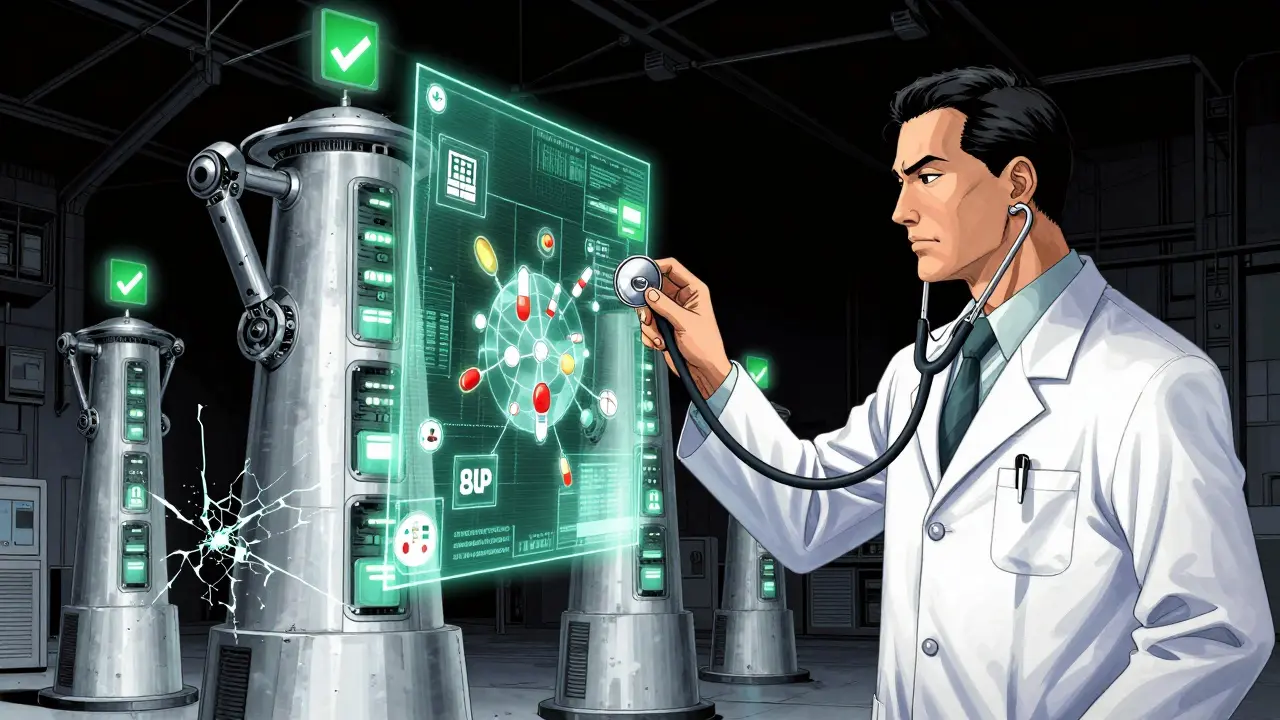
The Power of Medication Reconciliation
Economic and Safety Impact
Challenges in the System
What Changes Are Coming Next?
Why are pharmacists considered the last line of defense?
How much do pharmacists save the healthcare system?
Can computers replace pharmacists in checking errors?
What is drug utilization review?
Do all pharmacies have the same level of safety checks?
Sam Hayes
April 3, 2026 AT 10:12people think computers catch everything. i've worked in healthcare and seen the system fail. it takes a human brain to know when an alert is real. tech misses the context of a patients recent life changes. automation is good but you still need a person watching the screen
Will Baker
April 4, 2026 AT 03:57You sound like someone who has never actually been poisoned by a bad prescription though. The arrogance of assuming the system is broken when the people are just lazy is funny. Maybe you should try getting sick before writing about medicine safety.
angel sharma
April 4, 2026 AT 04:07I really think everyone here needs to stop and appreciate the sheer amount of work that goes into keeping us alive every single day.
We walk into the store and grab pills without thinking about the complex web of chemistry involved.
But these professionals are standing guard against the mistakes that doctors make constantly due to fatigue.
They look at history and cross reference interactions that software simply ignores because the database is outdated.
It makes me feel safer knowing that someone double checks the math on my dosage before i swallow anything.
My grandmother had a scare where two drugs were fighting each other in her bloodstream silently.
That was a pharmacist who caught it and saved her from going to the hospital unnecessarily.
We should be supporting these roles more instead of complaining about wait times at the counter.
Time spent checking means less time fixing later which is much better for everyone.
The economic savings alone justify keeping them in high demand positions everywhere.
Technology helps yes but it cannot replicate the intuition gained from years of seeing patient reactions.
You need a person who cares enough to override the noise on their screen manually.
We live in an era where efficiency often trumps safety but pharmacy seems to resist that trend well.
If you ever doubt the value then ask yourself why your life wasn't ruined last time you took an antibiotic.
It is worth remembering that they are the final gatekeepers of our health security systems.
simran kaur
April 5, 2026 AT 12:45Don't get too comfortable with these numbers since big pharma hides the actual failure rates from public view.
They want you to trust the badge rather than question the statistical integrity of the whole industry.
It feels like a cover up whenever stats change without independent verification happening outside corporate labs.
We need freedom of information laws applied to medical error reporting properly.
Joey Petelle
April 6, 2026 AT 15:01This country used to produce competent people who could handle basic chemistry without needing constant hand holding from computers now.
We built systems where the worker thinks they need permission to act instead of acting on training.
It is pathetic that we rely on screens to tell us what our education taught us decades ago.
American pharmacy schools are softening requirements to please politicians who want faster turnover rates in clinics.
Mark Zhang
April 8, 2026 AT 10:07Hey there I understand that frustration with the changing landscape of professional training standards.
It does feel like experience matters less than certification speeds in many modern institutions.
However many practitioners still care deeply about patient outcomes regardless of policy shifts in curriculum.
We should focus on encouraging mentorship between older and newer staff members.
Everyone benefits when knowledge is shared openly across generations of workers.
Dee McDonald
April 10, 2026 AT 07:12Stop talking about costs and start talking about the lives that are lost because of negligence in the supply chain.
It is insulting to reduce human suffering down to dollar signs in healthcare reports published online.
Families deal with permanent damage while executives argue about budget allocations for staffing ratios.
Nobody wants to hear about saving money when a mother loses a child to a dosing error preventable by a review.
Hope Azzaratta-Rubyhawk
April 10, 2026 AT 18:38Your passion regarding patient safety is noted clearly and deserves acknowledgment from everyone reading this discussion.
There is absolutely no room for complacency when discussing medication administration protocols in hospitals.
We must demand higher standards from legislative bodies to enforce strict staffing guidelines at all facilities.
Optimism comes from action taken to fix systemic issues rather than just identifying problems.
Joseph Rutakangwa
April 11, 2026 AT 02:13Check your bottles before leaving the window.
Always verify the name matches the label exactly.
Trust but verify is the only way to survive.
Don't assume
Rachelle Z
April 12, 2026 AT 07:02Exactly!!! And check the expiration dates too!! 🛑
Sometimes the old stock gets pushed to the front!
Stay safe friends!!! 😂👯♀️
Beth LeCours
April 12, 2026 AT 19:22Pharmacists save lives and thats all that matters honestly
Hudson Nascimento Santos
April 13, 2026 AT 02:59The dichotomy between technological efficiency and human judgment remains a central philosophical conflict in modern medicine practice today.
One side argues for standardization while the other claims intuition holds unique value in unpredictable scenarios.
Neither pole represents the complete truth of how care should be delivered to vulnerable populations globally.
Branden Prunica
April 13, 2026 AT 05:07OMG the drama of philosophy is exhausting but someone has to play the deep thinker card right??
This post literally made me cry because of the emotional weight of responsibility.
I almost fainted reading about the kidney function risks mentioned earlier.
Ace Kalagui
April 13, 2026 AT 07:13In my own community we value the elder pharmacists who guide the younger ones through difficult cases without rushing them.
There is a lot of wisdom held in the hands of those who have seen decades of changes in drug formulations.
When we support local pharmacies we also build social capital that keeps neighborhoods healthier overall for families living there.
Communication barriers are overcome by patience and translation services in many diverse areas.
Goodwin Colangelo
April 14, 2026 AT 20:41That is such a wonderful perspective on building neighborhood health infrastructure through professional relationships.
I always found that local knowledge adds significant value when managing chronic conditions for elderly residents.
Keep sharing stories like this to remind people why small businesses matter.