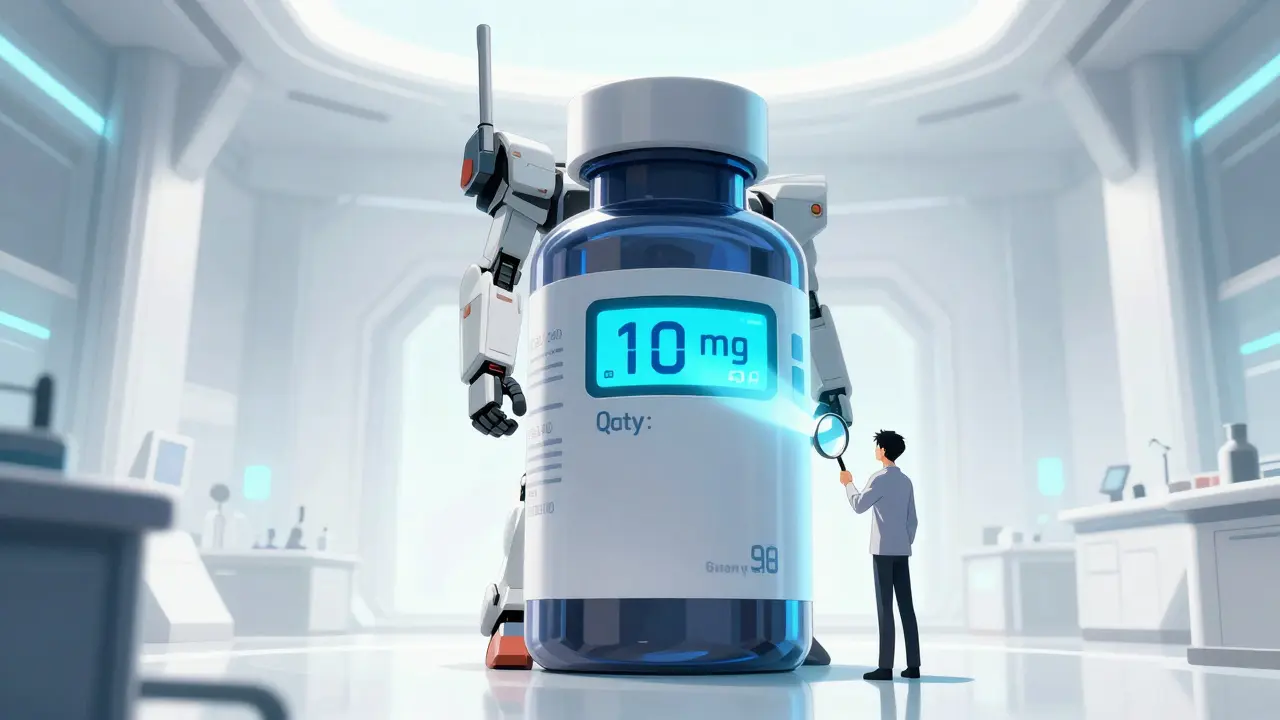
Imagine picking up a bottle of medicine. You glance at the label, see a number, and assume it’s correct. But what if that number is off by a factor of ten? What if you’re taking five times your intended dose because the decimal point was hard to spot? This isn’t just a hypothetical scare tactic. Medication errors are mistakes in prescribing, dispensing, or administering drugs that can lead to patient harm contribute to thousands of deaths annually in the United States. The good news? You hold the final line of defense. Learning how to read your prescription label accurately is one of the most powerful things you can do for your health.
We often trust pharmacies implicitly-and for the most part, we should. They are highly regulated environments with multiple checks. However, human error happens. A study by the Institute for Safe Medication Practices found that patients who actively verify their medication strength prevent about 28% of potential dosing errors. It takes less than a minute to check your label, but that minute could save you from serious side effects or hospitalization. Let’s break down exactly where to look, what those numbers mean, and how to catch mistakes before they happen.
Understanding the Core Elements of a Prescription Label
Every prescription label in the U.S. must follow strict guidelines set by the U.S. Food and Drug Administration (FDA) is the federal agency responsible for protecting public health by ensuring the safety, efficacy, and security of human and veterinary drugs. While designs vary between chains like CVS, Walgreens, and independent pharmacies, the core information remains standardized. To check your meds effectively, you need to know three specific data points: the drug name, the strength, and the quantity.
The drug name is usually the first thing you see. It might be the brand name (like Lipitor) or the generic name (atorvastatin). Sometimes both appear. Next to or below the name is the strength. This tells you how much active ingredient is in each single dose unit. Finally, the quantity tells you how many units are in the entire bottle. Confusing strength with quantity is the most common mistake people make, so let’s look closer at how to distinguish them.
Decoding Medication Strength: mg, mcg, and mL
Strength is not the total amount of medicine in the bottle. It is the concentration per pill, capsule, or teaspoon. For solid medications like tablets and capsules, strength is typically measured in milligrams (mg is a metric unit of mass equal to one-thousandth of a gram, commonly used for medication dosage) or micrograms (mcg is a metric unit of mass equal to one-millionth of a gram, often used for potent hormones or vitamins).
- Milligrams (mg): Used for most common drugs. For example, "500 mg" means each tablet contains 500 milligrams of the active ingredient.
- Micrograms (mcg): Used for very potent medications. Remember, 1 mg equals 1,000 mcg. Confusing these two can lead to a thousand-fold overdose or underdose.
- International Units (IU): Often used for vitamins like Vitamin D or insulin. These measure biological effect rather than weight.
Liquid medications are trickier. Their strength is expressed as a ratio, such as "250 mg/5 mL." This means there are 250 milligrams of medicine in every 5 milliliters (roughly one teaspoon). If the label says "5 mg/mL," there are 5 milligrams in every single milliliter. Always check if the denominator matches your measuring device. If your doctor prescribed 5 mL doses, ensure your cup has clear markings for that volume.
Distinguishing Strength from Total Quantity
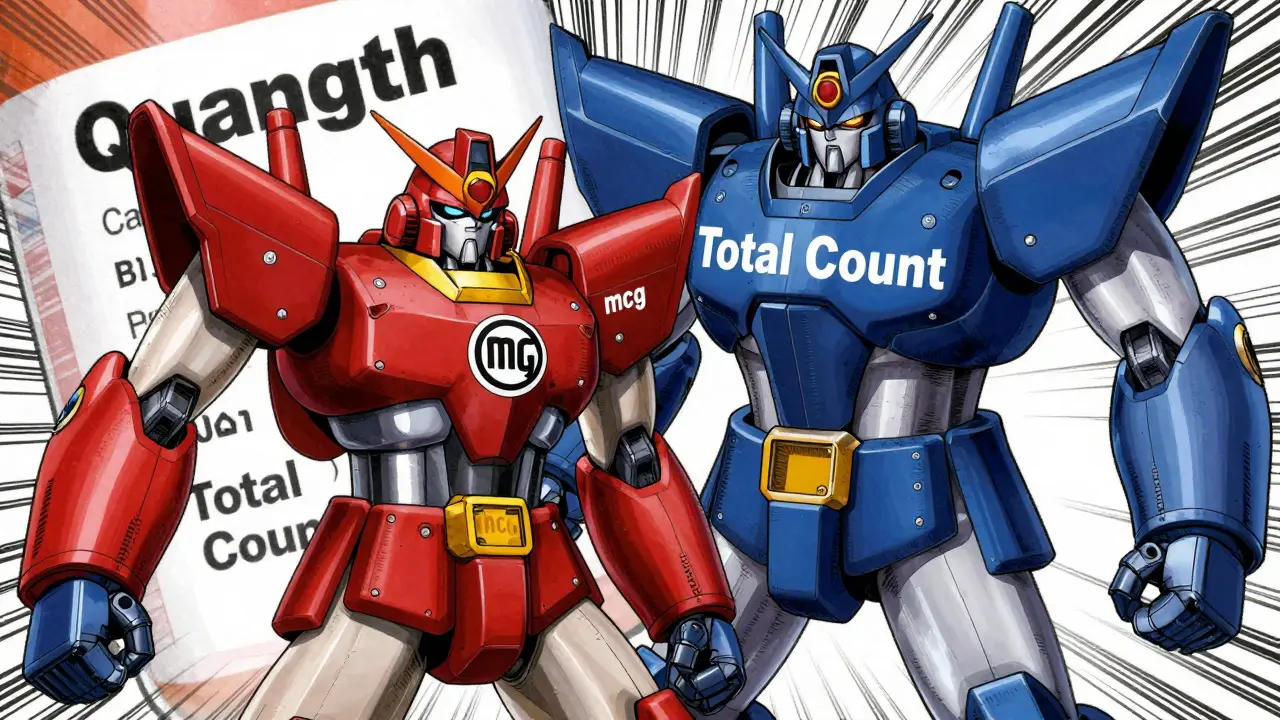
This is where most errors occur. Patients often look at the big bold number on the label and assume it’s the dose. In reality, that large number is usually the total quantity dispensed.
| Label Section | What It Means | Example Format |
|---|---|---|
| Strength | Amount of drug per single dose | 10 mg, 500 mg/cap, 250 mg/5 mL |
| Quantity | Total number of doses/volume in bottle | 30 tablets, 120 mL, 60 capsules |
For instance, if you pick up a blood pressure medication, the label might say "Lisinopril 10 mg" followed by "Qty: 90 Tablets." Do not take 90 pills at once. The "10 mg" is what you swallow daily. The "90" is how long your supply will last (likely 90 days). If you see "Dispense: #90," that confirms the count. Always cross-reference the small print next to the drug name (strength) with the larger print near the bottom (quantity).
Step-by-Step Verification Process
Developing a habit of checking your meds takes practice. Here is a simple four-step routine recommended by the Agency for Healthcare Research and Quality:
- Locate the Strength: Find the drug name. Look immediately adjacent to it. The strength should be within an inch of the name. If it’s missing or unclear, do not leave the counter.
- Check the Units: Is it mg or mcg? Is it per tablet or per milliliter? A decimal point matters immensely. 0.5 mg is ten times smaller than 5 mg. Misreading decimals accounts for nearly 19% of fatal pediatric dosing mistakes.
- Verify the Quantity: Count the pills if possible, or check the fluid level. Does the bottle look half-empty when it should be full? For liquids, shake gently and check the meniscus (the curve of the liquid) against the measurement lines.
- Cross-Reference Your Records: Pull out your original prescription slip or electronic record from your doctor’s portal. Does the strength match what you expect? If your doctor wrote "Amoxicillin 250 mg" but the label says "500 mg," stop. Call the pharmacy.
It may feel awkward to double-check, but pharmacists appreciate it. It signals that you are engaged in your own care. In fact, 78% of patients report feeling more confident after learning to verify these details.
Common Pitfalls and How to Avoid Them
Even careful readers fall into traps. One major issue is Look-Alike/Sound-Alike (LASA) medications are drugs with similar names or packaging that can be confused, leading to dispensing errors. For example, Celexa and Celebrex sound alike but treat completely different conditions. Another pitfall is confusing the total volume of a liquid with the dose volume. A bottle containing 120 mL does not mean you drink 120 mL at once; it means you have enough for many doses.
Low vision is another barrier. Over 60% of patients complain about tiny font sizes. If you struggle to read the label, ask for a high-contrast label or large-print option. Most chain pharmacies offer this automatically for Medicare Part D beneficiaries. You can also use your smartphone’s camera app to zoom in on the text. Some apps even allow you to scan the barcode to pull up digital instructions, which often display strength and quantity in larger, clearer formats.
Compounded medications pose unique challenges. These are custom-made drugs prepared by a pharmacist. Only about 63% of compounded labels clearly display strength information according to recent FDA studies. If you receive a compounding, always ask the pharmacist to verbally confirm the strength and write it clearly on the label if it’s ambiguous.
When to Call the Pharmacy Immediately
You don’t need to be a medical expert to spot red flags. Call your pharmacist if:
- The pill looks different from what you took before (different color, shape, or imprint).
- The strength on the label differs from your previous refill.
- The instructions are vague, such as "take as needed" without specifying limits.
- You cannot find the strength or quantity on the label.
- The expiration date is sooner than expected (usually 1 year from fill date).
Pharmacists are accessible resources. They can explain why a strength changed (perhaps due to insurance formulary updates) or clarify complex dosing schedules. Never guess. If something feels off, it probably is. A quick call prevents a trip to the emergency room.
The Future of Label Safety
Technology is helping bridge the gap. By 2026, many pharmacies are implementing enhanced labeling standards, including color-coded borders for high-alert medications. QR codes are becoming standard, linking directly to the FDA’s medication guides. Some forward-thinking chains are testing NFC tags that allow you to tap your phone to the bottle and instantly see verified strength and usage instructions. While these tools help, they supplement-not replace-your visual check. Human vigilance remains the gold standard.
Remember, you are the last checkpoint. The prescriber writes the order, the pharmacist verifies and dispenses it, but you administer it. Taking 30 seconds to decode the strength and quantity ensures that the medicine heals rather than harms. Make it a ritual. Every time you pick up a script, pause, look, and verify. Your health depends on it.
Where is the medication strength located on a prescription label?
The medication strength is typically located immediately next to or below the drug name. Federal regulations require it to be clearly visible. For example, if the drug is Amoxicillin, the strength "500 mg" will appear right beside it. In some pharmacy chains, it may be in parentheses following the name.
What is the difference between mg and mcg on a label?
mg stands for milligram, and mcg stands for microgram. One milligram equals 1,000 micrograms. This is a critical distinction. Confusing the two can result in a dose that is 1,000 times too strong or too weak. Always check the letter suffix carefully.
How do I read the strength of a liquid medication?
Liquid strengths are written as a ratio, such as 250 mg/5 mL. This means there are 250 milligrams of active ingredient in every 5 milliliters of liquid. You must use a proper measuring device (like an oral syringe or dosing cup) to ensure you get the exact volume specified by your doctor.
What does "Qty" mean on my prescription label?
"Qty" stands for Quantity. It indicates the total number of units (tablets, capsules) or total volume (mL, grams) dispensed in the container. It does not tell you how much to take at one time. That information is found in the "Directions" section.
Should I check my pill imprint against the label?
Yes. The American Medical Association recommends visually confirming that the pill’s appearance matches expectations. Many pills have unique imprints (letters or numbers) that correspond to their strength and manufacturer. If the pill looks different from your previous refill, contact your pharmacist before taking it.
What if the label is too small for me to read?
You can request a large-print or high-contrast label. Most major pharmacy chains offer this service, especially for Medicare patients. You can also use your smartphone camera to zoom in on the text or ask the pharmacist to verbally confirm the strength and quantity while handing you the bottle.
Is it safe to rely on QR codes for medication info?
QR codes are a helpful supplementary tool that link to official FDA guides or pharmacy databases. However, they should not replace visual inspection of the physical label. Always verify the printed strength and quantity on the bottle itself, as the QR code provides general information, not specific dispensing details for your individual bottle.
Why do some labels have decimal points like 0.5 mg?
Decimal points indicate fractions of a milligram. 0.5 mg is half a milligram. These are common for potent drugs like thyroid medication or heart drugs. Misplacing or missing the decimal point is a leading cause of serious medication errors. Always read the decimal carefully and compare it to your previous prescriptions.