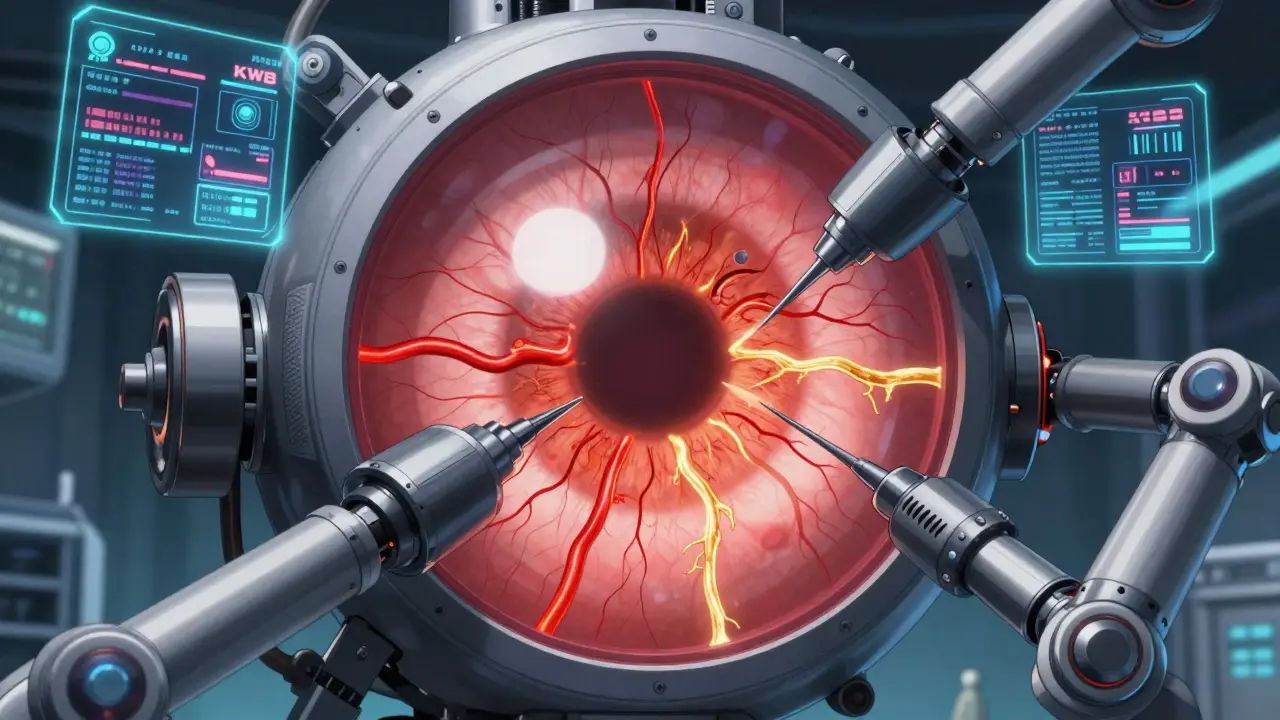
When your blood pressure stays too high for too long, it doesn’t just strain your heart and arteries-it starts eating away at the tiny blood vessels in your eyes. This isn’t a distant risk. It’s happening right now to millions of people who don’t even realize their vision is under attack. Hypertensive retinopathy is the name for this silent damage, and it’s one of the most reliable warning signs that your body is in trouble.
What Exactly Is Hypertensive Retinopathy?
Hypertensive retinopathy happens when high blood pressure (hypertension) causes physical changes in the retina-the light-sensitive layer at the back of your eye. The retina has a dense network of tiny blood vessels that supply oxygen and nutrients. When pressure in those vessels gets too high, their walls thicken, narrow, and sometimes leak. Over time, this cuts off blood flow, damages nerve cells, and leads to vision problems.
It’s not something you feel at first. Most people with early-stage hypertensive retinopathy have no symptoms. That’s why it’s called a silent killer. But by the time you notice blurry vision or dark spots, the damage may already be advanced. The good news? If caught early, this damage can often be reversed.
The Four Stages of Retinal Damage
Doctors use the Keith-Wagener-Barker (KWB) system to grade how bad the damage is. It’s simple, but powerful:
- Grade 1: Just mild narrowing of the retinal arteries. No bleeding or leaks yet. This can happen after just 3 years of uncontrolled blood pressure above 140/90 mmHg.
- Grade 2: More narrowing, plus arteriovenous nicking-where arteries press down on veins like a knot. This is a clear sign that pressure has been high for a while. About 22% of people with long-term hypertension show this by age 50.
- Grade 3: Now you see hemorrhages (tiny bursts of blood), cotton wool spots (white patches from nerve damage), and hard exudates (yellowish lipid deposits). These mean the blood-retinal barrier is breaking down. Vision may start getting blurry.
- Grade 4: The worst. Swelling of the optic nerve (papilledema), which means pressure is so high it’s affecting the brain too. This is malignant hypertension. At this stage, stroke risk jumps by 78%, and sudden vision loss can happen within hours.
Grade 4 isn’t just an eye problem. It’s a medical emergency. Patients often have kidney failure, heart strain, or brain swelling. If your blood pressure hits 180/120 mmHg or higher and you suddenly can’t see clearly, don’t wait. Go to the ER.
What You Might Notice (And What You Won’t)
Here’s the scary part: 68% of people with Grade 1 or 2 retinopathy feel nothing at all. No pain. No blurriness. No warning. But by Grade 3, 85% report vision problems-usually blurred or double vision. Some describe a "curtain" coming down over part of their vision. Others wake up with dark spots in the center of their sight.
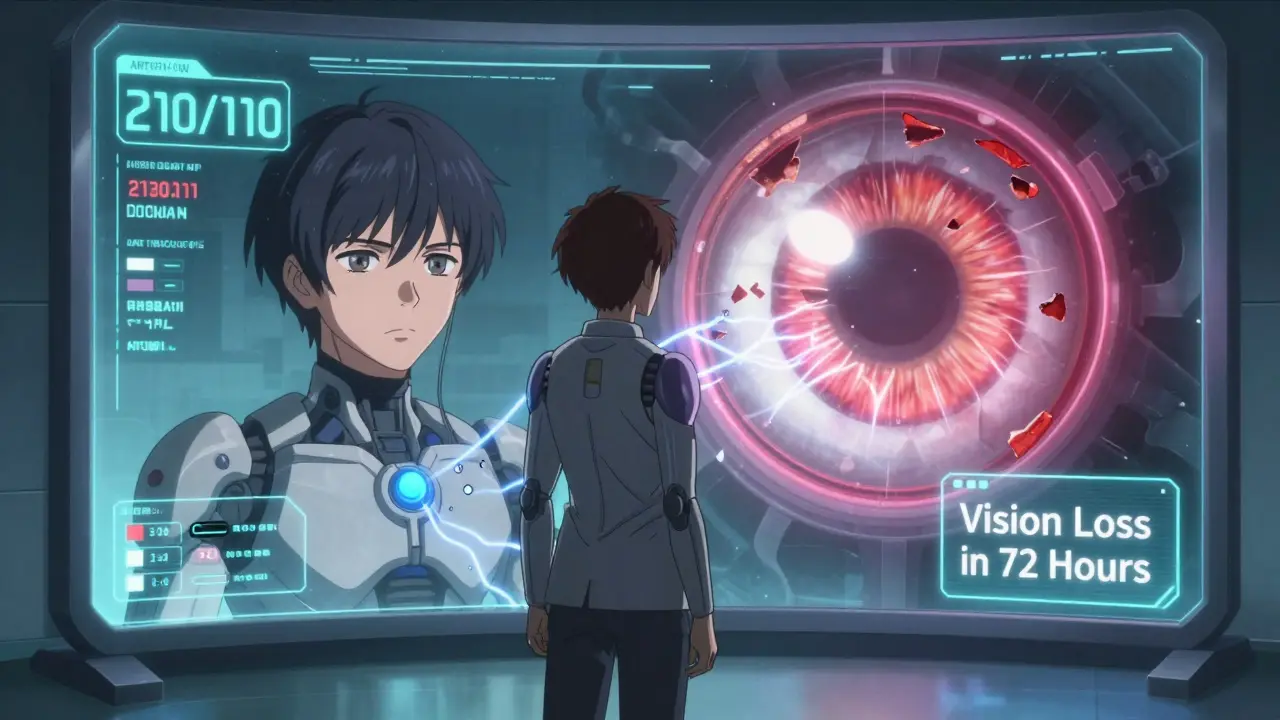
Reddit threads from patients show real experiences: "u/RetinaWarrior" wrote about waking up with central vision loss after their BP hit 210/110. Another user in r/Hypertension said they got double vision with crushing headaches-something they ignored for months. By the time they saw a doctor, they had Grade 3 damage.
Why the delay? Most people don’t connect eye changes to blood pressure. Only 15% link vision issues to hypertension without a doctor pointing it out. That’s why routine eye exams are critical-even if you feel fine.
How Doctors Spot It
An ophthalmologist can see the damage during a simple eye exam with a light and magnifying lens (fundoscopy). But modern tools make detection sharper:
- Optical Coherence Tomography (OCT): This scan measures retinal thickness. In exudative stages, the retina swells by 10-15%.
- AI-assisted imaging: Systems like IDx-DR and RetinaCheck AI (FDA-cleared in 2022) now analyze retinal photos with 92% accuracy-up from 75% with human eyes alone.
- Fluorescein angiography: A dye is injected to track blood flow. It’s invasive but still used for complex cases.
What’s surprising? Even "mild" hypertension-systolic pressure between 130-139 mmHg-can cause damage if left untreated for over 10 years. That’s a shift from older thinking. No more "it’s not bad yet" excuses.
Why Your Eyes Are a Window to Your Whole Body
Your retina is the only place in your body where doctors can see blood vessels directly. No surgery. No needles. Just light.
That’s why retinal changes predict bigger problems:
- People with hypertensive retinopathy have a 2.5x higher risk of heart attack or stroke.
- Arteriovenous nicking and optic disc swelling mean a 3.2x higher stroke risk.
- Patients with Grade 3 or 4 retinopathy are far more likely to have kidney disease or heart failure.
The American Heart Association calls this a "window to systemic vascular health." If your eyes show damage, your heart, brain, and kidneys are likely under stress too.
Can It Be Reversed?
Yes-but only if you act fast.
Controlling blood pressure is the only real treatment. No eye drops. No surgery. Just lowering your numbers.
- Reducing systolic BP by 25 mmHg within 24-48 hours resolves acute retinal changes in 65% of cases.
- Vision improvement often starts within 7-10 days of BP control.
- Macular damage (the center of your vision) can take 3-6 months to heal, if at all.
- 22% of patients end up with permanent vision loss, even with perfect treatment.
For Grade 4? Immediate hospitalization is needed. Blood pressure must be lowered slowly to avoid stroke. Rushing it can cause more harm.
Medication choice matters too. The European Society of Cardiology found ACE inhibitors reduce retinal damage progression by 32% compared to calcium channel blockers. If you’re on meds, ask your doctor if yours is the best for your eyes.
Who’s at Risk?
It’s not just older adults. About 13.9% of U.S. adults have stage 2 hypertension (BP ≥140/90 mmHg)-that’s roughly 19.2 million people. And 7.3% of all adults have retinal damage from it.
High-risk groups:
- People with BP over 160/100 mmHg for more than 5 years
- Those with resistant hypertension (BP still high after 3 medications)
- Diabetics with high BP-4.7x higher risk of permanent vision loss
- People who skip regular eye exams
And here’s a wake-up call: The American Heart Association now recommends eye exams every 6 months for people with resistant hypertension. That’s new. It used to be yearly.
What You Can Do Right Now
You can’t undo years of damage overnight. But you can stop it from getting worse.
- Check your BP at home. Use a validated monitor. Track it daily. A single reading won’t help. You need trends.
- Get your eyes checked annually. Even if you don’t wear glasses. Ophthalmologists spot retinopathy before you feel symptoms.
- Take your meds. Every day. 70% of people stick to their regimen when they link it to eye health.
- Know your numbers. Systolic (top number) above 130? Diastolic (bottom) above 80? That’s not "borderline." That’s early warning.
- Ask about ACE inhibitors. If you’re on BP meds, ask if switching could help your eyes.
There’s no magic pill. No supplement. No detox. Just consistent, disciplined blood pressure control. The American Heart Association’s "Check. Change. Control." program shows patients who understand the eye connection manage their BP 35% better.
The Future Is Here
New tech is making early detection easier. The RetiFlow system (completed Phase 3 trials in September 2023) can measure retinal blood flow without dye-94% accurate. NIH’s RETINA-HTN study (launched May 2023) is hunting for genetic markers that predict who’s most vulnerable. That could lead to personalized screening.
But none of this matters if you ignore your blood pressure. The eye doesn’t lie. If your retina shows damage, your whole body is in danger. And unlike a heart attack, you don’t get a second chance with vision.
Stephanie Paluch
March 14, 2026 AT 22:33Just got my annual eye exam and my doc said my retinal vessels look fine-thank god. But I’ve been tracking my BP at home since last year and it’s dropped from 152/94 to 124/82. No meds, just walking 30 mins daily and cutting sugar. I didn’t realize how much my eyes were silently screaming until I started paying attention.
So glad this post exists. We need more real talk like this.
Sabrina Sanches
March 16, 2026 AT 13:39I’ve been living with hypertension for 12 years and never once thought about my eyes
Now I’m scheduling an OCT scan tomorrow
Thank you for this
tynece roberts
March 18, 2026 AT 10:16so like… i had blurry vision for months and thought it was just stress or my phone screen too bright
turns out my bp was 168/102
my doc said my retina looked like a cracked sidewalk
im now on lisinopril and i swear i can see the color of grass again
also i hate my meds but i’d rather take a pill than go blind
Hugh Breen
March 18, 2026 AT 13:38THIS IS A GAME CHANGER. I’ve been telling my patients for years: your eyes are the first warning system. But most people don’t listen until they lose vision.
Here’s the truth: if your retina is damaged, your brain is already on fire.
Stop waiting for a heart attack to wake you up. Your eyes are screaming. Listen.
And if you’re on a calcium channel blocker? Ask your doc about ACE inhibitors. They’re not just for blood pressure-they’re for your future vision. I’ve seen patients regain 70% of lost clarity after switching. It’s not magic. It’s science.
Byron Boror
March 20, 2026 AT 00:40U.S. healthcare is a joke. You have to be almost blind before anyone takes your BP seriously. I had Grade 2 retinopathy at 34 and was told to "try yoga". Meanwhile, my cousin got a stroke because her doctor said "it’s just stress".
Stop blaming individuals. Fix the system.
Lorna Brown
March 20, 2026 AT 14:31It’s fascinating how the body uses the retina as a diagnostic mirror. We don’t just treat symptoms-we’re seeing the systemic narrative of vascular health unfold in real time.
What if retinal damage isn’t just a consequence of hypertension, but a signal of deeper metabolic dysregulation? The fact that ACE inhibitors outperform other drugs suggests we’re still underestimating the role of endothelial inflammation.
Maybe the real cure isn’t lowering numbers-but restoring vascular integrity.
Rex Regum
March 20, 2026 AT 16:21Oh wow, so now I’m supposed to believe that a 130/80 BP is "early warning"? That’s not hypertension, that’s normal for someone who eats veggies and walks.
And AI detecting retinal damage? Yeah right. Last time I checked, a 40-year-old with a 135 systolic had "early damage"? That’s fearmongering dressed up as science.
Next they’ll say your toenail fungus is a sign of impending stroke.
Kelsey Vonk
March 22, 2026 AT 03:49I’ve been reading about this for weeks now…
I didn’t know my BP was high until my mom had a stroke last year.
She’s okay now, but she lost some vision.
I started checking mine daily. It’s been 138/88 for months.
I’m not on meds yet. But I’m cutting processed food, sleeping 7 hours, and walking after dinner.
It’s scary to think this could be silent…
But also… hopeful? Like maybe I still have time.
Emma Nicolls
March 23, 2026 AT 04:42so i just got my first eye exam in 5 years and the doc said my arteries look like theyve been through a war
im 31
my bp was 156/98
im scared but also like… wow this is real
im starting tomorrow
no more soda
no more skipping meds
im gonna live
Richard Harris
March 23, 2026 AT 23:39My GP never mentioned eye exams until I asked. I’m 58, have had BP issues since 40, and never had a retinal check. Now I’m scheduled for OCT next week.
Thank you for the push.
Also-why is this not standard? It’s cheaper than a mammogram and more predictive.
Kandace Bennett
March 24, 2026 AT 12:51Oh sweetie, you’re telling me I need to get my eyes checked because of high blood pressure? Honey, I’ve been doing keto since 2019, I’ve lost 70 pounds, and I meditate daily. My BP is fine. 😘
Also, I’ve been told my "retina" looks like a masterpiece of resilience. 💖
So no, I’m not getting scanned. I’m a wellness warrior. 🌿✨
Tim Schulz
March 26, 2026 AT 06:02Oh wow. So the solution to 19 million Americans with hypertension is… more doctor visits? 😂
Let me guess-next they’ll tell us to buy a $1200 OCT machine for our living room?
Meanwhile, in the real world, people are choosing between insulin and groceries. But sure, let’s all get our retinas scanned. 💅
Also, ACE inhibitors? Yeah, because that’s not a 300% markup from Big Pharma. 😌
Jinesh Jain
March 27, 2026 AT 09:55I work in a rural clinic in India. We don’t have OCT or AI. We have a basic ophthalmoscope and a BP cuff.
But we still catch Grade 2 and 3 retinopathy every week.
People here don’t have time to wait for tech. They need simple, clear advice.
Check BP. Take meds. Eat less salt.
That’s it.
douglas martinez
March 27, 2026 AT 20:37As a healthcare provider, I want to emphasize that early detection saves vision and lives. The data presented here is robust and clinically validated.
Patients who engage with retinal screening show 40% better long-term BP adherence.
It is not an optional wellness activity-it is a critical component of cardiovascular risk management.
I urge all patients with hypertension to request fundoscopy at every visit. Do not wait for symptoms.
Katherine Rodriguez
March 29, 2026 AT 03:37Why are we even talking about this? If you’re too lazy to control your BP, don’t blame the system. Just don’t have kids. Problem solved.
Sabrina Sanches
March 30, 2026 AT 04:43Just read your comment about the 31-year-old. I was 32 when I got diagnosed. I thought I was invincible. Now I check my BP every morning. I don’t skip meds. I walk. I sleep. I’m alive because I listened. You’ve got this.