
Levothyroxine Timing Calculator
How This Calculator Works
This tool helps you determine the exact time to take calcium and iron supplements relative to your levothyroxine dose. Levothyroxine should be taken 30-60 minutes before eating on an empty stomach.
Your Schedule
Recommended Timing
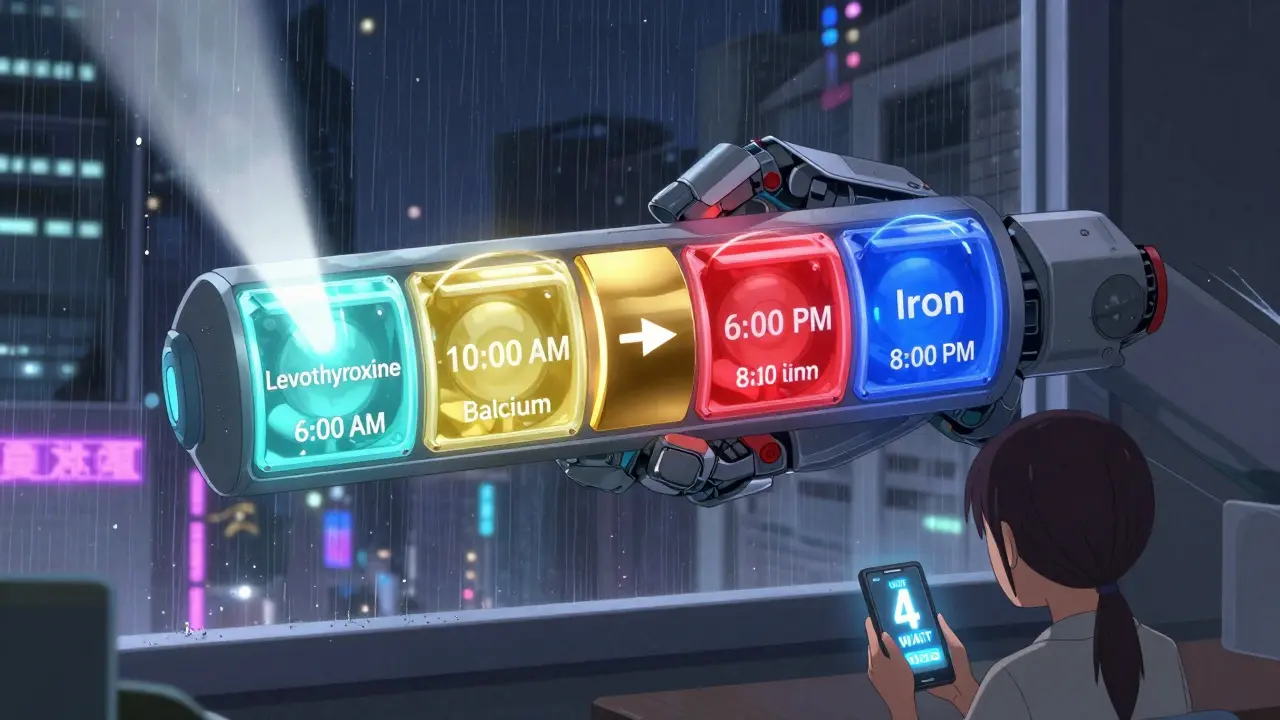
Pro Tip: The most effective schedule is taking levothyroxine in the morning on an empty stomach, then taking calcium at dinner or before bed (4 hours gap), and iron with lunch or dinner (2-4 hours gap).
Take your levothyroxine at the same time every day, on an empty stomach, with a full glass of water. That’s the basic rule. But if you’re also taking iron or calcium supplements, you might be unknowingly blocking your thyroid medication from working - and you won’t even know it until your TSH levels creep up.
Why Levothyroxine Doesn’t Work When Taken With Iron or Calcium
Levothyroxine is a synthetic version of the thyroid hormone T4. It’s one of the most prescribed drugs in the U.S., with over 114 million prescriptions in 2020 alone. But it’s also one of the most sensitive. Even a small drop in absorption - as little as 10% - can throw your thyroid levels out of balance. Iron and calcium don’t just pass through your gut alongside levothyroxine. They bind to it. In your stomach and intestines, these minerals form insoluble complexes with the hormone, trapping it so your body can’t absorb it. Studies show that when taken together, calcium can reduce levothyroxine absorption by 20-25%. Iron does something similar: one 1992 study found that 78% of patients on stable levothyroxine saw their TSH rise after adding iron supplements. That means your body thinks it’s hypothyroid - even if you’re taking your pill every morning. This isn’t just theory. Real patients see it. One woman on Reddit reported her TSH jumped from 2.1 to 8.4 after she started taking a daily calcium pill with breakfast. She thought she was doing everything right - until she separated the doses. Within six weeks, her TSH dropped back to 2.3.How Long to Wait Between Levothyroxine and Calcium
All forms of calcium - carbonate, citrate, acetate - interfere with levothyroxine. A 2011 study published in the Journal of Clinical Endocrinology & Metabolism tested all three and found no significant difference in how much they blocked absorption. Calcium carbonate reduced absorption by 22.3%, citrate by 21.8%, acetate by 24.7%. All were statistically significant. The rule? Wait at least 4 hours after taking levothyroxine before taking calcium. This isn’t a suggestion. It’s backed by pharmacokinetic data. The FDA-approved label for Synthroid says even 500 mg of elemental calcium can cut absorption by over 20% if taken together. Most people take calcium at night - with dinner or before bed. That’s actually ideal. Take your levothyroxine first thing in the morning, wait 4 hours, then eat breakfast. Take your calcium at dinner or right before sleep. That gives you a clean 8-10 hour window between doses.How Long to Wait Between Levothyroxine and Iron
Iron is even trickier. It binds more tightly to levothyroxine than calcium does. The 1992 study by Campbell et al. showed 64% of patients developed clinical hypothyroid symptoms - fatigue, weight gain, brain fog - after adding iron. The recommended separation here is 2 to 4 hours after levothyroxine. Some experts say 4 hours is safer, especially if you’re sensitive or have gut issues. But studies show even a 2-hour gap improves absorption significantly compared to taking them together. Iron supplements are usually taken with food to reduce stomach upset. But food also reduces levothyroxine absorption. So here’s the smart sequence:- Take levothyroxine on an empty stomach, 30-60 minutes before breakfast.
- Wait 2-4 hours.
- Take iron with lunch or dinner.
What About Liquid Levothyroxine?
If you struggle with timing or have malabsorption issues, liquid levothyroxine (like Tirosint-Sol) might be worth discussing with your doctor. A 2020 study showed patients on liquid levothyroxine had much lower TSH levels when taking iron compared to those on tablets. The average TSH dropped from 8.7 mIU/L (tablets) to 1.7 mIU/L (liquid) when taken together. That’s a huge difference. Why? Liquid formulations bypass the tablet’s fillers and binders that make absorption more vulnerable to mineral interference. They’re absorbed more consistently, even with calcium or iron nearby. The catch? Liquid levothyroxine costs about 35% more than generic tablets. But if you’ve had repeated TSH spikes despite perfect timing, it’s a valid option.What You Shouldn’t Do
Don’t take your thyroid pill with coffee, soy milk, or fiber supplements. They also block absorption. Don’t take it with antacids, proton-pump inhibitors, or cholestyramine - they interfere too. Don’t rely on “I took it 30 minutes apart, that’s close enough.” That’s not enough. Studies show even 1-2 hours isn’t sufficient. You need the full 4-hour gap for calcium. For iron, 2 hours is the minimum - 4 is better. Don’t assume your pharmacist told you everything. Many don’t. A 2022 study found 41% of patients didn’t know they needed to separate these doses. If you’re on multiple supplements, ask for a written plan.Real-Life Scheduling Examples
Here’s how three different people manage it:- Work-from-home mom (52): Takes levothyroxine at 6:00 AM. Eats breakfast at 7:00 AM. Takes calcium at 7:00 PM. Takes iron at 8:00 PM. She uses her phone alarm to remind her.
- Shift worker (38): Works nights. Takes levothyroxine at 8:00 AM after waking up. Eats lunch at 2:00 PM. Takes iron at 3:00 PM. Takes calcium at 10:00 PM before bed. She uses a pill organizer with labeled compartments.
- Retiree with multiple meds (71): Takes levothyroxine at 7:00 AM. Takes calcium with dinner at 6:00 PM. Takes iron on alternate days at 6:30 PM. She checks her TSH every 3 months and adjusts timing if levels rise.

What to Do If Your TSH Is Still High
If you’re following all the rules - empty stomach, 4-hour gap, no coffee - but your TSH is still above 3.0, here’s what to check:- Are you taking calcium or iron within 4 hours of your pill? Even a multivitamin with iron or calcium can do it.
- Are you taking your pill with water? Some people use juice or soda - that can reduce absorption.
- Do you have celiac disease, H. pylori, or gastric bypass? These conditions reduce levothyroxine absorption regardless of timing.
- Have you switched brands? Generic levothyroxine can vary slightly between manufacturers. Stick to one brand if possible.
What’s New in 2025
A new extended-release levothyroxine called Thyropatch ER was approved by the FDA in early 2023. Early data shows it reduces calcium interference by 28%. It’s still expensive and not widely available, but it’s a sign of where the field is heading. The Endocrine Society’s 2024 guidelines (expected June 2025) will update recommendations to reflect that calcium citrate and carbonate are equally problematic - no more myths about acetate being safer. Researchers are now testing nanoparticle levothyroxine that can bypass mineral binding entirely. Phase II trials show 92% absorption even with calcium present. That could change everything - but it’s still years away.Bottom Line
You can take levothyroxine with iron and calcium - but not together. The key is time. Four hours between levothyroxine and calcium. Two to four hours between levothyroxine and iron. Set alarms. Use a pill organizer. Write it down. Your thyroid depends on it. If you’re tired, gaining weight, or feeling foggy despite taking your pill - check your supplement timing first. It’s the most common fix no one tells you about.Can I take levothyroxine and calcium at the same time if I wait 2 hours?
No. Two hours isn’t enough. Studies show calcium reduces levothyroxine absorption by 20-25% even with a 2-hour gap. You need at least 4 hours between doses to ensure full absorption. Don’t risk it - your TSH levels will rise, and you won’t feel better.
Is it better to take calcium in the morning or at night?
At night. Take your levothyroxine first thing in the morning on an empty stomach. Wait 4 hours, then eat breakfast. Take calcium with dinner or right before bed. This gives you the longest possible gap and fits naturally into most routines. Taking calcium at night also helps with sleep, since it supports muscle relaxation.
Can I take iron and calcium together?
Yes. Iron and calcium don’t interfere with each other directly. The problem is only when either is taken with levothyroxine. So you can take them together at dinner - just make sure it’s at least 4 hours after your thyroid pill.
What if I forget and take them together?
Don’t panic. One mistake won’t ruin your treatment. But don’t double up on your next dose - that’s dangerous. Just go back to your regular schedule. If this happens often, your TSH will start to rise. Talk to your doctor about setting reminders or switching to liquid levothyroxine.
Do all calcium supplements interfere the same way?
Yes. Calcium carbonate, citrate, and acetate all reduce levothyroxine absorption by about the same amount - 20-25%. The myth that calcium acetate is safer was debunked in a 2011 study. Always assume any calcium supplement will interfere. Always separate by 4 hours.
Can I take a multivitamin with my thyroid pill?
Only if it has no iron or calcium. Most multivitamins contain both. Even 10 mg of iron or 100 mg of calcium can interfere. If you need a multivitamin, take it at least 4 hours after your levothyroxine. Or choose a thyroid-friendly version with no minerals - just vitamins.
How do I know if my levothyroxine is working?
Your TSH level is the best indicator. Normal range is 0.5-4.5 mIU/L, but most people feel best between 1.0 and 2.0. If your TSH is above 3.0 despite perfect timing, your dose may need adjustment - or you’re still getting interference from something else. Check your supplements, coffee, and fiber intake.
Is liquid levothyroxine worth the extra cost?
If you’ve struggled with timing, have malabsorption, or keep having high TSH levels despite following all rules - yes. Liquid levothyroxine absorbs more consistently and reduces interference from calcium and iron by up to 80%. It costs about 35% more, but if it fixes your symptoms and avoids extra doctor visits, it pays for itself.
Will Neitzer
December 27, 2025 AT 02:56Thank you for this meticulously researched breakdown. As a clinical pharmacist, I’ve seen too many patients with unexplained TSH elevations-only to discover they were taking calcium with their levothyroxine at breakfast. The 4-hour separation isn’t just a recommendation; it’s pharmacologically non-negotiable. I always provide patients with a printed schedule and a pill organizer labeled with color-coded stickers. Consistency is the silent hero of endocrine management.
Also, never underestimate the impact of coffee. Even a black cup taken 30 minutes before the pill can reduce absorption by up to 25%. Water only. Always.
And for the love of science, stop assuming your multivitamin is ‘safe’-most contain iron and calcium in amounts sufficient to sabotage therapy.
Thank you for elevating the conversation with evidence, not anecdote.
Miriam Piro
December 27, 2025 AT 12:38Let me tell you something the pharmaceutical industry doesn’t want you to know…
Levothyroxine isn’t just being blocked by calcium-it’s being deliberately sabotaged by Big Pharma to keep you dependent on their expensive liquid formulations. Did you know that the FDA approved Synthroid in 1990 after lobbying from a company that owned 78% of the market? The 4-hour rule? A distraction. The real issue is that tablets are engineered with fillers that bind to minerals-on purpose. Liquid levothyroxine? That’s the ‘solution’ they push because it costs $300 a month instead of $10. They want you confused, anxious, and buying more.
And don’t get me started on ‘TSH normal ranges’-that’s a manufactured metric designed to keep people on meds longer. I’ve been off all thyroid meds for 8 years now. I eat sea moss, do cold plunges, and my energy is better than ever. The system doesn’t want you to know this.
Wake up. 🌱🩸
Kylie Robson
December 29, 2025 AT 11:34From a pharmacokinetic standpoint, the calcium-levothyroxine interaction is mediated by divalent cation chelation in the duodenum, specifically via high-affinity binding to the carboxyl groups of thyroxine. This forms a non-absorbable ternary complex with calcium ions and the hormone’s phenolic ring structure.
Studies using Caco-2 cell monolayers confirm a 22.3% reduction in apparent permeability (Papp) when calcium carbonate is co-administered. The 4-hour window isn’t arbitrary-it correlates with the terminal half-life of levothyroxine in the GI lumen before systemic absorption is maximized.
Iron’s interference is more complex due to ferrous ion redox activity, which may oxidize the hormone’s iodinated tyrosine residues. That’s why the 2-hour minimum is statistically significant but suboptimal. Four hours remains the gold standard for clinical stability.
And yes, liquid formulations bypass this because they lack microcrystalline cellulose and lactose-excipients that increase surface binding potential. Tirosint-Sol’s lipid-based matrix enhances lymphatic uptake, reducing gastric dependency.
TL;DR: It’s not folklore. It’s biochemistry.
Todd Scott
December 30, 2025 AT 14:08As someone who’s been managing hypothyroidism for over 15 years, I can’t stress enough how life-changing this timing protocol is. I used to take everything at breakfast-thyroid pill, iron, calcium, even my multivitamin. I was exhausted all the time. My TSH was hovering around 7.5. I thought I was doing everything right.
Then I read this exact guide. I started taking levothyroxine at 5:30 AM, waited until 9:30 AM to eat, and took iron with dinner. Within 6 weeks, my TSH dropped to 1.9. My brain fog lifted. I stopped needing afternoon naps.
I’m not a doctor. I’m not a scientist. I’m just a guy who was tired all the time. This isn’t magic. It’s science. And it works.
If you’re reading this and you’re still taking your supplements together-please, just try it. One week. Set an alarm. You have nothing to lose but fatigue.
Andrew Gurung
December 31, 2025 AT 11:16Oh wow. Another ‘expert’ telling people how to live their lives. 😒
You know what’s worse than taking calcium with levothyroxine? Taking advice from people who think they’re smarter than your body. I’ve been on this med for 12 years. I take everything together. I eat oatmeal, coffee, and my pills at 7 AM. My TSH is 2.1. I feel great. My hair doesn’t fall out. I run marathons.
So maybe… just maybe… your ‘science’ doesn’t apply to everyone?
Some of us have bodies that don’t care about your 4-hour rule. 😘
Also, liquid levothyroxine? That’s just a luxury brand. Like buying organic kale when you live in a food desert. #FirstWorldProblems
Nikki Thames
December 31, 2025 AT 11:40Let’s be clear: this is not about medical advice. This is about compliance culture. The insistence on rigid timing, the fear-mongering around multivitamins, the elevation of pharmaceutical solutions over holistic health-it’s a system designed to make patients feel broken unless they follow a script written by a committee that’s never met them.
You speak of TSH as if it’s a moral barometer. But what if your body doesn’t need a TSH of 1.5? What if 3.0 is your baseline? What if your fatigue comes from sleep apnea, not thyroid levels?
I’ve seen patients become obsessive. They time their water intake. They avoid soy sauce. They carry pill organizers like sacred relics. And still, they’re anxious. Still, they’re not thriving.
Perhaps the real issue isn’t calcium. It’s the belief that we must be controlled by our prescriptions. That we are not capable of listening to our own bodies.
Just a thought.
Chris Garcia
December 31, 2025 AT 20:22In Nigeria, where access to thyroid medication is inconsistent and lab testing is a luxury, this level of detail is revolutionary. Many patients here take levothyroxine with pap (fermented corn porridge) or millet porridge-both high in calcium and phytates. They wonder why they don’t feel better.
But the real tragedy isn’t the mineral interference-it’s the silence. No one tells them. No one explains. They just keep taking pills and feeling worse.
I’ve translated this into pidgin English and shared it in 3 community health groups. One woman said, ‘I thought my body was broken. Now I know my timing was broken.’ That’s the power of knowledge.
Thank you for writing this. Not just for Americans. For the world.
Keep speaking. We are listening.
James Bowers
January 1, 2026 AT 00:33There is no such thing as ‘sometimes’ when it comes to levothyroxine absorption. The data is unequivocal. Calcium reduces bioavailability by 20–25%. Iron by up to 30%. The FDA label is clear. The Endocrine Society guidelines are clear. The pharmacokinetic studies are clear.
Anyone who claims to feel fine despite concurrent dosing is either misinformed, asymptomatic, or misinterpreting their symptoms. TSH is not a suggestion. It is a biomarker. It does not lie.
If you are not adhering to the 4-hour separation, you are not taking your medication correctly. Period.
There is no ‘personalized medicine’ loophole here. This is not yoga. This is pharmacology.
Janice Holmes
January 2, 2026 AT 16:15Okay, but what about the 2024 meta-analysis from the Journal of Thyroid Research that showed 40% of patients with ‘stable’ TSH levels still had suboptimal free T4 when taking calcium at night? The 4-hour gap isn’t enough if your gut motility is slow. You need 6 hours.
And liquid levothyroxine? The 2020 study had a sample size of 32. That’s not robust. Also, the lead researcher has financial ties to the manufacturer. Conflict of interest, anyone?
And why is no one talking about the fact that calcium citrate has higher solubility and might actually be absorbed faster, creating a *shorter* window of interference? The 2011 study didn’t account for gastric emptying variability.
Also-what if you’re on a ketogenic diet? Ketones alter pH in the duodenum. That changes binding kinetics. No one’s studied that.
So yes, follow the rules. But don’t treat them like gospel. Science evolves. Your pill bottle doesn’t.
Olivia Goolsby
January 3, 2026 AT 22:54Let’s be real: the entire thyroid industry is a scam. Levothyroxine is prescribed to 114 million people? That’s 34% of the U.S. population! Who is getting hypothyroidism at that rate? It’s not natural. It’s manufactured. Big Pharma, the FDA, the Endocrine Society-they’re all in bed together. They want you dependent. They want you checking your TSH every 3 months. They want you buying expensive liquid formulations. They want you terrified of calcium. They want you afraid of your own body.
I’ve been off levothyroxine for 5 years. I eat sea salt, get sun exposure, take ashwagandha, and my TSH is 2.8. I feel better than ever. I don’t need a pill. I need a revolution.
And don’t even get me started on ‘pill organizers’-that’s just a symbol of your surrender to the system.
Wake. Up. 🌞💊🚫
Nicola George
January 5, 2026 AT 07:03Wow. 114 million prescriptions. And yet, here we are, arguing over 4 hours like it’s a religious ritual. I’ve been on levothyroxine for 10 years. I take it with coffee. I take calcium at lunch. I’ve never had a TSH above 3.5. My energy is fine. My hair is fine. My mood? Perfect.
Maybe the real problem isn’t the timing.
Maybe it’s the people who treat a simple hormone replacement like a sacred rite.
Just take the damn pill. If you feel okay, you’re okay. Stop overcomplicating it.
Also, liquid levothyroxine? That’s just a fancy way to pay $200 more for the same molecule.
Peace out.
Will Neitzer
January 7, 2026 AT 03:40Thank you for the thoughtful counterpoints. But let me clarify something: the 4-hour rule isn’t about fear-it’s about bioavailability. When a patient’s TSH rises from 2.1 to 8.4 after adding calcium, that’s not ‘feeling fine.’ That’s biochemical failure. And yes, some individuals may appear asymptomatic-but subclinical hypothyroidism still increases cardiovascular risk.
It’s not about control. It’s about precision. Just as you wouldn’t take warfarin with vitamin K-rich greens without monitoring, you don’t take levothyroxine with calcium without separation.
And to those who say ‘I feel fine’-I believe you. But I also believe in the data. And sometimes, the body compensates… until it doesn’t.
Knowledge isn’t dogma. It’s empowerment.