
Have you ever wondered why a medication that worked perfectly for your friend might leave you feeling dizzy or nauseous? Or perhaps you've noticed that a dose of painkiller that used to take the edge off now makes you overly sleepy. If you are over 65, this isn't just bad luck-it's biology. As we age, our bodies change in ways that drastically alter how they process medicines. Specifically, the liver and kidneys, which act as the body's filtration and processing plants, slow down significantly.
This slowdown means drugs stay in your system longer and at higher concentrations than expected. For many seniors, this leads to adverse drug reactions, which account for roughly 10% of hospital admissions among older adults. Understanding these physiological shifts is not just academic; it is a matter of safety. By knowing how your liver and kidneys handle medications differently now compared to when you were younger, you can work with your doctor to avoid dangerous side effects and ensure your treatments actually work.
The Liver: Your Body's Chemical Factory Slows Down
Your liver is responsible for breaking down most medications through a process called metabolism. Think of it as a busy factory where enzymes act as workers dismantling chemical structures so they can be excreted. In older adults, this factory undergoes significant structural changes. Research indicates that liver mass decreases by about 30% between ages 20 and 80. More critically, blood flow to the liver drops by approximately 40%. This reduced traffic means fewer drugs reach the 'workers' (enzymes) per minute, slowing down the entire operation.
There are two main types of drug metabolism, and aging affects them differently:
- Phase I Metabolism (The Breakdown Crew): This involves enzymes like Cytochrome P450 (CYP). Studies show activity here can decrease by 37-60% in older individuals. Drugs processed this way, such as diazepam (Valium) or warfarin, may linger in the body much longer.
- Phase II Metabolism (The Packaging Crew): Surprisingly, this stage remains relatively preserved in aging humans. Drugs like acetaminophen often don't see the same drastic slowdown here, though caution is still needed due to other factors.
A key concept to understand is first-pass metabolism. When you swallow a pill, it travels to the liver before entering general circulation. In younger people, the liver might remove 90% of a drug during this first pass. In older adults, because the liver is less efficient, more of the drug survives this trip and enters the bloodstream. This can lead to a 25-50% increase in bioavailability for certain drugs, effectively doubling the dose you feel without changing the pill strength.
Kidney Function: The Filtration Rate Declines Steadily
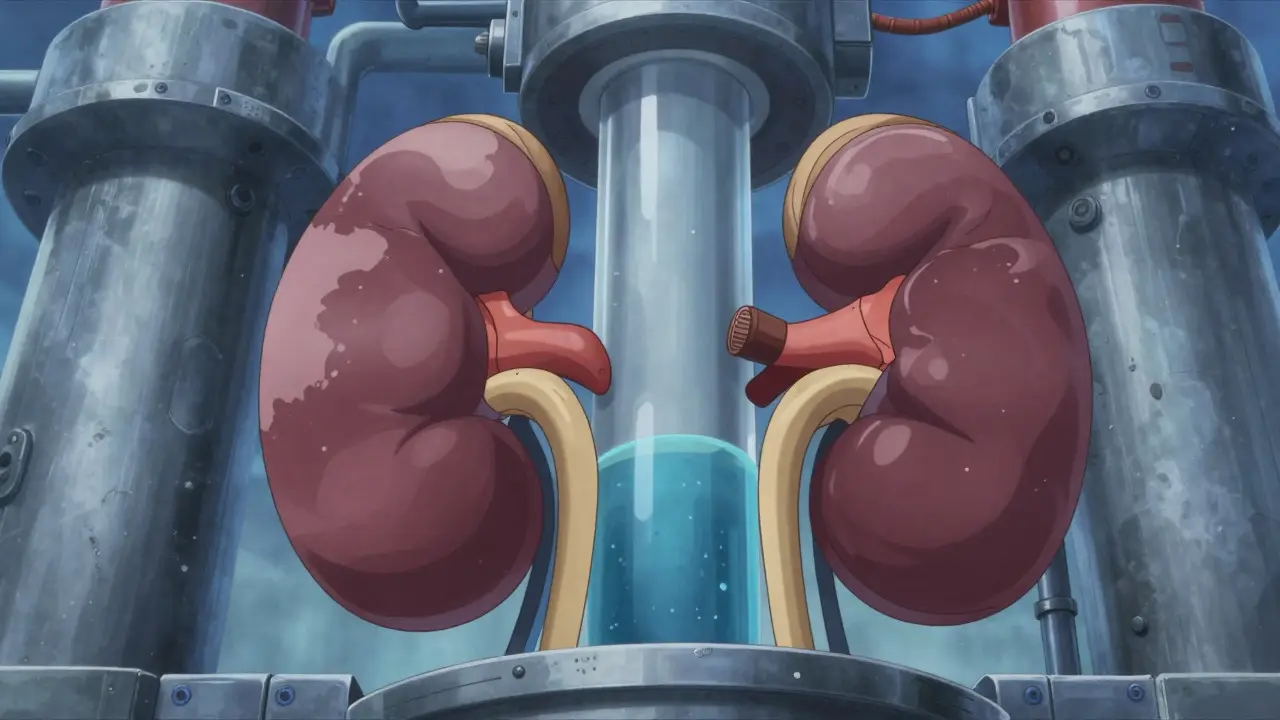
While the liver breaks down drugs, the kidneys filter waste products out of the blood and excrete them through urine. Kidney function declines steadily with age, starting around age 30. By the time you reach 80, your glomerular filtration rate (GFR)-the measure of how well your kidneys filter blood-can drop by 30-50%.
Here is the tricky part: standard blood tests often miss this decline. Doctors typically check serum creatinine levels to assess kidney health. However, creatinine is a waste product of muscle breakdown. Since older adults naturally lose muscle mass (a condition known as sarcopenia), their creatinine production drops. This can result in a 'normal' creatinine level even if the kidneys are functioning poorly. It’s like having a clogged drain but only a small amount of water flowing into it-the sink doesn't overflow, but the drain is still blocked.
To get an accurate picture, doctors use equations like the Cockcroft-Gault formula or the CKD-EPI equation to estimate GFR based on age, weight, and gender. If you are taking medications that rely heavily on kidney excretion-such as certain antibiotics, digoxin, or metformin-your doctor needs this estimated GFR to adjust your dose. Without this adjustment, toxic levels of the drug can build up, leading to confusion, weakness, or organ damage.
| Organ | Key Change | Impact on Drugs | Example Medications Affected |
|---|---|---|---|
| Liver | 40% reduction in blood flow; 30% loss of mass | Slower breakdown of Phase I drugs; increased bioavailability | Diazepam, Warfarin, Propranolol |
| Kidneys | 30-50% reduction in Glomerular Filtration Rate (GFR) | Accumulation of renally excreted drugs | Digoxin, Metformin, Certain Antibiotics |
| Combined Effect | Reduced clearance + decreased muscle mass masking kidney issues | Higher risk of toxicity and adverse events | Most prescription medications |
Why Standard Doses Can Be Dangerous
The combination of slower liver processing and reduced kidney filtration creates a perfect storm for medication errors. Many drugs are prescribed based on 'standard' doses derived from clinical trials that historically included mostly younger, healthier participants. Only about 38% of new drug trial participants are aged 65+, leaving a gap in knowledge about how these drugs behave in aging bodies.
Consider propranolol, a beta-blocker used for high blood pressure. It is a 'flow-limited' drug, meaning its clearance depends heavily on blood flow to the liver. Since liver blood flow drops by 40% in older adults, the body clears propranolol much slower. A standard dose might result in dangerously low heart rates or severe fatigue in a senior patient. Conversely, some prodrugs-medicines that need the liver to activate them-might become *less* effective. Perindopril, an ACE inhibitor, requires hepatic conversion to work. If the liver is sluggish, the active drug levels may be too low to control blood pressure effectively.
Polypharmacy, the use of five or more medications simultaneously, exacerbates this issue. About 41% of adults over 65 take five or more prescriptions. Each additional drug competes for the same limited enzymatic resources in the liver. If Drug A slows down the enzyme that processes Drug B, Drug B builds up to toxic levels. This interaction risk increases by 88% in patients taking multiple medications.

Practical Steps for Safer Medication Management
You don't need to be a pharmacist to manage these risks, but you do need to be proactive. Here is how to navigate medication changes as you age:
- Request a Medication Review: Ask your doctor or pharmacist to review all your medications, including over-the-counter drugs and supplements. Use tools like the Beers Criteria®, which lists medications potentially inappropriate for older adults due to increased sensitivity or metabolic changes.
- Ask About Renal Dosing: If you have any history of kidney issues, ask your doctor, "Has my dose been adjusted based on my estimated GFR?" Don't assume a normal creatinine test means your kidneys are handling meds perfectly.
- Start Low, Go Slow: Geriatric prescribing follows the mantra "start low and go slow." Initial doses should often be 20-40% lower than those for younger adults. If you feel fine, the dose can be gradually increased. This minimizes the risk of sudden toxicity.
- Monitor for Subtle Side Effects: Adverse drug reactions in older adults often present as non-specific symptoms like confusion, falls, dizziness, or loss of appetite. If you experience a sudden change in mental status or balance after starting a new med, contact your doctor immediately. It might not be dementia or a stroke-it could be your medicine.
- Check Interactions: Simple things like grapefruit juice can inhibit liver enzymes (specifically CYP3A4), further reducing the liver's ability to clear certain statins and blood pressure meds. Always disclose what you eat and drink alongside your pills.
The Future of Personalized Dosing
Healthcare is moving toward precision geriatric pharmacology. New software tools, such as GeroDose v2.1, allow clinicians to simulate drug concentration profiles based on individual patient factors like age, weight, and specific enzyme activities. Researchers are also looking at epigenetic factors-changes in gene expression caused by aging-to predict who will metabolize drugs slowly. While these technologies are emerging, the current best practice remains vigilant monitoring and open communication with your healthcare team.
By understanding that your liver and kidneys are working harder and slower than they did decades ago, you empower yourself to advocate for safer, more effective treatment. Your body has changed; your medication plan should too.
How does aging affect liver metabolism?
Aging reduces liver mass by about 30% and decreases blood flow to the liver by 40%. This slows down Phase I metabolism (breakdown by enzymes like CYP450) by 37-60%, causing drugs to stay in the body longer. However, Phase II metabolism remains relatively stable.
Why do kidney function tests sometimes look normal in older adults with poor kidney function?
Standard tests measure serum creatinine, a waste product from muscle. Older adults often have less muscle mass, so they produce less creatinine. This can mask a reduced Glomerular Filtration Rate (GFR), making kidneys appear healthier than they are. Doctors use equations like CKD-EPI to estimate true kidney function.
What are the signs of adverse drug reactions in older adults?
Signs often include confusion, dizziness, falls, nausea, excessive sleepiness, or loss of appetite. Because older adults may not report typical side effects like headaches, subtle changes in behavior or physical stability are key indicators.
Should I stop taking my medication if I feel side effects?
Do not stop abruptly without consulting your doctor, as this can cause withdrawal or rebound effects. Instead, contact your healthcare provider immediately to discuss dose adjustments or alternative medications that may be safer for your age group.
What is the Beers Criteria?
The Beers Criteria® is a guideline developed by the American Geriatrics Society that identifies medications potentially inappropriate for older adults. It helps doctors avoid drugs with high risks of side effects or interactions in the elderly population.