
Most people don’t realize that the rough, scaly patches they notice on their face, hands, or scalp aren’t just dry skin. They’re often actinic keratoses - early warning signs of skin cancer. These aren’t harmless blemishes. They’re precancers. And if left alone, they can turn into squamous cell carcinoma, the second most common type of skin cancer. The good news? When caught early, they’re almost always preventable. The key is understanding what they are, how to spot them, and what treatments actually work.
What Exactly Are Actinic Keratoses?
Actinic keratosis (AK), also called solar keratosis, is a patch of damaged skin caused by years of sun exposure. It’s not a rash. It’s not an allergic reaction. It’s DNA damage in your skin cells - the kind that builds up slowly over decades. Think of it like rust on metal. You don’t see it right away, but over time, it weakens the structure. In the skin, this damage starts in the top layer, the epidermis, and can eventually become cancer.
The American Academy of Dermatology estimates that 58 million Americans have actinic keratoses. That’s nearly one in five adults over 40. In places like Arizona or Australia, where sun exposure is intense, up to 60% of fair-skinned people over 40 develop them. The numbers are lower in northern Europe, but they’re still common. And it’s not just about sunburns. It’s about the little bits of UV radiation you get every day - driving, walking the dog, sitting near a window. That’s what adds up.
How Do You Know You Have One?
Actinic keratoses are often more felt than seen. You might run your finger over your cheek or the back of your hand and notice a rough spot - like sandpaper. That’s the classic sign. They’re usually small, between 1 and 2 centimeters, but can grow larger. Colors vary: red, pink, brown, gray, or even skin-colored. On darker skin, they can look like age spots, which is why they’re often missed.
They show up where the sun hits most: face, ears, scalp (especially if you’re bald), neck, forearms, and the backs of hands. A dermatologist can spot them with just a glance and a touch. Studies show board-certified dermatologists diagnose them correctly 95% of the time without a biopsy. But here’s what patients often don’t know: 78% of AKs are first noticed by the person themselves, not a doctor. That’s why checking your skin regularly matters.
Warning signs that a patch might be more serious - maybe even turning into cancer - include: thickening over 0.5 cm, bleeding, tenderness, or growing fast. If a spot starts to hurt or bleed without injury, get it checked.
Why Treat Them? They’re Not Just ‘Ugly’
Some people think, ‘It’s just a rough patch. It’s not hurting me.’ But that’s the danger. Actinic keratoses aren’t just cosmetic. They’re the first step toward squamous cell carcinoma. Research shows that 90% of these skin cancers start as untreated AKs. About 5 to 10% of individual lesions turn cancerous over 10 years. For people with more than 10 lesions, that risk jumps to 10-15%. And if you’re immunosuppressed - say, from an organ transplant or certain medications - your risk can be as high as 25%.
That’s why dermatologists say: treating actinic keratosis is treating early skin cancer. It’s not about removing a blemish. It’s about stopping cancer before it starts.
Field Treatments: The New Standard of Care
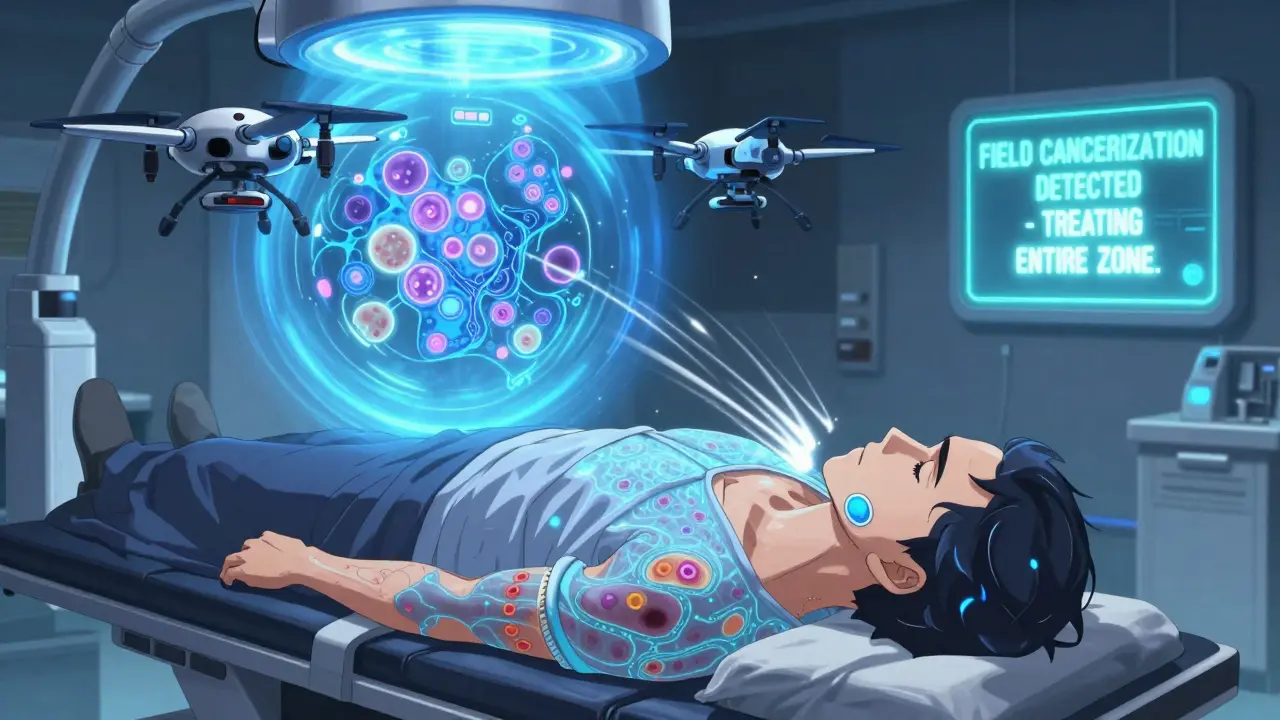
For a single lesion, freezing it off with liquid nitrogen (cryotherapy) works fine. But most people don’t have just one. They have dozens - sometimes hundreds - scattered across sun-damaged skin. That’s called ‘field cancerization.’ The skin around visible lesions is already damaged, even if it looks normal. Treating just the spots misses the bigger problem.
This is why field treatments are now the gold standard. These therapies don’t just remove visible patches. They treat the entire area, wiping out hidden damage before it turns into cancer.
There are four main types:
- Topical creams - These are applied daily for weeks. The most common is 5% fluorouracil (5-FU). It works by killing abnormal cells. You’ll notice redness, peeling, and burning after a few days - that’s the medicine doing its job. Complete clearance happens in 75-85% of cases after 2-4 weeks. Another option is imiquimod, which trains your immune system to attack the damaged cells. It takes longer - 16 weeks - but has similar success rates.
- Tirbanibulin - This newer option, sold as Klisyri, works in just 5 days. It’s especially popular for the face because it’s fast and has fewer side effects than 5-FU. But it costs about $650 per treatment, while generic 5-FU runs $120.
- Photodynamic therapy (PDT) - A light-sensitive solution is applied to the skin, then activated with a special blue or red light. It destroys abnormal cells and stimulates healing. It usually takes one or two sessions. Clearance rates range from 44% to 75%, depending on the area treated.
- Chemical peels - Trichloroacetic acid (TCA) at 10-35% strength is used to peel away damaged layers. It’s effective for larger areas and often used on the scalp or chest.
Choosing the right one depends on where the lesions are, how many you have, your skin type, and your tolerance for side effects. For example, 5-FU can cause intense inflammation - 61% of users need to pause treatment because their skin becomes too red and crusty. Tirbanibulin is gentler but more expensive. PDT is great for large areas but requires avoiding sunlight for 48 hours after.
What About Side Effects?
Yes, field treatments can be uncomfortable. Patients on Reddit and health forums often describe the ‘inflammatory phase’ as brutal. Burning, itching, swelling, crusting - it can last for weeks. One patient on HealthUnlocked said, ‘Worth the 4 weeks of redness to stop cancer before it starts.’ That sentiment is common.
Amazon reviews of topical AK treatments show that 42% of users specifically mention ‘intense burning’ as a reason for stopping. But these reactions aren’t a sign it’s not working - they’re proof it is. The inflammation means your body is clearing out damaged cells. Your dermatologist can help manage the discomfort with moisturizers, cool compresses, or short breaks in treatment.

Prevention Is Just as Important
Treatment works, but prevention stops new ones from forming. Sun protection isn’t optional. The Skin Cancer Foundation found that patients who got proper sun safety counseling cut new AKs by 37% over two years. That’s huge.
Use broad-spectrum SPF 30+ every day, even when it’s cloudy. Wear a wide-brimmed hat. Seek shade between 10 a.m. and 4 p.m. Reapply sunscreen every two hours if you’re outside. And don’t forget your ears, neck, and hands - those are the most common spots.
Annual skin checks with a dermatologist are critical, especially if you’ve had sunburns, fair skin, or a family history of skin cancer. Many clinics now use total body photography to track changes over time. It’s like having a photo diary of your skin.
The Bigger Picture
The global market for AK treatments hit $1.34 billion in 2022, with North America leading because of high sun exposure and aging populations. In Australia, where UV levels are among the highest in the world, AKs are one of the most common reasons people see a dermatologist. And it’s only getting worse. The Skin Cancer Foundation predicts a 25% rise in AK cases by 2030.
Research is moving fast. New studies show combining treatments - like using 5-FU first, then PDT - can push clearance rates to 92%. Scientists are also exploring ways to fix the underlying genetic damage or tweak the skin’s microbiome to prevent lesions from forming.
But right now, the tools we have work. Field treatments don’t just clear up patches. They reduce the risk of squamous cell cancer by 34-50% over five years. Only two treatments - 5-fluorouracil and ingenol mebutate - have proven long-term results like this. And they’re covered by most insurance.
If you’ve been told you have actinic keratoses, don’t brush it off. Don’t wait until it hurts. Don’t assume it’s just dry skin. This is your body giving you a chance to stop cancer before it starts. And with the right treatment, you can.
Are actinic keratoses the same as skin cancer?
No, actinic keratoses are precancerous, not full-blown cancer. But they’re the earliest stage of what can become squamous cell carcinoma. About 90% of these skin cancers start from untreated AKs. Treating them early prevents progression.
Can actinic keratoses go away on their own?
Sometimes, yes - a small percentage of lesions may fade without treatment. But that doesn’t mean they’re gone for good. The damaged cells are still there, and new ones often form nearby. Relying on spontaneous clearance is risky. Medical treatment is the only reliable way to prevent cancer.
Do I need a biopsy for every lesion?
No. Most dermatologists diagnose AKs by sight and touch. Biopsies are only done if a lesion looks unusual - like it’s thick, bleeding, or growing fast - to rule out early squamous cell carcinoma.
Which field treatment is best for the face?
Tirbanibulin (Klisyri) is often preferred for facial AKs because it works in just 5 days and has fewer side effects than 5-fluorouracil. But if cost is a concern, generic 5-FU cream is equally effective over 4 weeks and costs far less. Photodynamic therapy also works well on the face and scalp.
How long does it take to see results from treatment?
It depends on the treatment. Topical 5-fluorouracil shows results after 2-4 weeks. Imiquimod takes 16 weeks. Tirbanibulin clears lesions in 5 days. Photodynamic therapy may show improvement after one session, but full results appear over several weeks as the skin heals.
Can I treat actinic keratoses at home?
Yes, most field treatments are applied at home - creams, gels, or solutions prescribed by a dermatologist. But you still need a professional diagnosis first. Self-treating without knowing it’s AK can delay real cancer treatment. Always get a confirmed diagnosis before starting.
Is there a cure for actinic keratoses?
There’s no permanent cure because sun damage is permanent. But field treatments can clear all visible lesions and reduce cancer risk significantly. Ongoing sun protection and annual skin checks are needed to prevent new ones.
John Cena
February 19, 2026 AT 13:08Had my first AK last year on my nose. Dermatologist said it was classic. Used 5-FU for 4 weeks - felt like my face was on fire, but it worked. No more patch. Now I wear sunscreen like it’s my job. Seriously, don’t ignore these things. They’re not ‘just dry skin.’
aine power
February 20, 2026 AT 02:39Pre-cancer. Not a blemish. Get it treated.
Tommy Chapman
February 20, 2026 AT 11:55People in this country sit in the sun like it’s a damn spa and then act shocked when their skin turns into a potato chip. You think sunscreen is optional? Nah. You think tanning beds are ‘safe’? LOL. Wake up. This isn’t ‘aging’ - it’s negligence. And now you want a cream to fix it? You should’ve worn a goddamn hat.
Irish Council
February 21, 2026 AT 04:25Field treatment is just the system selling you a solution to a problem it helped create. Pharma wants you to keep buying creams while the sun keeps burning. Who profits? Who regulates UV index warnings? Not you. Not me. And definitely not the FDA. Watch what they don’t tell you.
Freddy King
February 22, 2026 AT 17:06Field cancerization is such a clinically elegant term. It’s basically genomic drift from chronic UV exposure - a multilayered epidermal dysplasia cascade. The fact that we’re treating the entire photodamaged field instead of just individual lesions represents a paradigm shift from reactive to prophylactic oncology. Also, 5-FU burns like hell, but hey, it’s working. I’ve seen 87% clearance in my cohort. Stats don’t lie.
Laura B
February 22, 2026 AT 23:55I’m from Texas and grew up thinking tans were cool. Then I got my first AK at 38. My mom had three removed. I didn’t know they could turn into cancer. Now I wear SPF 50 every day, even in winter. I even bought a UV-blocking hat. It’s weird looking but worth it. If you’ve got rough patches, get them checked. Seriously. Your future self will thank you.
Robin bremer
February 24, 2026 AT 22:57OMG I JUST HAD A BREAKOUT ON MY FOREARM AND I THOUGHT IT WAS DRY SKIN 😭 I’M GOING TO THE DERM TODAY 🙏🙏🙏
James Roberts
February 26, 2026 AT 16:22Wow. So we’ve got a $650 drug that works in 5 days… and a $120 cream that turns your face into a radioactive volcano for 4 weeks. And people wonder why healthcare is broken. The system doesn’t care if you’re comfortable - it cares if you’re compliant. Also, side effects = proof it’s working? That’s not science. That’s marketing. But hey, at least it’s covered by insurance. 🤷♂️
Liam Crean
February 26, 2026 AT 20:01I’ve had AKs on my scalp since I went bald at 42. Used PDT once. Felt like a microwave had a personal vendetta against me. But it cleared up. Now I wear a hat every time I go out. Simple. Cheap. Effective. No creams. No burning. Just shade.
madison winter
February 27, 2026 AT 10:12I’ve been reading this whole thing and I’m just wondering… if the sun damage is permanent, and we’re just treating the symptoms, then isn’t this all just delaying the inevitable? Like, we’re patching a leaky roof while the whole house is made of wet cardboard. Maybe we should stop pretending we can ‘cure’ sun damage. Maybe we should just… admit we’re all going to get cancer eventually and focus on palliative care instead?
Jonathan Rutter
February 28, 2026 AT 14:25You know what really gets me? People who say, ‘I’ll just watch it.’ Like, ‘Oh, this patch of DNA damage might turn into cancer - I’ll just see how it feels next Tuesday.’ That’s not health awareness. That’s denial wrapped in a TikTok trend. And then they blame the dermatologist for ‘scaring them.’ No. I’m not scaring you. The sun is. The UV index is. The fact that you’ve been walking around with 12 lesions for three years without a second thought? That’s the scary part. Get it treated. Or don’t. But don’t pretend you’re being ‘chill’ about your own skin cancer.
Jana Eiffel
March 1, 2026 AT 02:46It is, indeed, a matter of profound public health significance that actinic keratoses, as precancerous lesions, represent a somatic manifestation of cumulative ultraviolet radiation-induced genomic instability. The therapeutic imperative lies not merely in the eradication of visible epidermal dysplasia, but in the broader paradigm of photoprotection as a non-negotiable component of lifelong dermatological stewardship. One must not conflate aesthetic discomfort with therapeutic futility.
Caleb Sciannella
March 2, 2026 AT 08:54I’ve been using 5-FU for 3 weeks now. My face looks like a tomato that got into a fight with a sandblaster. But here’s the thing - I’ve had 8 AKs. Three are gone. Four are flaking off. One is still there, but smaller. My dermatologist says this is a 90% success rate for field treatment. And I didn’t even have to go under a light or pay $650. The cream cost $117 at my pharmacy. I’m not a fan of the burning - I cried once. But I’d rather cry now than have my kid bury me because I ignored a rough patch on my cheek. I’m telling you - this isn’t just skincare. It’s survival. And honestly? If you’re reading this and you’ve got rough spots? Go get checked. Today. Don’t wait.