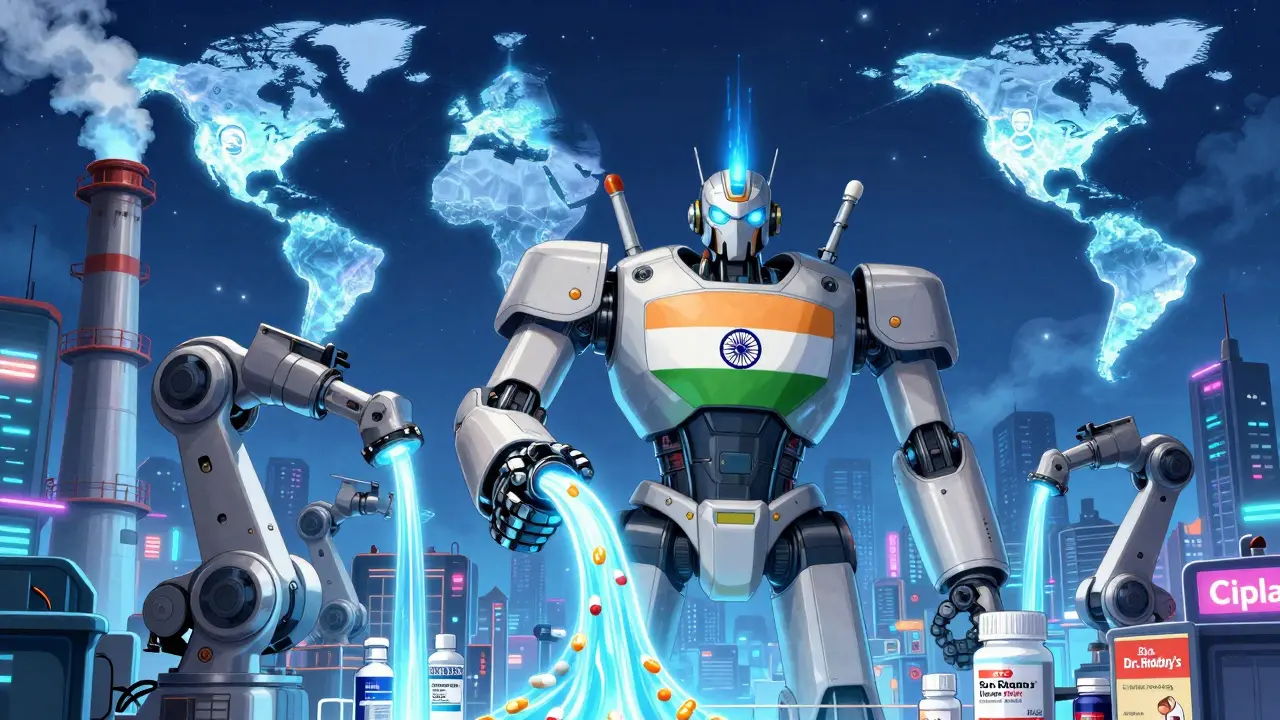
India’s Generic Drug Industry Powers Global Healthcare
When you take a generic pill for blood pressure, antibiotics, or diabetes, there’s a strong chance it came from India. The country doesn’t just make medicines-it supplies the world. More than 20% of all pharmaceuticals shipped globally originate from Indian factories. That’s not a small number. It’s the backbone of treatment for millions in Africa, Latin America, and even the United States. In fact, nearly 40% of all generic drugs prescribed in the U.S. are made in India. This isn’t luck. It’s the result of decades of strategic policy, disciplined manufacturing, and a relentless focus on affordability without sacrificing quality.
How India Became the Pharmacy of the World
India’s rise didn’t happen overnight. In the 1970s, the country changed its patent laws to allow local companies to copy branded drugs after the original patent expired. This move, called compulsory licensing, broke the monopoly of Western drugmakers and gave Indian firms the green light to produce cheap versions of life-saving medicines. At the time, companies like Cipla and Dr. Reddy’s started reverse-engineering HIV drugs, cancer treatments, and antibiotics that cost thousands in the West but could be sold for under $100 in India.
By the early 2000s, these same companies began targeting global regulators. They invested heavily in meeting FDA and European standards. Today, India has over 650 FDA-approved manufacturing plants-more than any other country outside the U.S. That’s why the FDA inspects Indian facilities as often as American ones. It’s not about trust-it’s about proof. These factories follow the same rules as Pfizer or Merck. The difference? Labor, infrastructure, and scale keep costs low.
Who Makes the Medicines You Use?
India’s pharmaceutical sector isn’t made up of a few big names. It’s a vast ecosystem of over 10,000 manufacturing units and 3,000 companies. But a handful of giants dominate exports. Sun Pharma leads the pack with a market cap of over $43 billion. Cipla and Dr. Reddy’s aren’t far behind, each worth more than $10 billion. These companies don’t just make simple pills-they produce complex formulations like extended-release tablets, transdermal patches, and sterile injectables that require precision engineering.
They also lead in biosimilars-copies of expensive biologic drugs like those used for rheumatoid arthritis or cancer. In 2024, biosimilars made up 8% of India’s export value, up from just 3% in 2020. Companies like Biocon have spent over $500 million each to build biologics labs. This shift is critical. The future isn’t in copying old drugs anymore-it’s in making the next generation of affordable biologics that can compete with brands like Humira or Enbrel.
Why Is India’s Medicine So Cheap?
Cost isn’t just a side effect-it’s the entire business model. Indian manufacturers cut prices by 30% to 80% compared to branded drugs. How? Three things: scale, automation, and labor efficiency. A single plant in Gujarat or Hyderabad can produce over a billion tablets a year. They use automated packaging lines, robotic quality checks, and standardized processes that reduce waste. They also benefit from lower wages and strong government support for industrial zones.
But here’s the catch: they make up for low prices with volume. India exports over 60,000 generic drug formulations and more than 500 active pharmaceutical ingredients (APIs). That’s more than any other country. Yet, despite producing one-fifth of the world’s medicines by volume, India only earns about 10% of the global generics market value. That’s because most of its exports go to price-sensitive markets like Africa, Southeast Asia, and public health programs in the U.S. and U.K.

Where Do Indian Generic Drugs Go?
India’s medicines reach every corner of the globe. In the U.S., Indian generics fill 40% of all generic prescriptions. In the U.K., they make up 33% of NHS drug supplies. In Sub-Saharan Africa, where public health budgets are tight, Indian companies supply 50% of all medicines. Doctors Without Borders relies on Indian-made antimalarials and antibiotics because they’re 65% cheaper and still 95% effective in real-world conditions.
Even in places like Brazil, Mexico, and Indonesia, Indian drugs are the default choice for government health programs. Why? Because when you’re treating millions of people on a limited budget, price matters more than brand. A single vial of insulin made in India can cost $3-compared to $100 in the U.S. That’s the difference between life and death for someone without insurance.
The Hidden Weakness: Dependence on China
Despite its strength, India has a serious vulnerability: it imports 70% of its active pharmaceutical ingredients (APIs) from China. That means if a factory in Shanghai shuts down due to pollution controls or political tension, Indian drugmakers can’t make their medicines. This became painfully clear during the pandemic when lockdowns in China caused global shortages of antibiotics and antivirals.
The Indian government is trying to fix this. It launched a ₹3,000 crore ($400 million) Production Linked Incentive (PLI) scheme to boost domestic API production. The goal? To reach 53% self-sufficiency by 2026. But building API plants isn’t easy. It takes $50 million and three years to set up one facility. Only a few large companies like Aurobindo and Divi’s Labs have the capital to do it. Smaller firms still rely on Chinese suppliers-and that’s a risk no one can ignore.
Quality Concerns: Real or Overblown?
There’s no denying that some Indian-made drugs have caused problems. Investigations by The Bureau of Investigative Journalism and others have found cases of substandard tablets, contamination, and falsified records. These stories make headlines. But they’re rare. Out of billions of pills exported, less than 1% are flagged as unsafe.
The FDA’s compliance rate for Indian plants has jumped from 60% in 2015 to 85-90% today. That’s on par with the U.S. and Europe. Most failures happen during initial inspections-new companies trying to break into the U.S. market often get shut down on their first try. But once they pass, they stay compliant. Patients in the U.S. and U.K. report high satisfaction. On PharmacyChecker.com, 87% of users who took Indian generics rated them as effective and affordable.
Complaints? They’re usually about packaging-labels in the wrong language, blister packs that break easily-or shipping delays. Not about the medicine itself.

What’s Next for India’s Pharma Industry?
India isn’t resting. The government launched Pharma Vision 2047-a plan to turn the country into a $190 billion export powerhouse. That means moving beyond basic generics. The focus now is on high-value products: biosimilars, complex injectables, inhalers, and even gene therapies. Companies are hiring chemists from the U.S. and Europe, building AI-driven quality control systems, and partnering with global distributors.
But the real test will be whether they can reduce API imports, maintain quality as they scale, and compete with rising players like South Korea and Vietnam. Right now, India still wins on cost and volume. The next decade will decide if it can win on innovation too.
How Do You Know If Your Generic Is From India?
If you’re on a prescription drug, check the label. Most pharmacies list the manufacturer. If you see names like Sun Pharma, Cipla, Dr. Reddy’s, or Lupin, it’s Indian-made. Online pharmacies that sell to the U.S. often say “Made in India” right on the product page. You can also check the FDA’s database of approved manufacturers-it’s public and free.
There’s no need to avoid Indian generics. They’re not second-rate. They’re the reason millions can afford treatment. If your doctor prescribes a generic, and you’re concerned about quality, ask if it’s FDA-approved. That’s the real guarantee-not where it’s made, but who checked it.
Are Indian generic drugs safe to take?
Yes, the vast majority are safe. Over 650 Indian manufacturing plants are FDA-approved, and compliance rates have risen to 85-90% since 2015. These facilities follow the same strict standards as U.S. and European plants. While there have been isolated cases of quality issues, they represent less than 1% of total exports. Patient satisfaction in the U.S. and U.K. remains high, with 87% reporting no difference in effectiveness compared to branded drugs.
Why are Indian generic drugs so much cheaper than brand-name drugs?
Indian manufacturers avoid the high costs of drug discovery and marketing. They produce drugs after patents expire, using low-cost labor, large-scale automation, and government-supported infrastructure. They don’t spend billions on advertising or clinical trials. Instead, they focus on efficient production and volume. This allows them to sell the same medicine at 30-80% lower prices while maintaining quality.
Does India make all the active ingredients for its drugs?
No. India imports about 70% of its active pharmaceutical ingredients (APIs) from China. This is a major vulnerability, especially during global supply chain disruptions. To fix this, India launched a $400 million incentive program to boost domestic API production, aiming for 53% self-sufficiency by 2026. But building these facilities takes years and billions in investment, so dependence on China remains a risk for now.
Can I trust Indian generic drugs for chronic conditions like diabetes or high blood pressure?
Absolutely. Millions of people in the U.S., U.K., and Africa rely on Indian-made generics for chronic conditions. Studies show they work just as well as branded versions. The FDA and WHO regularly inspect Indian plants. If your doctor prescribes a generic and it’s from a major Indian company like Cipla or Sun Pharma, you’re getting a product that meets global standards. The only difference is the price-often 90% lower.
What’s the difference between Indian and Chinese generic manufacturers?
China makes cheaper APIs and bulk drugs, but has far fewer FDA-approved facilities-only 153 compared to India’s 650. India’s strength is its ability to turn raw ingredients into finished, regulated medicines that meet Western standards. China focuses on volume and cost; India focuses on compliance and export readiness. For patients, that means Indian generics are more likely to be approved and safe for use in the U.S., Europe, and Australia.
Is India moving beyond generics into new drug development?
Yes. While still known for generics, Indian companies are now investing heavily in biosimilars-copies of expensive biologic drugs used for cancer and autoimmune diseases. Companies like Biocon and Dr. Reddy’s are spending over $500 million each annually on biologics research. India aims to become a leader in affordable biologics, not just low-cost pills. This shift could redefine its role from “pharmacy of the world” to “innovation hub for global health.”
What This Means for You
If you’re paying for medication out of pocket, Indian generics are one of the best ways to save. If you’re part of a public health system, they’re the reason treatment is even possible. If you’re worried about quality, check the manufacturer. If it’s FDA-approved, you’re covered. The real story isn’t about where the pill is made-it’s about how a country turned a legal loophole into a global lifeline.
Alex Flores Gomez
January 29, 2026 AT 00:11Jasneet Minhas
January 29, 2026 AT 05:57Megan Brooks
January 30, 2026 AT 14:21Robin Keith
February 1, 2026 AT 13:54Sheryl Dhlamini
February 3, 2026 AT 06:06Doug Gray
February 4, 2026 AT 01:36Kristie Horst
February 5, 2026 AT 08:43LOUIS YOUANES
February 6, 2026 AT 20:43Laia Freeman
February 8, 2026 AT 01:11rajaneesh s rajan
February 8, 2026 AT 13:22