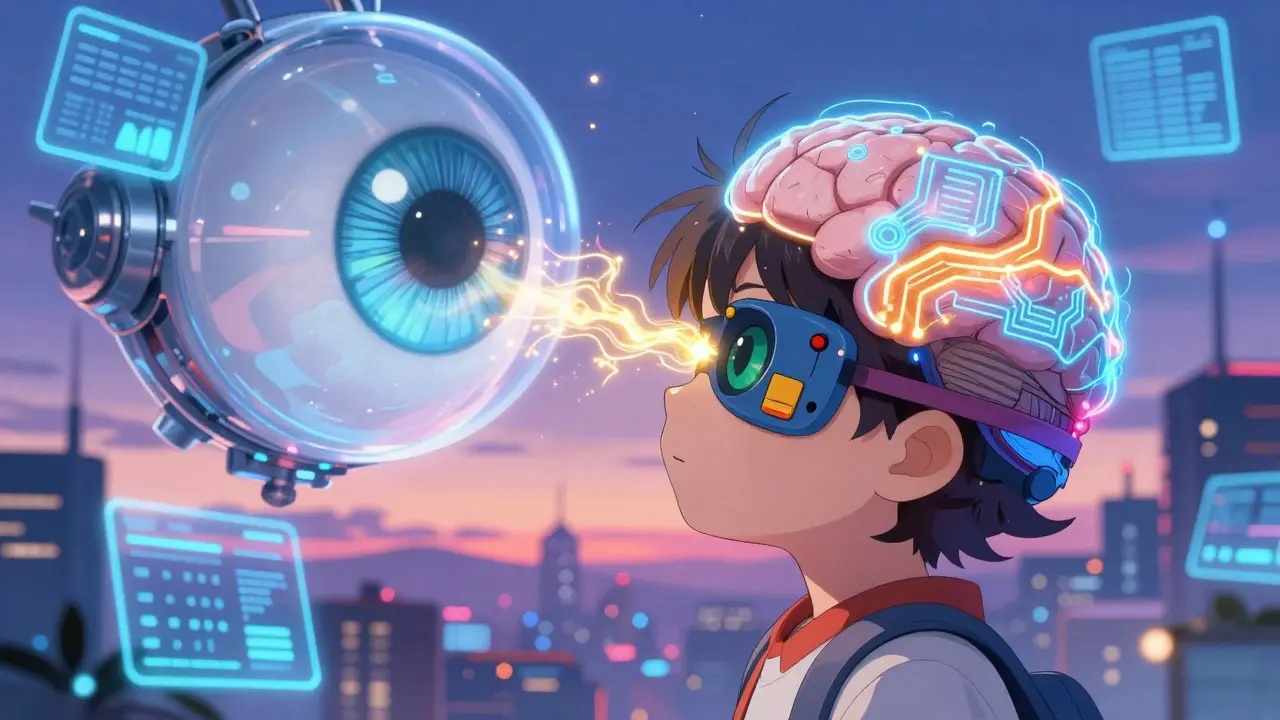
When a child’s brain starts ignoring one eye, it’s not just a blurry picture-it’s a silent crisis in vision development. This is amblyopia, often called "lazy eye," and it’s the most common cause of preventable vision loss in kids. About 2% to 4% of children have it, according to the National Center for Biotechnology Information. The good news? Most cases can be fixed-if caught early and treated the right way.
What Exactly Is Amblyopia?
Amblyopia isn’t a problem with the eye itself. It’s a brain issue. During the first few years of life, a child’s brain learns how to see by combining input from both eyes. If one eye sends a blurry, misaligned, or blocked image, the brain starts to ignore it. Over time, that eye doesn’t develop normal vision, even with glasses. The eye looks fine, but the brain doesn’t know how to use it properly. There are three main types:- Strabismic amblyopia (about half of cases): One eye turns inward, outward, up, or down. The brain shuts off the misaligned eye to avoid double vision.
- Anisometropic amblyopia (about 30%): One eye has a much stronger glasses prescription than the other. The brain favors the clearer image and ignores the blurry one.
- Deprivation amblyopia (10-15%): Something physically blocks light from entering the eye-like a cataract, droopy eyelid, or clouded cornea.
Bilateral amblyopia can happen too, when both eyes have high refractive errors. It’s less common but just as serious.
Why Early Detection Matters
The window for fixing amblyopia is narrow. The brain’s ability to rewire vision-called neuroplasticity-is strongest from birth to about age 7. After that, it gets harder. But here’s the key: the earlier you start treatment, the better the results. Studies show children treated before age 5 recover 85-90% of their vision. Between ages 5 and 7, that drops to 50-60%. After age 8, gains are much smaller. That’s why the American Academy of Pediatrics recommends full eye exams by age 3. Many parents think if a child doesn’t complain, everything’s fine. But amblyopia often has no obvious signs. A child might not realize one eye sees worse. They just adapt.Patching Therapy: The Gold Standard
The most proven treatment is patching therapy. You cover the stronger eye with a patch, forcing the brain to use the weaker one. This rewires the visual pathways. It sounds simple, but it’s backed by decades of research. The landmark Amblyopia Treatment Study (ATS) found that for moderate amblyopia (vision between 20/40 and 20/100), just 2 hours of daily patching worked just as well as 6 hours. That’s a big deal-it means less stress for kids and parents. Patching isn’t one-size-fits-all. Doctors tailor it by:- Age
- Severity of vision loss
- How well the child tolerates it
Most kids wear the patch for 2 to 6 hours a day. For severe cases, it might be longer. Treatment usually lasts 6 to 12 months. Regular check-ups every 4 to 8 weeks track progress using visual acuity tests.

Why Compliance Is the Biggest Hurdle
Here’s the hard truth: only 40-60% of kids stick with patching. Parents report resistance, skin irritation, teasing at school, and frustration. One study found 35% of families quit before treatment was complete. Successful programs don’t just hand out patches-they build support systems:- Start slow: Begin with 30-minute sessions and gradually increase.
- Make it fun: Use patching parties, reward charts, or let the child decorate their patch.
- Use tech: Apps like "LazyEye Tracker" help log hours and send reminders. About 22% of pediatric eye clinics now use them.
- Involve the child: Let them pick their patch design. Kids are more likely to cooperate when they feel in control.
Parent education is critical. Clinics that explain the science behind neuroplasticity-how the brain can change-see 89% adherence. Those that just say "wear the patch" get only 45%.
Alternatives to Patching
Not every child can handle a patch. That’s where other options come in:- Atropine drops: A drop of 1% atropine in the stronger eye blurs near vision for 12-24 hours. The child then uses the weaker eye to read or play. Studies show it works just as well as patching for moderate cases. Many parents prefer this because it’s less visible.
- Bangerter filters: These are translucent stickers placed on glasses lenses over the strong eye. They blur vision slightly without looking like a patch. They’re best for older kids who refuse patches, with 60-70% effectiveness.
- Digital vision therapy: Platforms like AmblyoPlay use games and interactive exercises on tablets to train the brain. FDA-cleared since 2021, these tools report 75% compliance-far higher than traditional patching. They’re especially helpful for kids who find patching boring or isolating.
For kids with strabismus (eye turn), surgery might be needed first to align the eyes. But even after surgery, patching or drops are still required to train the brain.
What About Vision Therapy?
Vision therapy isn’t a replacement for patching-it’s a partner. It includes exercises to improve eye tracking, focusing, and depth perception. When combined with patching, studies show 15-20% better improvement in stereopsis (3D vision). Therapy sessions are usually 45-60 minutes, 2-3 times a week, with daily home exercises. It’s not magic. It’s hard work. But for kids who struggle with depth perception or eye coordination, it makes a real difference.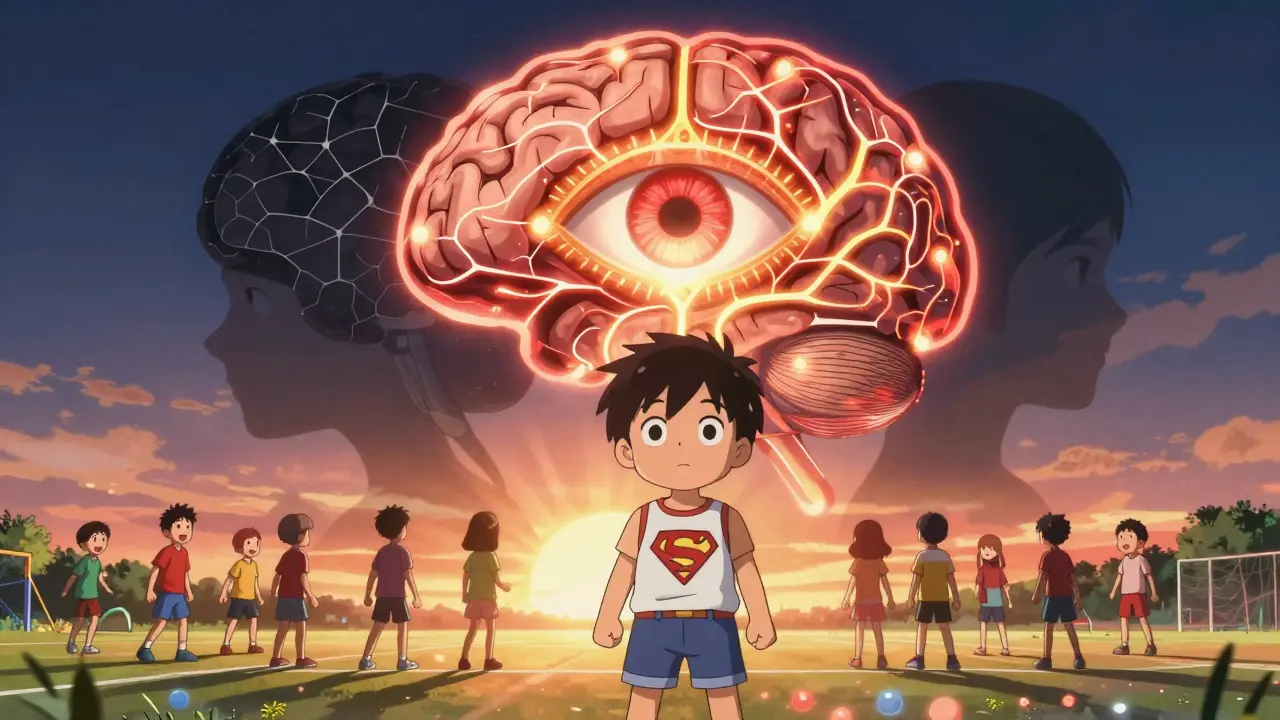
Can Adults Be Treated?
For years, doctors thought amblyopia couldn’t be fixed after childhood. New research is changing that. Studies in adults show modest improvements with intensive perceptual learning-like playing video games designed to stimulate the weaker eye. But gains are small, and the brain’s plasticity is much lower. Childhood remains the golden window.What Happens If It’s Not Treated?
Untreated amblyopia doesn’t just mean poor vision in one eye. It means losing depth perception, which affects sports, driving, and even jobs later in life. If the good eye gets injured or develops disease, the child is left with permanent, uncorrectable vision loss. That’s why screening is so important.What Parents Should Do
- Schedule a full eye exam by age 3-even if your child seems to see fine.
- Watch for signs: squinting, head tilting, closing one eye to see, poor depth perception.
- If diagnosed, ask about patching, atropine, or digital therapy options.
- Don’t give up if it’s hard. Progress takes time.
- Ask for support. Many clinics offer parent groups and behavioral coaching.
The goal isn’t just better vision-it’s giving a child the full range of sight. With early action, most kids with amblyopia can see clearly, safely, and confidently for life.
Can amblyopia fix itself without treatment?
No, amblyopia won’t fix itself. The brain continues to ignore the weaker eye, and vision in that eye will not improve on its own. Without treatment, the vision loss becomes permanent.
How long does patching therapy take to work?
Improvement can start in as little as a few weeks, but full treatment usually takes 6 to 12 months. Regular check-ups every 4 to 8 weeks help doctors adjust the patching schedule based on progress.
Is patching harmful to the strong eye?
No, patching doesn’t harm the strong eye. It temporarily reduces its use so the brain can strengthen the weaker one. Vision in the strong eye returns to normal once patching stops. Doctors monitor both eyes closely during treatment.
Can glasses alone fix amblyopia?
Glasses can help if the amblyopia is caused by a refractive error, like nearsightedness or farsightedness. But for most cases, glasses alone aren’t enough. The brain still needs to be trained to use the weaker eye, which requires patching, drops, or digital therapy.
What if my child refuses to wear the patch?
Many children resist at first. Try starting with short sessions, let them pick fun patch designs, use reward charts, or try alternatives like atropine drops or Bangerter filters. Clinics with behavioral support programs see much higher success rates.
Can amblyopia come back after treatment?
Yes, in about 25% of cases, vision can regress if treatment ends too soon or follow-up isn’t maintained. That’s why doctors recommend gradual weaning off patching and regular check-ups for at least a year after treatment ends.
Are digital vision therapy apps effective?
Yes. Apps like AmblyoPlay, cleared by the FDA in 2021, use gamified exercises to stimulate the weaker eye. Real-world data shows 75% compliance-much higher than traditional patching-and they’re equally effective for moderate amblyopia when used consistently.
Annette Robinson
January 7, 2026 AT 18:07Patching was such a struggle with my daughter at first-she’d cry every time we put it on. But we started with 30 minutes a day, let her pick superhero patches, and used a sticker chart. Now she asks for it. It’s not just about vision-it’s about giving her confidence. She doesn’t even notice her eye is different anymore.
Trust me, it’s worth every tear.
And yes, the clinic’s app helped us track progress without the guilt trips.
Early detection saved her.
Don’t wait for them to complain.
They won’t.
Kristina Felixita
January 8, 2026 AT 22:04omg i literally just found out my 4yo has amblyopia and i thought it was just her squinting cuz she’s tired 😭 i’m so glad i read this bc i was about to just wait and see… now i’m booking the eye doc tomorrow!! patching sounds brutal but if it fixes it?? worth it. also-where do you get those cute patches?? i want one with unicorns!!
christy lianto
January 9, 2026 AT 13:12Let me tell you something-this isn’t just a medical issue, it’s a parenting battlefield. You think you’re doing everything right until your kid screams like you’re torturing them because you put a patch on. But here’s the truth: if you don’t fight for their vision now, you’re signing them up for a lifetime of limitations. I’ve seen it. My cousin lost 80% of his depth perception because his parents thought he’d ‘grow out of it.’ He can’t drive. He can’t play baseball. He can’t even judge how far a stair is. Don’t be that parent. Start patching. Today. No excuses.
Manish Kumar
January 10, 2026 AT 08:13You know, in the grand scheme of human perception, amblyopia is just one manifestation of the brain’s tendency to optimize, to prune, to discard what it deems inefficient. The eye is merely a lens; the mind is the true seer. When the brain ignores one eye, it’s not weakness-it’s adaptation. But here’s the irony: we call it a disorder because we value symmetry, because we fear asymmetry in the human form. Yet nature thrives on asymmetry. The human face isn’t perfectly mirrored. Why should vision be? Perhaps we’re pathologizing a natural variation, and in doing so, we’re imposing a cultural ideal of ‘normal’ vision onto a child’s developing mind. Maybe the real crisis isn’t the lazy eye-it’s our refusal to accept that seeing differently is still seeing.
But… I still patch my kid. Because I don’t want him to be the kid who can’t catch a ball.
So… contradiction? Yes. But I’m human.
Aubrey Mallory
January 11, 2026 AT 14:24Every single parent reading this needs to hear this: your child’s vision is not a luxury. It’s a right. If your pediatrician says ‘wait until next year’-find a new one. If your insurance denies coverage for digital therapy-fight them. If your kid cries-hold them. But don’t you dare stop. We’ve known for decades how treatable this is. The fact that so many kids still slip through the cracks isn’t medical-it’s systemic. And it’s unacceptable. I’ve worked in pediatric clinics for 18 years. I’ve seen the ones who got help. I’ve seen the ones who didn’t. There’s no gray area here. Do the work.
Dave Old-Wolf
January 12, 2026 AT 08:23I didn’t know this was even a thing until my niece got diagnosed. I thought if you had glasses, you were good. Turns out, nope. My sister was so stressed out. We tried the patch, but she hated it. Then we tried the eye drops-way easier. She didn’t even notice. Now she’s doing better. I just wish we’d known sooner. Why don’t they tell you this stuff at the regular checkups? Like, why is this so hidden?
Prakash Sharma
January 14, 2026 AT 07:49Why do Americans always make everything so complicated? In India, we just patch the good eye and tell the kid to sit still. No apps. No unicorns. No reward charts. Just discipline. And guess what? It works. Your culture of coddling kids is why they won’t wear the patch. You give them choices, they choose to be lazy. We don’t ask if the child wants to wear the patch-we tell them to wear it. Period. Vision is too important for your ‘feel-good’ therapy nonsense.
Donny Airlangga
January 15, 2026 AT 13:17I’ve been reading up on this since my son got diagnosed. I didn’t realize how much of a game-changer digital therapy is. We’re using AmblyoPlay now. He plays it like a video game. He asks for it. He’s even better at depth perception than before. I didn’t think a tablet could help-but it did. The best part? He doesn’t feel ‘different.’ He just thinks he’s winning levels. That’s huge for his self-esteem.
Molly Silvernale
January 16, 2026 AT 12:24There’s poetry in the brain’s plasticity-it’s not broken, it’s waiting. Amblyopia is not a defect, it’s a whisper from the mind, a quiet plea to be seen differently. The patch is not a punishment-it’s a bridge. A fragile, temporary, beautiful bridge between what was ignored and what could be. We treat it like a medical protocol, but it’s a rebirth. Every hour of patching is a neuron firing back to life. Every drop of atropine, a sigh of the eye saying, ‘I’m still here.’ And when the child finally sees the world in three dimensions? That’s not a cure. That’s a miracle. And miracles don’t come with instructions. They come with patience. And love. And a stubborn parent who refuses to give up.
So patch on, warriors. The brain is listening.
Joanna Brancewicz
January 17, 2026 AT 12:15Neuroplasticity window: 0–7 years. ATS data confirms 2h/day = 6h/day for moderate cases. Atropine non-inferior for anisometropia. Digital therapy compliance: 75%. Deprivation amblyopia requires surgical intervention prior to visual training. Follow-up mandatory for 12 months post-treatment. Regression rate: 25%. Early screening = 85–90% recovery. No self-resolution. Glasses insufficient alone. Patching safe for dominant eye. Evidence-based. No speculation.
Evan Smith
January 18, 2026 AT 10:04So… you’re telling me the cure for ‘lazy eye’ is basically forcing your kid to play with one eye shut… and then you call it ‘therapy’? And we pay for this? And we feel guilty if they cry? And now we have apps that gamify it? I’m not mad, I’m just… impressed. We’ve turned childhood blindness into a Netflix series with rewards. Next they’ll be selling branded patches on Etsy. ‘I ❤️ My Lazy Eye Patch’-I’m buying one.
Lois Li
January 19, 2026 AT 07:17I’m a teacher and I’ve had three students with amblyopia. None of them ever said anything. One kept tilting her head. Another closed one eye when reading. Another just seemed ‘off’ in sports. We didn’t know. Schools need to partner with eye clinics. We’re screening for hearing, why not vision? And if parents don’t know, how can we expect them to act? This isn’t just a medical issue-it’s an education issue. We need to stop waiting for kids to fail before we help them.
Ken Porter
January 20, 2026 AT 01:02Why are we even talking about this? Just patch the eye. No apps. No games. No unicorns. Just do it. The science is clear. The data is clear. The only reason this is a ‘problem’ is because modern parents are too soft. If your kid won’t wear it, ground them. Take away their iPad. That’s parenting. Not bribing them with stickers. Grow up.
swati Thounaojam
January 20, 2026 AT 11:06in india we dont have access to all these fancy apps or drops. patching is all we got. my son cried for 3 weeks. i cried with him. but we did it. 6 months later, his vision is 20/20. no magic. just persistence. if you can afford apps, good for you. if you cant, just keep trying. the eye will heal if you dont give up.
Luke Crump
January 20, 2026 AT 13:37Let me ask you something: if the brain is so ‘plastic,’ why does it only care about vision? Why not hearing? Why not smell? Why do we treat one eye as more important than the other? What if the ‘lazy eye’ isn’t lazy at all-what if it’s the *other* eye that’s the problem? What if the brain is rejecting the dominant eye because it’s too loud, too dominant, too controlling? Maybe amblyopia isn’t a disorder… maybe it’s a protest. Maybe the child’s brain is saying, ‘I don’t want to see the world the way you force me to.’
And maybe… we should listen.