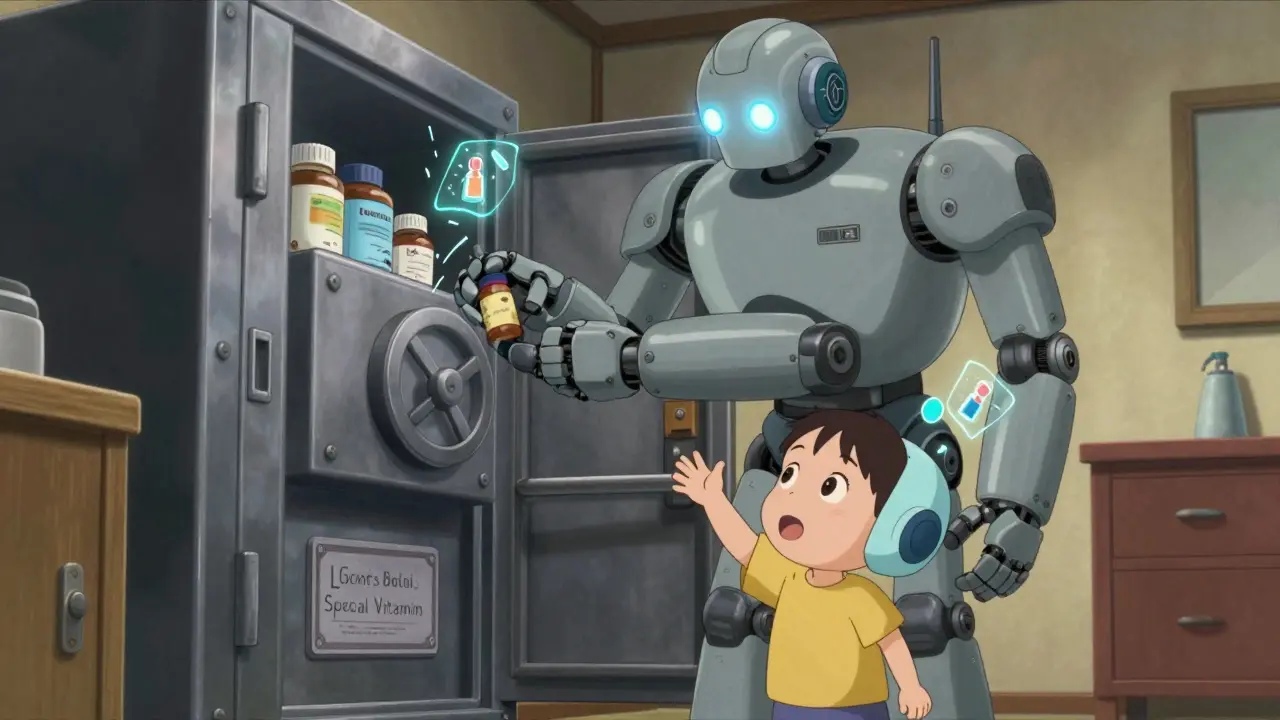
Every year, more than 58,000 children under five end up in the emergency room because they got into medicine they weren’t supposed to. And in nearly four out of ten of those cases, the medicine came from a grandparent’s purse, nightstand, or kitchen counter. It’s not because grandparents are careless. It’s because most of them don’t realize how easily a curious toddler can find and open a pill bottle-even one with a child-resistant cap.
Grandparents are more involved in childcare than ever. One in seven U.S. children lives with a grandparent, and over seven million live with them full-time. At the same time, 34% of grandparents take daily prescription meds. That’s an average of 4.7 medications each. Many keep them in places that feel convenient: the bathroom cabinet, the bedside table, the handbag. To them, it’s just life as usual. But to a 2-year-old, those bottles look like candy.
Why Grandparents Are at the Center of This Problem
Parents are usually careful. Studies show 68% of parents store medications safely-locked up, out of reach, in original containers. Grandparents? Only 52% do. That gap isn’t about neglect. It’s about different habits, different knowledge, and different assumptions.
Many grandparents believe child-resistant caps are enough. They’re not. CDC testing shows 30% of 4-year-olds can open them in under five minutes. Others transfer pills into weekly pill organizers because they forget what’s in each bottle. That’s a big risk-those containers aren’t child-resistant at all. And 29% of caregiving grandparents admit they’ve done this.
Memory issues, arthritis, and complex medication schedules make it harder to stay consistent. Some grandparents don’t know how to use child-resistant caps properly. One study found only 54% could open their own bottles correctly. Others keep meds in purses because they’re used to carrying them around. A third of grandparents admit to keeping medicine in their handbags-right where a grandchild can grab it.
And here’s the quiet truth: many grandparents feel defensive when someone tells them to “be safer.” They’ve raised kids, cared for families, and don’t want to feel like they’re being accused of being irresponsible. That’s why the message matters as much as the method.
What Works: The PROTECT Campaign and Real-World Fixes
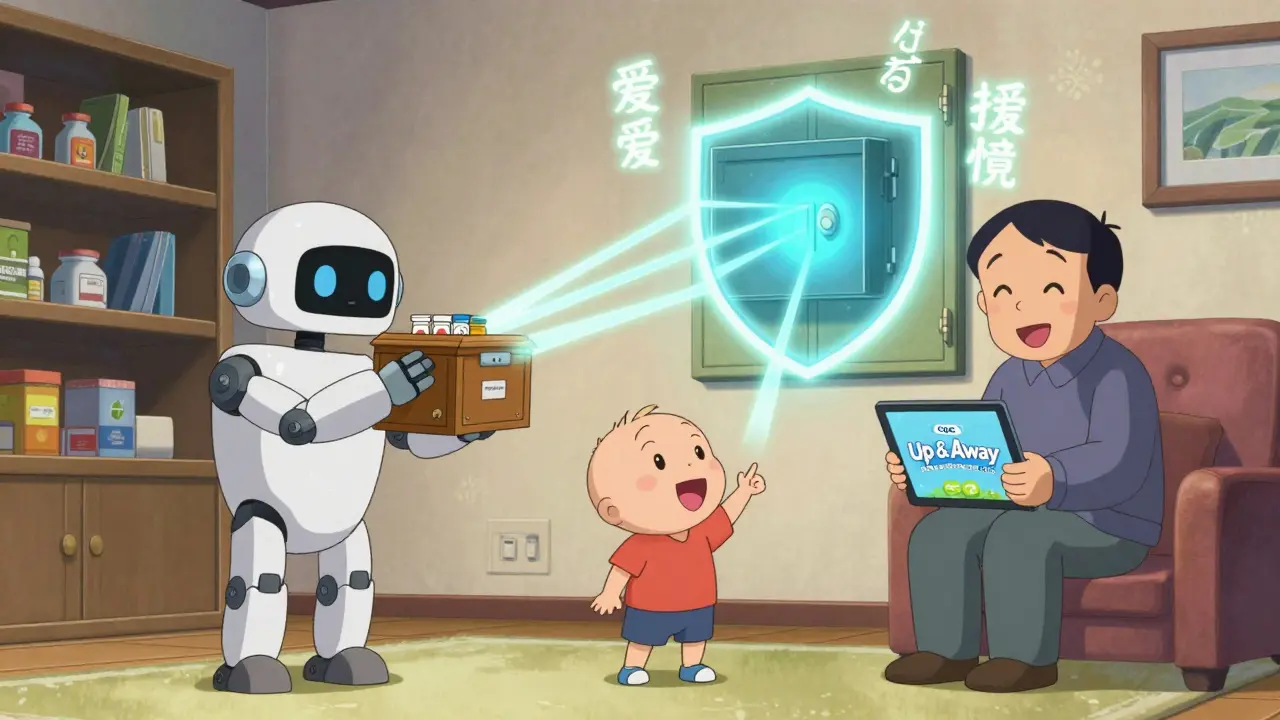
The CDC and Consumer Healthcare Products Association launched the “Up & Away and Out of Sight” campaign over a decade ago. It’s simple, direct, and backed by data. And it works.
A 15-minute educational session with grandparents-focused on safe storage, not blame-boosted safe medication habits from 39% to 78% within two months. That’s not a small change. That’s life-saving.
Here’s what they taught:
- Keep all medicine-prescription, over-the-counter, vitamins, patches-up high, out of sight. Think above 4 feet, locked in a cabinet or box.
- Never leave medicine on counters, nightstands, or in purses.
- Always keep pills in their original bottles with child-resistant caps.
- Dispose of expired or unused meds safely. Many pharmacies take them back for free.
Visuals help. A picture of a locked cabinet labeled “Grandma’s Special Vitamins” sticks in a child’s mind better than a lecture. Some families even make a game of it: “Where do we keep medicine?” and let the grandchild point to the right spot.
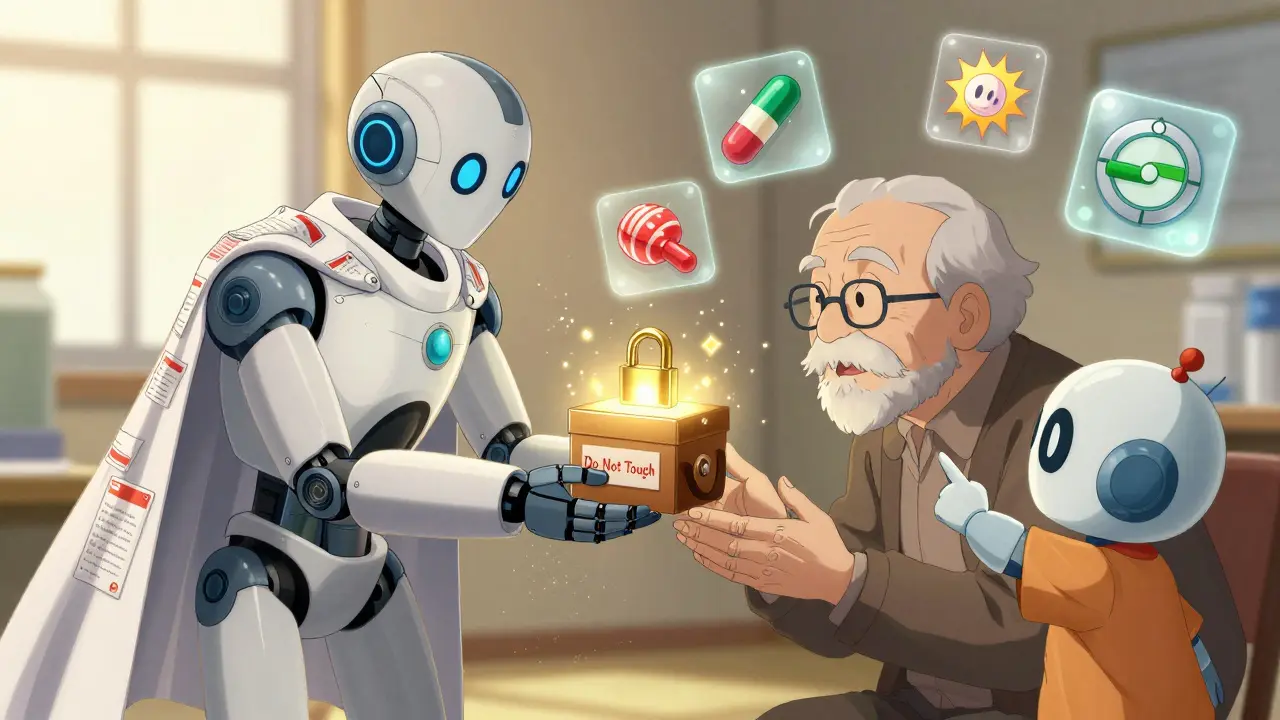
One grandmother in Ohio started keeping her meds in a locked box in her closet after her grandson nearly swallowed her blood pressure pills. She told her grandkids, “These are Grandma’s special vitamins. Only grown-ups touch them.” She didn’t say, “You’re dangerous.” She didn’t shame them. She turned safety into a routine.
How to Talk to Grandparents Without Making Them Feel Judged
Start with care, not correction.
Instead of saying, “You need to lock up your pills,” try: “I know you want to keep our grandkids safe. Let’s make sure no one finds your medicine by accident.”
Use phrases like:
- “Let’s make sure our grandkids stay safe.”
- “I know you’ve always been careful-this is just one more way to help.”
- “We’re all learning. Can I show you this simple trick?”
Offer to help. Bring a lockbox. Show them how to use it. Walk them through checking expiration dates. Make it a visit activity, not a chore.
Many grandparents feel more comfortable learning from someone they trust-like a pharmacist or a grandchild’s pediatrician. Ask the doctor to mention medication safety during checkups. Pharmacists can hand out free lockboxes and explain safe storage during prescription pickups. In fact, 78% of grandparents who got personalized advice from a pharmacist changed their habits.
What to Do When Grandparents Live With Your Child
If your child lives with grandparents full-time, safety needs to be a team effort.
Start with a quick conversation: “We want to make sure everyone’s safe. Can we go over where your medicines are kept?”
Then, take action:
- Ask to see all meds-prescription, OTC, supplements, patches.
- Move everything to one locked container. A simple lockbox from the hardware store works.
- Keep it high, like on a top shelf or inside a closet.
- Use a label: “Grandma’s Special Vitamins” or “Grandpa’s Medicine-Do Not Touch.”
- Keep the key or combination with you or another trusted adult.
Set up a monthly check-in. Go through the meds together. Throw out what’s expired. Make sure nothing new has been added. Kids grow fast. Their needs change. So do their risks.
Also, teach your child: “Medicine is not candy. Only grown-ups give medicine. If you find medicine, tell an adult right away.” Repeat it often. Say it during playtime. Sing it. Make it part of their routine.
What Grandparents Can Do Right Now
You don’t need to overhaul your life. Just make three small changes today:
- Find all your meds-prescriptions, painkillers, vitamins, sleep aids, patches-and put them in one place. A locked box, a high cabinet, a drawer with a child lock.
- Put them back in their original bottles. No more pill organizers for meds you keep around kids.
- Check expiration dates. Toss what’s old. Ask your pharmacist how to dispose of them safely.
And if you’re unsure about how to open a child-resistant cap? Practice with a family member. Ask your pharmacist to show you. It’s not about being “old.” It’s about being safe.
Many pharmacies now offer free lockboxes to seniors. Ask at your local CVS, Walgreens, or independent pharmacy. Some even give them out during flu shots or wellness visits.
Why This Matters More Than Ever
The number of seniors living with grandchildren is growing fast. By 2040, one in five Americans will be over 65. And more of them are taking more meds than ever. That means more opportunities for accidents.
But here’s the good news: when grandparents get the right info, they change. In one study, 87% of grandparents said they were very worried about their grandkids’ safety. That’s more than parents. They just needed to know how to act on it.
The tools are there. The campaigns work. The science is clear. What’s missing is the conversation.
Don’t wait for a near-miss. Don’t assume someone else will handle it. Talk to your grandparents. Help them. Make it easy. Make it normal.
Because the best way to keep kids safe isn’t to lock them away from medicine. It’s to lock the medicine away from them.
Can child-resistant caps really stop a toddler?
No. While child-resistant caps are required by law, they’re not child-proof. Testing shows that 30% of 4-year-olds can open them in under five minutes. That’s why storage matters more than the cap. Always keep medicine locked up and out of sight-even if the bottle has a child-resistant cap.
What if my grandparent refuses to lock up their medicine?
Start by asking why. Maybe they think it’s insulting, or they’re worried about forgetting where they put it. Offer to help. Bring a lockbox and show them how easy it is. Say, “I’m not saying you’re careless-I’m saying we’re both trying to keep the kids safe.” Many grandparents change their minds once they see how simple it is.
Are over-the-counter meds and vitamins dangerous too?
Yes. Tylenol, ibuprofen, cough syrup, and even children’s vitamins can be toxic if taken in large amounts. A single bottle of liquid acetaminophen can cause liver damage in a toddler. Always treat all meds-prescription or not-as dangerous if left within reach.
Where’s the safest place to store medicine at home?
High, locked, and out of sight. A cabinet above 4 feet with a latch that requires 15+ pounds of force to open. Avoid bathrooms, kitchens, and bedrooms-these are the top three places kids find medicine. A locked box in a closet or a high shelf in a bedroom (not the one where kids sleep) works best.
Can I get a free lockbox for my meds?
Yes. Many pharmacies, including CVS, Walgreens, and independent stores, give out free lockboxes to seniors. Ask at the counter when picking up prescriptions. Some community centers and senior programs also provide them. The CDC’s “Up & Away” campaign partners with over 78% of major pharmacy chains to make them available.
How do I safely dispose of old medicine?
Don’t flush it or throw it in the trash. Take it to a pharmacy that offers a take-back program. Many have drop-off bins near the front. If none are nearby, mix pills with coffee grounds or cat litter, seal them in a bag, and throw them in the trash. Always remove personal info from the bottle first.
What should I do if my grandchild swallows medicine?
Call Poison Control immediately at 1-800-222-1222. Don’t wait for symptoms. Don’t try to make them vomit. Have the medicine bottle ready when you call-this helps them give the right advice. Keep this number saved in your phone and posted on the fridge.
Michael Dillon
December 25, 2025 AT 23:30Let’s be real-grandparents aren’t the problem. The real issue is that we’ve turned parenting into a compliance checklist where every mistake is a potential lawsuit waiting to happen. Kids are curious. That’s evolution. Locking up medicine like it’s nuclear launch codes doesn’t teach them safety-it teaches them secrecy. Maybe we should be teaching kids what medicine actually does instead of treating it like a horror movie prop.
Sophie Stallkind
December 26, 2025 AT 00:14While I appreciate the intent behind this piece, I must emphasize that the structural and systemic support for elderly caregivers remains woefully inadequate. The burden of medication safety is disproportionately placed upon individuals who are often navigating cognitive decline, physical limitations, and socioeconomic constraints-without access to adequate resources, education, or institutional assistance. To frame this as a matter of personal responsibility is, frankly, misaligned with the realities of aging in contemporary America.
Lindsay Hensel
December 27, 2025 AT 09:31This is so important. I’ve seen it firsthand. My mom kept her blood pressure pills in her purse-and my 2-year-old found them. We were lucky. But we shouldn’t be lucky. We should be prepared.
Gary Hartung
December 28, 2025 AT 09:00Oh, here we go again-the ‘grandparents are dangerous’ narrative, wrapped in CDC-branded platitudes and passive-aggressive ‘Up & Away’ slogans. Let me guess: next they’ll tell us to lock up scissors because toddlers might ‘accidentally’ become modern artists? This isn’t safety-it’s surveillance dressed as concern. And don’t get me started on the ‘free lockbox’ propaganda. Who’s funding this? Big Pharma? The pharmaceutical industry profits from fear, not from safe storage. This is a distraction from the real issue: the over-medication of the elderly and the under-regulation of OTC dosages.
Justin James
December 29, 2025 AT 19:22Have you ever stopped to ask why 34% of grandparents are on 4.7 meds? It’s not because they’re careless-it’s because the medical-industrial complex has turned aging into a pharmacological experiment. Every doctor’s office pushes another pill, every ad on TV screams ‘Are you deficient?’ and suddenly your grandmother’s morning routine is a cocktail of synthetic chemicals. And now we’re blaming her for not locking them up? Meanwhile, the same system that over-prescribes refuses to fund safe storage programs, ignores home visits for elderly patients, and cuts senior health education budgets. This isn’t about child-resistant caps-it’s about a society that treats the elderly as liabilities and children as liabilities-in-waiting. Lockboxes won’t fix that. A cultural reckoning might.
Zabihullah Saleh
December 30, 2025 AT 19:40In my village back home, elders kept medicines in clay jars on the highest shelf-not because they read a CDC pamphlet, but because they knew children climbed. They didn’t need a lockbox. They needed respect. We’ve lost that. Now we treat grandparents like broken machines that need retrofitting instead of wise people who’ve raised generations. The answer isn’t more rules-it’s more listening. Ask them: ‘What’s hard about this?’ Not ‘Why don’t you do it right?’
Rick Kimberly
December 31, 2025 AT 17:57The data presented is compelling and aligns with multiple peer-reviewed studies on pediatric unintentional poisoning. However, the intervention framework lacks a longitudinal component. While the 39% to 78% improvement is statistically significant, it is unclear whether this behavioral change is sustained beyond the two-month window. Furthermore, the reliance on pharmacist-led interventions introduces selection bias, as access to such services is not equitable across socioeconomic strata. A scalable, community-based model-perhaps integrated into Medicare wellness visits-would be a more robust solution.
Katherine Blumhardt
January 2, 2026 AT 02:06i just read this and cried. my grandma had diabetes and kept her insulin in her purse. one time my cousin found it and tried to inject it into her stuffed bear. she thought it was a toy needle. i was 8. i still think about it. we need to talk about this. not just lockboxes. we need to talk.