Methadone QT Risk Checker
Assess Your Methadone Risk
Enter your methadone dose and selected medications to see your QT prolongation risk level.
Risk Assessment
Recommendations
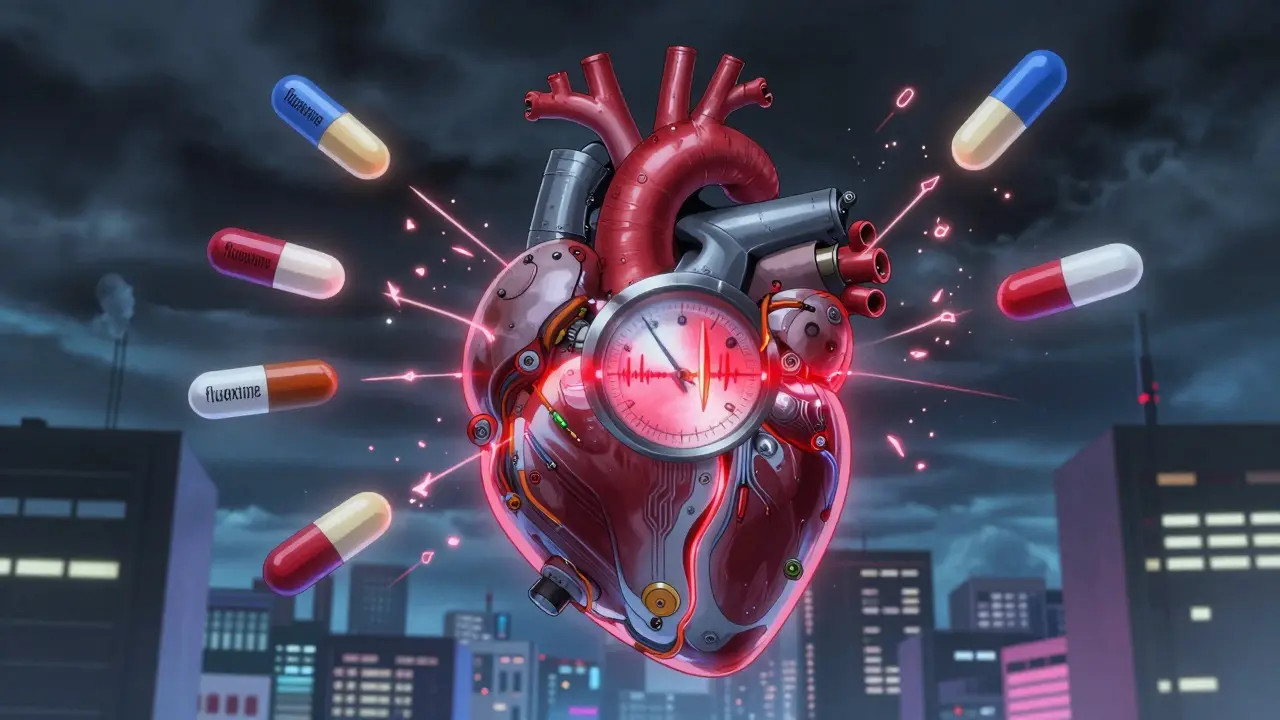
When someone starts methadone for opioid dependence, they’re often told it’s safe, effective, and once-daily. But beneath that simplicity lies a hidden danger-one that can turn a routine dose into a life-threatening event. The real risk isn’t just the opioid effect. It’s what happens when methadone meets other drugs in the body, especially those that mess with liver enzymes. And the consequences? A stretched-out heart rhythm, a silent ticking clock, and a very real chance of sudden cardiac arrest.
How Methadone Slows Down Your Heart’s Reset Button
Methadone isn’t like other opioids. Yes, it binds to mu-opioid receptors to reduce cravings and withdrawal. But it also blocks something called the hERG potassium channel in heart cells. That’s the same channel that helps the heart reset after each beat. When it’s blocked, the heart takes longer to recharge. On an ECG, that shows up as a longer QT interval. A normal QTc (corrected for heart rate) is under 430 ms for men and under 450 ms for women. Once it crosses 470 ms in women or 450 ms in men, the risk of a dangerous rhythm called torsade de pointes starts climbing. At 500 ms or higher? The chance of sudden death jumps fourfold.
And here’s the catch: methadone doesn’t always raise the QT interval in a predictable way. Some people on 40 mg a day spike to 520 ms. Others on 200 mg never go above 440 ms. That’s why you can’t just rely on dose alone. You have to look at what else is in the system.
The Liver’s Role: CYP Enzymes and the Silent Amplifier
Methadone is broken down mostly by two liver enzymes: CYP3A4 and CYP2B6. When these enzymes are working normally, methadone gets cleared at a steady pace. But when something blocks them? Methadone builds up. And with it, the QT prolongation risk.
Drugs that inhibit CYP3A4 are the biggest red flags. Fluoxetine (Prozac), clarithromycin (a common antibiotic), fluconazole (a fungal treatment), and valproate (used for seizures and mood) all do this. A 2007 study in JAMA Internal Medicine found that nearly 30% of methadone patients had QTc intervals over 460 ms-almost three times the rate of people not on methadone. Of those with dangerous prolongation, fluoxetine, clarithromycin, and fluconazole showed up again and again.
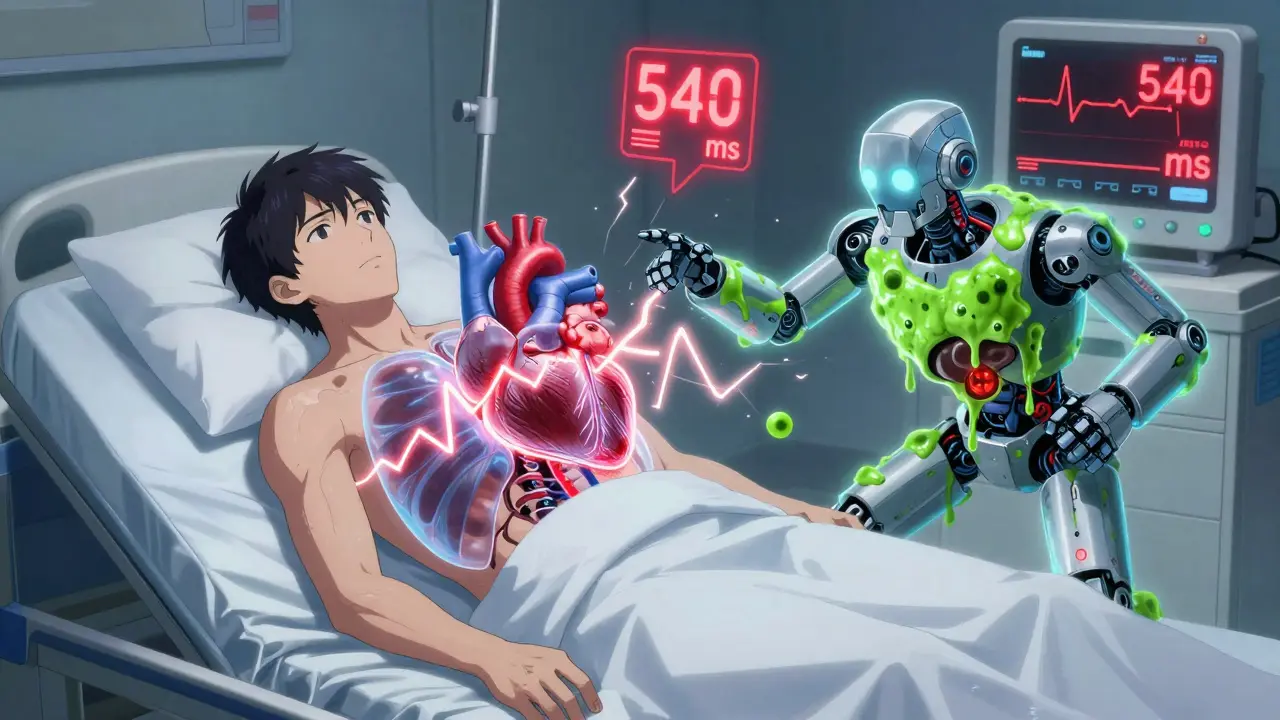
Even more dangerous? Combining multiple inhibitors. One patient on methadone 120 mg/day, fluoxetine 20 mg/day, and fluconazole 100 mg/day had a QTc of 540 ms. All three drugs together pushed methadone levels up by nearly 50%. That’s not a coincidence. It’s a perfect storm.
Why Some Patients Crash and Others Don’t
It’s frustrating for doctors. You see someone with high-dose methadone, a CYP inhibitor, low potassium, and a history of heart disease-and they’re fine. Meanwhile, someone on 60 mg with no obvious risk factors suddenly goes into torsade de pointes. Why?
Genetics play a role. Some people have a CYP2B6 gene variant that slows methadone metabolism by 30-50%. That means even a standard dose can become toxic. Electrolytes matter too. Low potassium or magnesium? That makes the heart even more sensitive to methadone’s effects. Liver disease? Slows clearance even more. And don’t forget: methadone sticks around. Its half-life can stretch from 8 to over 50 hours. So if you add a CYP inhibitor on Monday, the spike in methadone levels doesn’t peak until Wednesday. And the QT prolongation? It can last for days after you stop the interfering drug.
A 2018 review of 32 cases of methadone-induced torsade found that 57% of patients were on at least one other QT-prolonging drug. But 28% of those cases had methadone doses under 100 mg/day. That’s the problem: the old rule of thumb-monitor only if you’re over 100 mg-is outdated.
What Changed in 2023: The New Monitoring Rules
In 2009, San Mateo County Health recommended ECGs for patients on 100 mg/day or more. That made sense then. But newer data changed everything.
By 2023, the American Society of Addiction Medicine (ASAM) updated its national guideline: all patients on methadone doses above 50 mg/day should get a baseline ECG. Why? Because QT prolongation isn’t just a high-dose problem. In patients taking fluoxetine or fluconazole, even 30 mg of methadone can push QTc past 500 ms. The same study found that 12% of patients with QTc >470 ms were on less than 70 mg/day.
Now, clinics are required to check ECGs before starting methadone, again at dose stabilization, and whenever a new interacting drug is added. Some programs are starting to do monthly ECGs for high-risk patients. That’s not overkill-it’s survival.
What to Avoid: The Top 5 Dangerous Combinations
If you’re on methadone, these five drugs should raise a red flag immediately:
- Fluoxetine (Prozac) - A common antidepressant that strongly inhibits CYP2D6 and CYP3A4. Even low doses can spike methadone levels.
- Clarithromycin - A macrolide antibiotic. Used for sinus infections or pneumonia. One course can push methadone levels into toxic range.
- Fluconazole - A fungal treatment, often used for yeast infections. Strong CYP3A4 inhibitor. Often prescribed without checking methadone use.
- Valproate - Used for seizures and bipolar disorder. Doubles the QT prolongation risk when combined with methadone.
- Ritonavir (in Paxlovid) - The booster in the COVID-19 antiviral. Extremely potent CYP3A4 inhibitor. A 5-day course can cause methadone toxicity even in stable patients.
There’s also a long list of other drugs to watch: certain antipsychotics (haloperidol, ziprasidone), antiarrhythmics (sotalol, dofetilide), and even some antifungals and HIV meds. Always check before prescribing anything new.

What to Do: A Practical Checklist
If you’re managing methadone therapy, here’s what works:
- Baseline ECG before starting methadone-no exceptions.
- Repeat ECG after any dose change above 50 mg/day, and every 3 months if on higher doses.
- Check potassium before and after starting interacting drugs. Aim for >4.0 mEq/L.
- Use an EHR drug interaction checker-and don’t ignore the alerts. Many clinics have them built in.
- Ask about all medications-including OTC, herbal, and recreational. Cocaine, even once, can worsen QT prolongation.
- Have a plan if QTc goes above 470 ms: reduce methadone dose, stop the interacting drug, consider switching to buprenorphine.
Buprenorphine doesn’t have this problem. It doesn’t block hERG channels. It doesn’t cause significant QT prolongation. That’s why its use is growing. In 2021, buprenorphine prescriptions in the U.S. hit 2.1 million-up from 1.4 million in 2016. More patients are choosing it not just for convenience, but for safety.
The Bottom Line: Methadone Still Works-But It Demands Respect
Methadone saves lives. It keeps people in treatment, reduces overdose deaths, and helps rebuild stability. But it’s not a gentle drug. It’s a powerful one-with a hidden cardiac trigger. The old belief that "it’s fine if you’re not on a high dose" is dangerously wrong. The new standard is clear: anyone on methadone, regardless of dose, needs cardiac monitoring if they’re taking other meds.
Don’t wait for a cardiac arrest to happen. Check the ECG. Review the med list. Monitor potassium. Talk to the pharmacist. If you’re on methadone and you’ve been prescribed a new antibiotic, antifungal, or antidepressant-ask: "Could this interact?" Most clinicians won’t think to ask. But you should.
Can methadone cause sudden death even if I don’t feel any symptoms?
Yes. Methadone-related cardiac arrest often happens without warning. People may feel fine one day and collapse the next. QT prolongation doesn’t cause chest pain, dizziness, or palpitations in most cases. That’s why regular ECG monitoring is critical-even if you feel perfectly healthy.
Is buprenorphine safer than methadone for heart health?
Yes. Unlike methadone, buprenorphine does not significantly block hERG potassium channels or prolong the QT interval. Multiple studies, including those from San Mateo County Health and the CDC, confirm its cardiac safety profile is far superior. For patients with heart disease, electrolyte imbalances, or those on multiple medications, buprenorphine is often the safer choice.
How long does methadone stay in the system after stopping?
Methadone’s half-life ranges from 8 to 59 hours, meaning it can take 3 to 7 days to fully clear. QT prolongation can persist for days after stopping methadone, especially if you’ve been on a high dose or have liver impairment. This is why ECG monitoring should continue for at least 72 hours after dose reduction or discontinuation.
Do I need an ECG if I’m on less than 50 mg/day of methadone?
If you’re taking any other medication that affects CYP3A4 or CYP2B6-like fluoxetine, fluconazole, or clarithromycin-yes. Even low-dose methadone (20-40 mg/day) can cause dangerous QT prolongation when combined with these drugs. The 50 mg threshold is a guideline, not a cutoff. Risk depends on interactions, not just dose.
Can I take over-the-counter antifungals like fluconazole while on methadone?
No. Fluconazole is a strong CYP3A4 inhibitor and has been directly linked to fatal QT prolongation in methadone patients. Even a single 150 mg dose can raise methadone levels by over 40%. If you have a yeast infection, ask your doctor about non-interacting alternatives like topical clotrimazole.
Every year, hundreds of people on methadone die from preventable cardiac events. Not because the drug failed. Because the system did. Monitoring isn’t bureaucracy-it’s the difference between life and death.
Adam M
March 14, 2026 AT 09:06Methadone isn't the problem. The system is. Doctors prescribe like it's candy and forget the heart's a ticking bomb.
Dylan Patrick
March 14, 2026 AT 17:00Bro, I’ve seen this too many times. Someone gets on methadone, feels fine, then gets an antibiotic for a sinus infection… next thing you know, they’re gone. No warning. No symptoms. Just… gone. We need to stop treating this like it’s just another pill.
Fluconazole? Yeah, it’s just for yeast. But if you’re on meth? That’s a cardiac grenade. I’ve had patients crash at 40 mg with nothing else going on. It’s not about dose. It’s about combo. And nobody checks.
Elsa Rodriguez
March 15, 2026 AT 02:15My cousin died on methadone. She was on 60mg. Had a yeast infection. Took fluconazole. Said she felt ‘weird’ the day before… but didn’t think much of it. They didn’t even do an ECG. No one thought to ask about meds. Now I scream at every pharmacist I see.
It’s not just ‘risk.’ It’s a silent killer. And the worst part? Everyone’s too scared to talk about it. Like if you mention it, it’ll happen to you.
Kathy Leslie
March 16, 2026 AT 12:55Just wanted to say thank you for writing this. I’m on methadone and I’ve been terrified since I started. I never knew about the CYP stuff. I’ve been on fluoxetine for years too. I just called my clinic and they’re scheduling my ECG tomorrow. This post saved me.
Amisha Patel
March 18, 2026 AT 03:10Serena Petrie
March 18, 2026 AT 22:16So… just don’t take methadone then?
Buddy Nataatmadja
March 20, 2026 AT 04:59Interesting. In Indonesia, methadone is barely used. Buprenorphine is the go-to. No one talks about QT here. Maybe because the population has lower baseline risk? Or maybe we just don’t screen. Either way, this is a wake-up call.
mir yasir
March 21, 2026 AT 05:29One must question the methodological rigor of the cited studies. The JAMA Internal Medicine paper referenced lacks sufficient multivariate adjustment for confounding variables, particularly genetic polymorphisms and concomitant electrolyte disturbances. One cannot infer causality from observational cohort data alone.
Stephanie Paluch
March 22, 2026 AT 01:58thank you for this 🙏 i’ve been on methadone for 3 years and just started clarithromycin last week… i’m gonna call my clinic right now 😳
tynece roberts
March 23, 2026 AT 06:54so like… i got on methadone last year after my overdose, and i’ve been feelin good, yknow? but i also take that antifungal cream for my athlete’s foot… is that a thing? like, the cream? or is it just the pills? i don’t wanna die but i also don’t wanna stop feelin normal
also my doc never said nothin about ecg’s… should i be freakin out? lol
Emma Nicolls
March 24, 2026 AT 17:00thank you for sharing this i really needed to hear this today
i’m on 45mg and on sertraline and i had no idea this could be dangerous
i’m gonna get my ecg done tomorrow
douglas martinez
March 25, 2026 AT 00:30This is a masterclass in clinical awareness. The shift from dose-based to interaction-based monitoring is long overdue. Clinicians must treat methadone as a high-risk medication with narrow therapeutic windows-not a benign substitute. Protocols must be standardized, not left to individual discretion.
ECG monitoring is not optional. It is the standard of care. Failure to implement it constitutes negligence.
Rosemary Chude-Sokei
March 26, 2026 AT 19:22As a clinician who has managed methadone patients for over 15 years, I can attest to the terrifying unpredictability of QT prolongation. I’ve lost patients who were ‘low dose’ and ‘low risk.’ The assumption that toxicity only occurs above 100 mg is not only outdated-it is lethal.
Every patient deserves a baseline ECG. Every interaction must be flagged. Every potassium level must be tracked. This isn’t bureaucracy. It’s the bare minimum of ethical practice.
I’ve switched 32 patients to buprenorphine in the last two years. Not because they wanted to. But because they needed to survive.
Devin Ersoy
March 27, 2026 AT 22:28Oh please, here we go again with the fearmongering. Methadone’s been around for 70 years. People don’t just keel over from fluconazole. That’s like saying coffee causes heart attacks because it has caffeine. You’re scaring people with half-baked science.
Let me guess-next you’ll say we should stop prescribing insulin because it can cause hypoglycemia. Real talk? If you’re scared of your meds, don’t take them. But don’t scare the rest of us with doomscrolling.