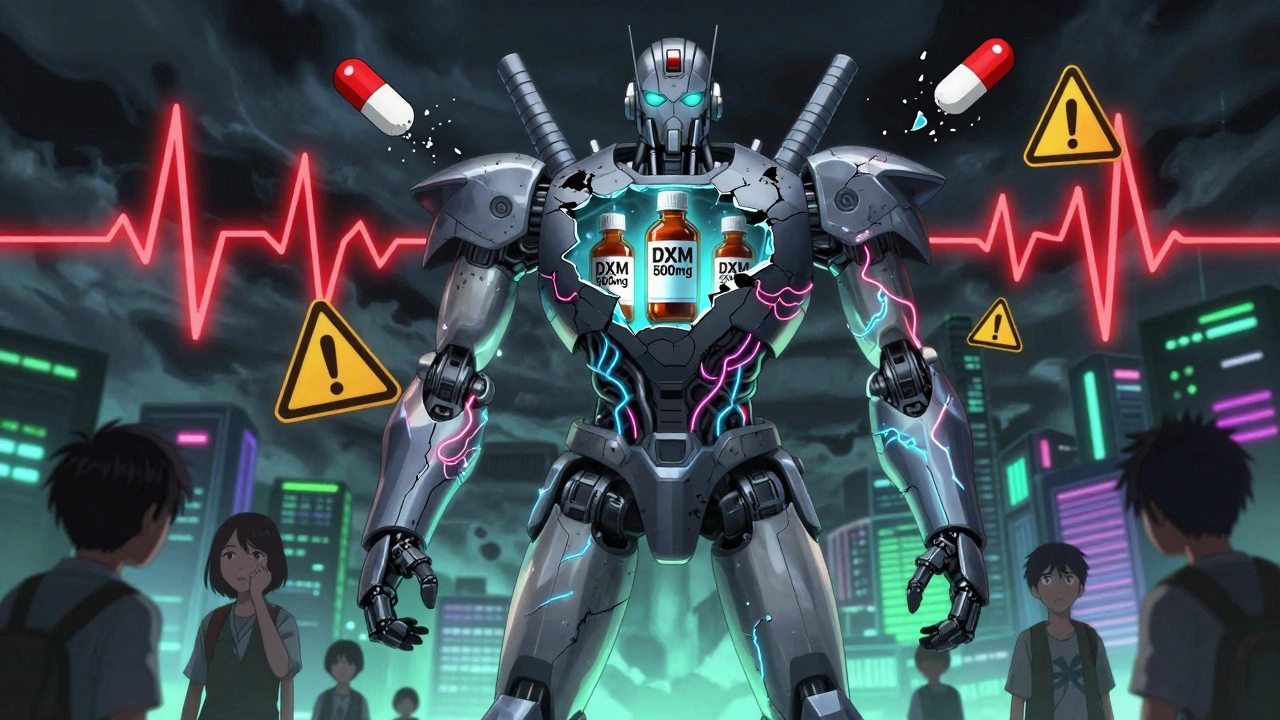
Most people think over-the-counter (OTC) drugs are safe because you don’t need a prescription. But taking more than the label says, mixing them with other meds, or using them to get high isn’t harmless-it’s dangerous. Every year, thousands end up in emergency rooms because of OTC drug misuse, and many don’t even realize they’ve crossed the line. The truth is, these pills and syrups can wreck your body, mess with your mind, and lead to worse addictions if you keep going.
What OTC Drugs Are Most Often Misused?
The big culprits aren’t obscure chemicals-they’re the ones sitting in your medicine cabinet right now. Dextromethorphan (DXM), found in cough syrups like Robitussin and Coricidin, is the most common. At normal doses (15-30 mg), it suppresses coughs. At 100 mg or more, it starts to distort your senses. At 500 mg, you’re not just high-you’re dissociating, losing control of your body, and risking organ damage.
Another hidden danger is loperamide, sold as Imodium for diarrhea. The recommended dose is 2 mg per use, up to 16 mg a day. But some people take 50, 100, even 200 mg to get a opioid-like high. That’s enough to slow your heart to a dangerous rhythm. In 2023, the FDA approved a new treatment for loperamide overdose using low-dose naltrexone, because so many people were nearly dying from it.
And then there’s the combo packs-cold meds with acetaminophen (Tylenol), pseudoephedrine, or antihistamines. Taking extra doses to feel better? You’re not helping yourself. You’re overloading your liver. The FDA says 4,000 mg of acetaminophen a day is the max. One bottle of some cough syrups has 1,000 mg per 30 mL. Take five of those? You’ve hit the limit. Do that daily for a week? Your liver can start shutting down.
Physical Signs You’re Crossing the Line
It’s not always obvious at first. But if you’re misusing OTC drugs, your body sends signals-clear, measurable ones.
- Your pupils stay wide open or shrink to pinpoints, even in normal light.
- You slur your words or stumble when walking, even if you haven’t been drinking.
- You lose weight without trying-12 pounds or more in three months is common among chronic users.
- Your heart races without reason: 120 to 180 beats per minute when it should be under 100.
- Your body temperature climbs to 103°F or higher, even when you’re not sick.
- You get dizzy, nauseous, or vomit after taking what you think is a normal dose.
These aren’t random symptoms. They’re direct results of drug toxicity. In one study, people taking 500 mg of DXM showed a 68% increase in speech errors compared to normal use. That’s not a bad day-it’s brain chemistry being hijacked.
Behavioral Red Flags You Can’t Ignore
Physical signs are scary, but the behavioral changes are often the first warning you’ll notice in yourself or someone else.
- You’re hiding pills-storing them in vitamin bottles, empty spice jars, or snack packs.
- You’re visiting three or more pharmacies a month, always asking for different brands or avoiding the same cashier.
- You’re spending $100-$150 a month on cold medicine you don’t need.
- You’ve stopped hanging out with friends. Social interactions drop from five times a day to one or none.
- You’re secretive about your phone, locking it constantly, deleting texts, or changing passwords.
- You’re skipping school, work, or chores. Grades or performance drop fast-sometimes 1.5 GPA points in one semester.
One case study followed 15 teens in treatment. Every single one hid their meds. Eighty-seven percent visited multiple pharmacies. That’s not coincidence-it’s a pattern of addiction.

Psychological Changes That Don’t Go Away
It’s not just about feeling weird for a few hours. Long-term misuse rewires your brain.
People who regularly take high doses of DXM report:
- Paranoia that lasts for hours after the high fades.
- Emotional numbness that sticks around for a full day.
- Mood swings that happen nearly six times more often than in non-users.
- Visual hallucinations-like static on a TV screen-that linger for weeks after stopping.
And it gets worse. Dr. Nora Volkow from NIDA found that chronic DXM use shrinks the hippocampus-the part of your brain responsible for memory-by 8.3% in just six months. That’s not temporary forgetfulness. That’s brain damage.
One in three chronic users develops persistent psychosis. That means hallucinations, delusions, and paranoia that don’t go away even after they stop taking the drug. They need antipsychotic meds for life.
Why This Leads to Worse Addictions
Most people don’t start with heroin or oxycodone. They start with a bottle of cough syrup.
Research shows that 67% of people who misuse OTC drugs move on to prescription painkillers or illicit drugs within 18 months. Why? Because tolerance builds fast. You need more and more to feel the same effect. Within 4-6 weeks, you’re taking 3 to 5 times the recommended dose just to get high.
And when your body can’t get the same rush from DXM anymore, your brain starts craving stronger highs. That’s when you turn to opioids. SAMHSA data shows 41% of OTC misusers switch to prescription opioids within 14 months. 29% end up using heroin within 22 months.
It’s not a stretch. It’s a progression. And it’s happening to teenagers and adults alike.

What to Do If You Recognize These Signs
If you see these signs in yourself or someone you care about, don’t wait. Don’t assume it’s just a phase. The sooner you act, the better the outcome.
Step 1: Stop immediately. Don’t taper. Don’t cut back. If you’re taking 500 mg of DXM daily, you’re already in danger. Quit cold turkey-but only if you’re ready for support.
Step 2: Talk to someone. Call SAMHSA’s National Helpline at 1-800-662-HELP. It’s free, confidential, and available 24/7. In 2022, they handled over 14,000 calls about OTC drug misuse. You’re not alone.
Step 3: Get medical help. Withdrawal from DXM can cause anxiety, depression, and sleep problems for weeks. About 78% of users need antidepressants during recovery. Loperamide withdrawal can trigger dangerous heart rhythms. You need monitoring.
Step 4: Remove access. Lock up all OTC meds. Throw out expired or extra bottles. Don’t leave them in unlocked cabinets-72% of homes do, and that’s linked to 3.2x higher misuse rates.
Step 5: Get therapy. Cognitive behavioral therapy (CBT) combined with family therapy works best for teens. It cuts relapse rates by more than half compared to therapy alone. Adults benefit too. The goal isn’t just to quit-it’s to rebuild your life without needing drugs to feel okay.
How to Prevent Misuse Before It Starts
If you’re a parent, caregiver, or just someone who keeps meds at home, here’s how to protect yourself and others:
- Keep all OTC drugs locked up-even the ones you think are harmless.
- Check expiration dates and toss old bottles. Expired meds don’t work, but they’re still dangerous if someone takes them.
- Teach kids that “more doesn’t mean better.” A 2023 study showed school programs like ‘Know the Dose’ reduced first-time DXM misuse in 8th graders by 29%.
- Read labels. Know what’s in each product. Many have multiple active ingredients. You might be doubling up without realizing it.
- Don’t use OTC drugs to self-medicate for anxiety, depression, or insomnia. See a doctor. There are safer, proven treatments.
OTC doesn’t mean risk-free. It means you’re responsible. And that responsibility starts with knowing the real cost of a little extra pill.
Can you really get addicted to cough syrup?
Yes. Dextromethorphan (DXM) isn’t just a cough suppressant-it’s a dissociative drug at high doses. People who take 300 mg or more regularly develop tolerance, cravings, and withdrawal symptoms like anxiety, insomnia, and depression. Studies show 63% of users need 3-5 times the normal dose within 4-6 weeks just to feel the same effect. That’s addiction.
Is it safe to take more than the label says if I feel worse?
No. Taking more than directed doesn’t make you feel better-it makes you sicker. Many OTC cold meds contain acetaminophen. Exceeding 4,000 mg a day can cause irreversible liver damage. Some people have died from accidental overdose because they thought, “I’ll just take one more.” There’s no safe margin beyond the label.
How do I know if someone is hiding OTC drug use?
Look for changes: sudden secrecy, multiple pharmacy visits, unexplained spending on cold medicine, hiding pills in vitamin bottles, or using cough syrup as a sleep aid. Behavioral signs like dropping grades, social withdrawal, and mood swings often appear before physical ones. If you see three or more signs together, it’s not coincidence-it’s a red flag.
Can loperamide (Imodium) really kill you?
Yes. Taking more than 16 mg a day-especially 100 mg or more-can cause your heart’s electrical rhythm to slow dangerously. This leads to a condition called QT prolongation, which can trigger fatal arrhythmias. Since 2011, loperamide misuse has increased 278%. In 2023, the FDA approved a new treatment using naltrexone because so many people were dying from it.
Is there help for teens misusing OTC drugs?
Yes. Family-based cognitive behavioral therapy has a 68% success rate at keeping teens drug-free after six months. Schools in 32 states now run ‘Know the Dose’ programs that have cut first-time DXM use by nearly a third. The key is early intervention-before addiction takes hold. Call SAMHSA’s helpline or talk to a school counselor. You don’t have to handle this alone.
Next Steps: What You Can Do Today
If you’re worried about your own use, don’t wait until you’re in crisis. Open your medicine cabinet. Count how many bottles you have. Check the labels. Are you taking more than directed? Are you using them for reasons other than what they’re meant for?
If you’re concerned about someone else, talk to them. Not with anger, but with care. Say: “I’ve noticed you’ve been taking a lot of cough syrup lately. I’m worried. Can we talk?”
And if you’re not sure where to start, call 1-800-662-HELP. It’s free. It’s confidential. And it’s there for people just like you.
Ada Maklagina
December 5, 2025 AT 05:02Stephanie Bodde
December 6, 2025 AT 13:59Philip Kristy Wijaya
December 7, 2025 AT 08:29Jennifer Patrician
December 7, 2025 AT 09:25Ali Bradshaw
December 7, 2025 AT 12:25Lynette Myles
December 8, 2025 AT 03:33Jimmy Jude
December 8, 2025 AT 13:44Rupa DasGupta
December 9, 2025 AT 13:18Marvin Gordon
December 9, 2025 AT 20:03ashlie perry
December 9, 2025 AT 22:35Laura Saye
December 10, 2025 AT 13:28sean whitfield
December 12, 2025 AT 09:44Norene Fulwiler
December 13, 2025 AT 13:07