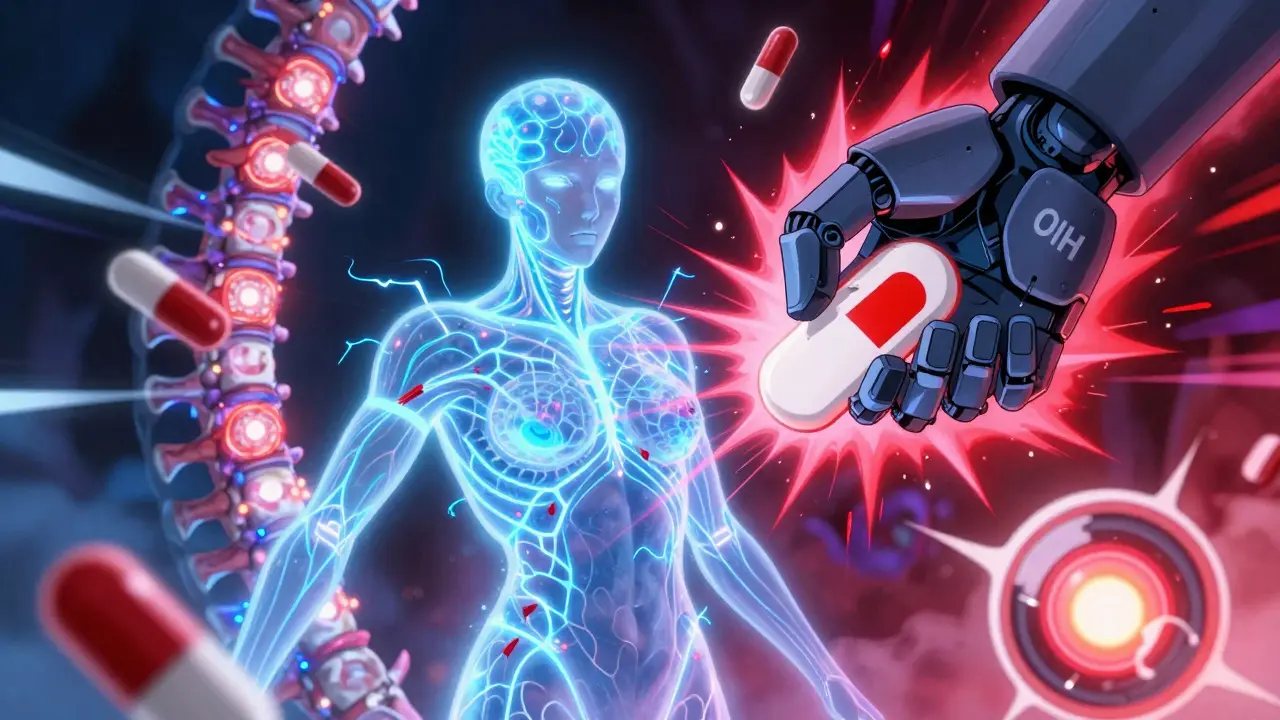
It sounds impossible: you’re taking opioids to relieve pain, but your pain is getting worse. You increase the dose, hoping for relief, and instead, the pain spreads-now it hurts to touch your skin, or even wear clothes. This isn’t disease progression. It’s not tolerance. It’s opioid-induced hyperalgesia-a paradoxical condition where opioids, meant to calm pain, actually make your nervous system more sensitive to it.
What Exactly Is Opioid-Induced Hyperalgesia?
Opioid-induced hyperalgesia (OIH) isn’t a rare lab curiosity. It’s a real, measurable change in how your nervous system processes pain. First observed in rats in 1971, it’s now well-documented in humans. Unlike tolerance-where you need more drug to get the same pain relief-OIH makes you feel more pain when you take more opioids. The more you use, the worse it gets.
Patients with OIH often report pain that spreads beyond the original area. Someone with low back pain might suddenly feel burning in their legs, or their arms become painfully sensitive to light touch. This is called allodynia-pain from something that shouldn’t hurt, like a breeze or a shirt seam. Studies show OIH affects 2% to 15% of people on long-term opioids, and up to 30% of cases once labeled as "tolerance" may actually be OIH.
It doesn’t take huge doses to trigger it. While high-dose IV morphine (>300 mg/day) or hydromorphone are common culprits, even moderate oral doses over weeks can cause it. People with kidney problems are especially at risk because opioid metabolites build up and directly irritate pain pathways in the spinal cord.
Why Does This Happen? The Science Behind the Pain
OIH isn’t just "your body getting used to it." It’s a rewiring of your nervous system. Here’s what’s happening inside:
- NMDA receptor activation: Opioids accidentally turn on NMDA receptors in the spinal cord-receptors normally involved in pain signaling. This creates a feedback loop where pain signals get louder, not quieter.
- Toxic metabolites: Morphine breaks down into morphine-3-glucuronide (M3G), a metabolite that doesn’t relieve pain but actively stimulates pain nerves. Hydromorphone does the same with its own metabolite.
- Spinal dynorphin surge: Opioids trigger the release of dynorphin, a natural brain chemical that, in excess, makes pain signals stronger.
- Descending facilitation: Brainstem pathways that normally block pain start sending more pain signals instead.
- Genetic factors: People with certain variations in the COMT gene (which breaks down stress chemicals like adrenaline) are more likely to develop OIH.
This isn’t just theory. The same NMDA pathway that causes OIH is why ketamine-a drug that blocks NMDA receptors-can reverse it. That’s why some pain clinics now use low-dose ketamine infusions specifically for suspected OIH.
How to Tell If It’s OIH (Not Tolerance or Disease Progression)
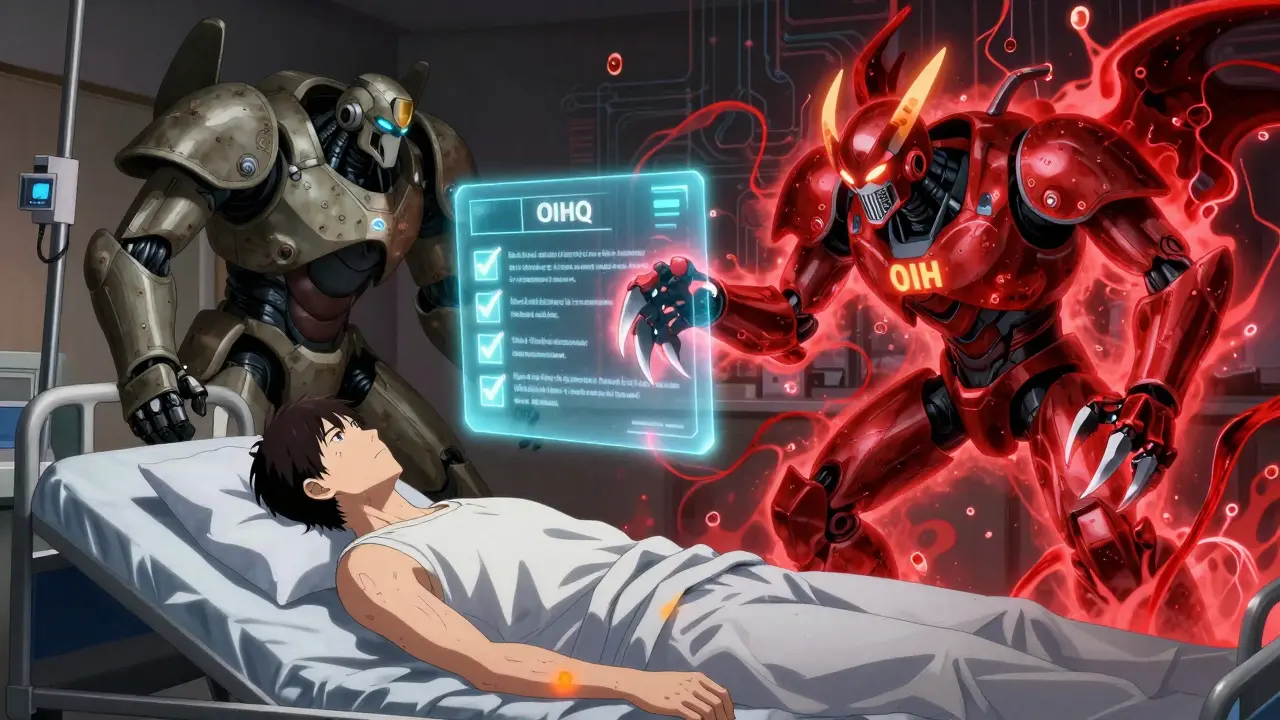
Distinguishing OIH from other causes of worsening pain is critical. Misdiagnosing it as tolerance leads to dangerous dose escalations. Here’s how to spot the difference:
| Feature | Opioid-Induced Hyperalgesia (OIH) | Tolerance | Disease Progression |
|---|---|---|---|
| Pain pattern | Becomes more diffuse, spreads beyond original site | Same location, less relief | Same location, new signs (swelling, imaging changes) |
| Response to higher dose | Pain gets worse | Pain improves temporarily | Pain improves slightly, then worsens again |
| Allodynia present? | Yes-pain from light touch | No | No |
| Timeframe | Appears after 2-8 weeks of continuous use | Develops gradually over months | Follows known disease course |
| Response to dose reduction | Pain improves within days to weeks | Pain worsens temporarily | Pain remains unchanged or worsens |
Doctors often miss OIH because it looks like tolerance. But if pain worsens after a dose increase, and there’s no new injury or tumor growth, OIH should be suspected. A validated tool called the Opioid-Induced Hyperalgesia Questionnaire (OIHQ) has 85% sensitivity and 78% specificity for identifying it. It asks about pain spread, sensitivity to touch, and whether higher doses made pain worse.
How to Treat It: Stop Escalating, Start Reducing
The worst thing you can do is keep increasing the opioid dose. That’s like pouring gasoline on a fire. Treatment requires a shift in strategy:
- Reduce the dose: Start by lowering the current opioid by 10% to 25% every 2-3 days. This isn’t withdrawal-it’s resetting the nervous system. Pain may spike briefly, then improve over 2-4 weeks.
- Switch opioids: Some opioids are less likely to trigger OIH. Methadone is often used because it blocks NMDA receptors. Buprenorphine is another option-it has a ceiling effect and doesn’t overstimulate pain pathways like morphine does.
- Add NMDA blockers: Low-dose ketamine (0.1-0.5 mg/kg/hour via IV) can reverse OIH within hours. Oral memantine, an Alzheimer’s drug that also blocks NMDA, is being studied for daily use.
- Use non-opioid drugs: Gabapentin or pregabalin (300-1800 mg three times daily) calm overactive nerves. Clonidine (0.1-0.3 mg twice daily) reduces spinal pain signaling. Both are well-studied for OIH.
- Non-drug therapies: Cognitive behavioral therapy helps retrain how the brain responds to pain signals. Physical therapy prevents deconditioning and reduces pain sensitivity through movement.
It takes time. Most patients see improvement in 2-4 weeks, with full recovery taking 4-8 weeks. But many patients resist dose reduction-up to 60% fear pain will return. Clear communication is key: "This isn’t your pain getting worse. It’s the drug making your nerves too sensitive. We’re turning down the volume."

What’s Changing in 2026? New Tools and Guidelines
Recognition of OIH is accelerating. In 2024, the Palliative Care Network of Wisconsin updated its Fast Fact #142 with clearer diagnostic criteria. The FDA now requires opioid labels to mention OIH as a possible side effect. Pain fellowships that once ignored OIH now teach it as core curriculum-78% include it today, up from 40% in 2018.
Two major developments are on the horizon:
- Genetic testing: A commercial test for COMT gene variants linked to OIH risk is expected to launch in Q2 2025. This could help identify high-risk patients before they start long-term opioids.
- New drugs in trials: Three new NMDA modulators are in Phase II/III trials specifically for OIH. One combines low-dose ketamine with a slow-release formulation for daily oral use.
Even as opioid prescriptions drop nationwide (down 44% since 2016), over 10 million Americans still rely on them. That means OIH will remain a critical issue in pain clinics for years to come.
What If You’re Already on Opioids?
If you’re on long-term opioids and your pain is worsening, ask yourself:
- Has the pain spread to new areas?
- Does light touch now hurt?
- Did increasing your dose make things worse, not better?
If yes, don’t assume you need more. Talk to your provider about OIH. Bring up the OIHQ. Ask if switching to methadone or adding gabapentin is an option. Don’t accept dose escalation as the only answer.
Many patients who switch strategies don’t just feel less pain-they regain function. They sleep better. They walk without flinching. They stop fearing their own skin.
OIH isn’t a failure of pain management. It’s a signal that the system is out of balance. The fix isn’t more drugs. It’s smarter ones-and sometimes, less of them.
Can opioid-induced hyperalgesia happen with low-dose opioids?
Yes. While high doses (especially IV) are more common triggers, OIH can develop with oral doses as low as 50 mg of morphine daily if taken for more than 4-6 weeks. It’s not about the amount-it’s about how long the nervous system is exposed and whether you have genetic or metabolic risk factors.
Is OIH the same as opioid withdrawal?
No. Withdrawal happens when you stop opioids and your body reacts with anxiety, sweating, nausea, and muscle aches. OIH happens while you’re still taking opioids, and it’s characterized by increased pain sensitivity-not systemic symptoms. Withdrawal improves with more opioids. OIH gets worse with them.
Can ketamine really reverse OIH?
Yes. Multiple clinical studies show that low-dose IV ketamine (0.1-0.5 mg/kg/hour) can significantly reduce pain in OIH patients within hours. It works by blocking NMDA receptors, the same pathway opioids overstimulate. Some clinics now use daily oral memantine (an NMDA blocker) for maintenance after ketamine infusion.
Why don’t all doctors know about OIH?
OIH was long dismissed as a lab curiosity. It wasn’t until the 2010s that clinical studies confirmed it in real patients. Many providers still confuse it with tolerance. But awareness is growing: 65% of pain specialists now recognize OIH as a real condition, up from 30% in 2010. Training and updated guidelines are closing the gap.
What if reducing my opioid dose makes my pain worse at first?
It’s common. When you reduce opioids, your nervous system may temporarily overreact-this is called rebound sensitivity. It’s not the original pain returning. It’s your nerves adjusting. With proper support-like gabapentin, clonidine, or physical therapy-this phase usually lasts 3-7 days before pain begins to improve. Don’t stop the taper unless you’re in severe distress. Work with your provider to manage the transition.
Are there any long-term risks if OIH isn’t treated?
Yes. Untreated OIH can lead to chronic central sensitization, where your nervous system stays stuck in "high pain" mode even after stopping opioids. This increases risk of developing widespread chronic pain syndromes like fibromyalgia. Early recognition and correction of OIH can prevent this permanent shift in pain processing.
Recognizing opioid-induced hyperalgesia changes everything. It turns a dead-end cycle of dose escalation into a clear path forward. The goal isn’t to eliminate opioids overnight. It’s to stop making pain worse-and start healing the system that got damaged along the way.
Brad Ralph
February 14, 2026 AT 03:17Reggie McIntyre
February 15, 2026 AT 21:23Jack Havard
February 17, 2026 AT 10:21Kristin Jarecki
February 18, 2026 AT 23:40Jonathan Noe
February 19, 2026 AT 06:58Rachidi Toupé GAGNON
February 19, 2026 AT 12:07Jim Johnson
February 19, 2026 AT 17:28Vamsi Krishna
February 19, 2026 AT 18:37Jonathan Noe
February 21, 2026 AT 08:17