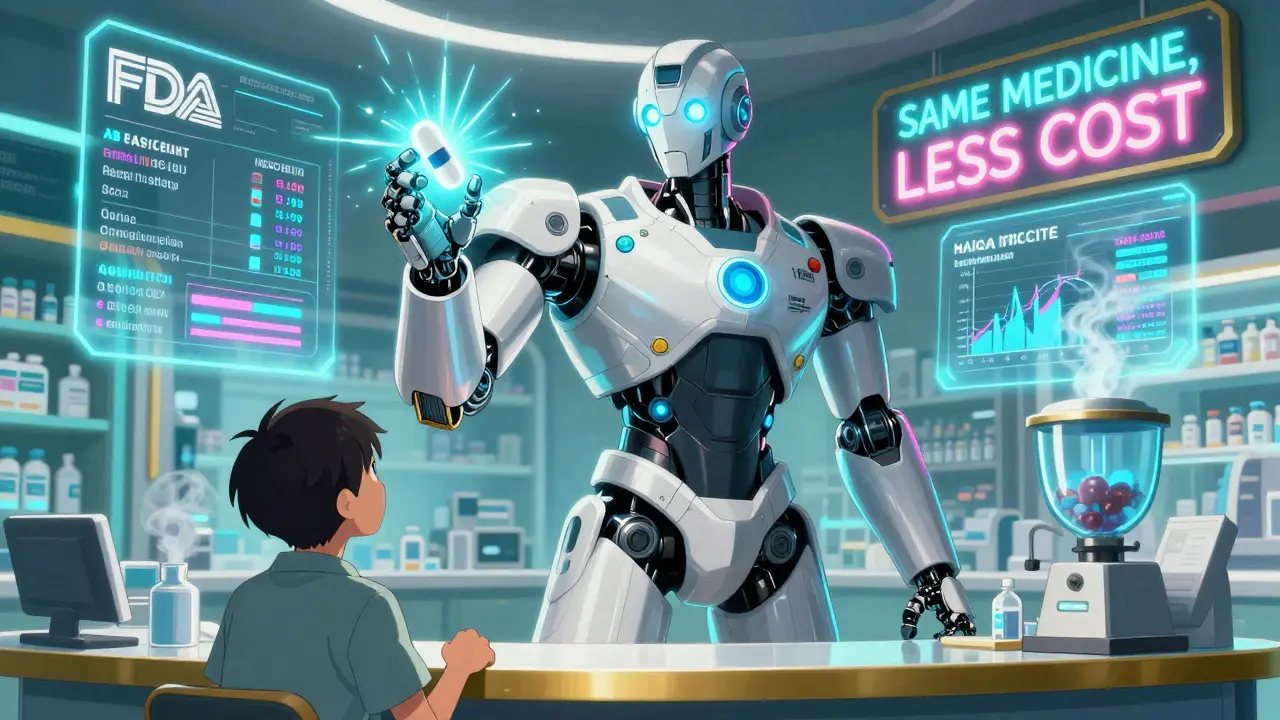
When you pick up a prescription at the pharmacy and see a pill that looks completely different from what you’ve been taking, it’s normal to pause. Generic medications are not a downgrade-they’re the same medicine, just cheaper. But without clear guidance, that change in size, color, or shape can make you doubt whether it will work. That’s where pharmacy counseling comes in. It’s not just a formality. It’s your chance to get real answers before you leave the counter.
Why Your Generic Looks Different
Generic drugs have the same active ingredient, strength, and effect as the brand-name version. The FDA requires it. But the fillers, dyes, and coatings? Those can be different. That’s why your new pill might be blue instead of white, or oval instead of round. It doesn’t mean it’s weaker. It just means the manufacturer used different inactive ingredients to make it. For most people, this makes zero difference. But if you’re allergic to lactose, gluten, or certain dyes, those differences matter. Always ask: "What’s in this pill besides the medicine?"Therapeutic Equivalence: What It Really Means
The FDA uses a system called "therapeutic equivalence" to rate generics. If a drug has an "AB" rating in the Orange Book the official FDA listing of approved drug products with therapeutic equivalence evaluations, it means the generic has been proven to work exactly like the brand. There’s no wiggle room. The active ingredient must be identical. The dose must match. The way it enters your bloodstream must be within 80-125% of the brand’s performance. That’s not a guess-it’s lab-tested, verified, and tracked. Over 90% of all prescriptions filled in the U.S. are generics. And studies show they work just as well. A 2018 analysis of 12.7 million patients found that switching to generics actually improved adherence by 8.2%. People took their meds more consistently because they cost less.What Your Pharmacist Must Tell You
By law, pharmacists have to answer specific questions when you get a generic. They don’t always do it well, but they’re required to cover:- That this is a generic version of your brand-name drug
- That it has the same active ingredient and works the same way
- How to take it-dosage, timing, food interactions
- Possible side effects, including those from inactive ingredients
- Why it costs less
- What to do if you feel different after switching
When You Should Be Extra Cautious
Not all drugs are created equal when it comes to substitution. Medications with a narrow therapeutic index a small margin between effective and toxic doses need special care. These include drugs like warfarin (blood thinner), levothyroxine (thyroid), and phenytoin (seizure control). Even tiny changes in how your body absorbs them can cause serious problems. In 24 states, pharmacists can’t automatically swap these without the doctor’s approval. If you take one of these, always ask: "Is this substitution approved by my doctor?" And if you’ve had a bad reaction to a generic before, tell your pharmacist. Keep a list of what worked and what didn’t.
What to Do If You Feel Different
Some people swear their generic doesn’t work the same. Sometimes it’s psychological. Other times, it’s real. Inactive ingredients can cause reactions-like a rash from a dye or stomach upset from a filler. If you notice new side effects after switching, write them down. Note the date, what you took, and how you felt. Bring it back to your pharmacist or doctor. Don’t just stop the medication. That’s dangerous. Ask: "Could this be the new filler?" Or: "Is there another generic version available?" Different manufacturers use different ingredients. One might suit you better.Cost Savings Are Real-But Only If You Take It
A generic version of a blood pressure pill might cost $4 instead of $120. That’s not a typo. That’s $1,152 saved per year. But if you skip doses because you’re worried it won’t work, you’re losing more than money-you’re risking your health. Studies show people who understand generics are 37% more likely to stick with them. That’s why video counseling and printed handouts are now being used in 23 states. One patient, SarahJ, told her story: "My pharmacist showed me the FDA entry for my drug. I saw the exact same active ingredient. I switched and saved $300 a month. No difference in how I felt." That’s the goal.Know Your Rights
In 17 states-including California, Texas, and Florida-you have the right to say no to a generic substitution. The pharmacist must ask your permission first. In other states, they can swap automatically. But even in those states, you can still ask for the brand. You just might pay more. Always ask: "Can I get the brand if I want to?" And if you’re not comfortable with the switch, say so. Your pharmacist’s job is to help you make an informed choice, not push a cheaper option.
How to Spot a Good Counseling Session
A good counseling session takes 2-5 minutes. If your pharmacist just hands you the bottle and says, "Here you go," that’s not enough. Look for these signs:- They mention the generic name and brand name side by side
- They explain why the pill looks different
- They ask you to repeat the instructions
- They mention possible side effects from inactive ingredients
- They offer to check your history for allergies
What to Bring to Your Next Visit
Before you go to the pharmacy, prepare:- A list of all your medications, including doses
- A list of any allergies, especially to dyes, lactose, or gluten
- Questions like: "Is this the same as my old pill?" and "What’s different?"
- Your past experiences with generics-good or bad
Steve Hesketh
January 21, 2026 AT 11:56Man, I used to freak out every time my pills changed color. Thought I was getting fake stuff. Then my pharmacist sat me down with a printout from the FDA website-showed me the exact same active ingredient. Saved me $200 a month and I didn’t feel any different. Why do people make this so complicated? It’s science, not magic.
Also, if you’re allergic to dye or lactose, ask. Seriously. I didn’t know my rash was from the red dye until I asked. Pharmacist looked at me like I was a genius. Turns out, I’m just not dumb.
Generics aren’t cheap because they’re bad. They’re cheap because Big Pharma stopped charging you for the logo.
shubham rathee
January 22, 2026 AT 07:01you know what they dont tell you right the generics are made in china and india and the quality control is a joke i mean i read this one study where they found traces of heavy metals in some pills and the fda just looks away because its cheaper i think this whole system is rigged for profit not health
MAHENDRA MEGHWAL
January 23, 2026 AT 01:19While I appreciate the comprehensive overview presented, I must emphasize the importance of regulatory harmonization across international supply chains. The FDA's oversight, while robust, does not extend to manufacturing facilities located abroad, thereby introducing a latent variable in therapeutic consistency. A patient's physiological response may vary not due to psychological factors, but due to unreported deviations in excipient purity.
Sangeeta Isaac
January 24, 2026 AT 00:23so like… i got my generic blood pressure pill and it was this tiny blue thing and i swear i felt like a robot after taking it. like, i started humming and couldn’t stop. my cat stared at me like i was the weird one. turns out it was the dye. i asked for a different brand and now it’s white and i’m back to being a normal human. also, my pharmacist didn’t say a word. zero. zip. nada. like she was on autopilot. why do we still have to be the ones to ask?
Alex Carletti Gouvea
January 25, 2026 AT 19:44Why are we letting foreign manufacturers make our medicine? This isn’t just about cost-it’s about national security. If every American was on a generic, and the supply chain got cut off, we’d be sitting ducks. We need to bring this production home. FDA ratings don’t mean squat if the pill was made in a basement in Mumbai.
Uju Megafu
January 27, 2026 AT 16:26OMG I KNEW IT. I switched to a generic thyroid med and my hair started falling out. I told my doctor and she said ‘it’s probably stress.’ STRESS? I WAS TAKING A PILLS MADE BY SOMEONE WHO DOESN’T EVEN SPEAK ENGLISH. I went to another pharmacy and got the brand. Hair stopped falling. I’m not crazy. I’m just the only one brave enough to say it out loud. Also, I posted about it on Facebook and now 12 people are DMing me saying the same thing. This is a cover-up. Someone’s getting rich off our suffering.
lokesh prasanth
January 29, 2026 AT 05:46active ingredient same but body feels different so its not the same
MARILYN ONEILL
January 30, 2026 AT 00:27I don’t understand why people are surprised. It’s a pill. It’s not supposed to be a luxury item. If you can’t tell the difference between a $4 pill and a $120 pill, maybe you shouldn’t be taking medicine at all. I’ve been on generics for 15 years. I’m alive. My bank account is alive. My therapist? Also alive. You’re welcome.
Coral Bosley
January 31, 2026 AT 11:44I just want to say I cried the first time I saw the price difference. Not because I was sad. Because I realized I’d been paying $120 for a placebo with a fancy label for five years. My anxiety didn’t improve. My wallet did. I didn’t need the brand. I needed to be told the truth. And no one ever did. Not my doctor. Not the ads. Not even the pharmacist. I had to Google it myself. That’s not healthcare. That’s exploitation dressed up as care.
Kevin Narvaes
February 2, 2026 AT 06:05you ever think maybe the reason you feel different is because you believe the generic is inferior? the mind is a powerful thing. the pill doesn’t care if you think it’s fake. your body doesn’t either. it just does what it’s told. but your brain? it’s screaming ‘this isn’t the real one’ and that’s what’s making you feel weird. it’s not the dye. it’s the doubt.
Dee Monroe
February 3, 2026 AT 11:05There’s something profoundly human about the fear of the unfamiliar-even when it’s scientifically identical. We don’t fear the medicine. We fear the erasure of control. The brand name was a ritual. The color, the shape, the logo-it was a promise. When that changes, we don’t just lose familiarity. We lose the illusion of safety. And in a world where so little is certain, even a pill becomes a symbol. That’s why counseling matters. Not because the science is complex. But because the psychology is. We don’t just need to know what’s in the pill. We need to know we’re still ourselves after taking it.
And if your pharmacist doesn’t take five minutes to help you feel that? That’s not negligence. That’s a failure of care. Not just medical. Human.